Jeffries' socialism dilemma: New York victories expose Democratic Party divide
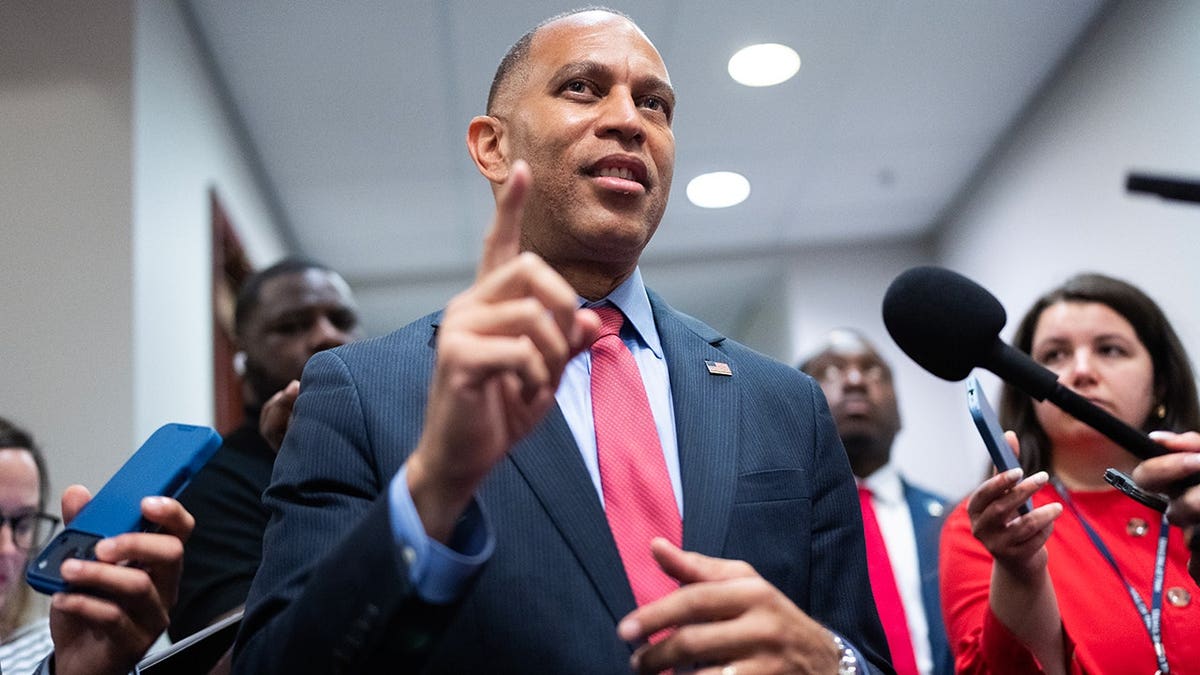
Surging socialism deepens Democrat divisions as Hakeem Jeffries pushes back
Fox News contributor Byron York discusses socialism rise on deepening Democrat divisions as House Minority Leader Hakeem Jeffries struggles to counter far-left candidates. York analyzes the impact of extreme candidates, like those backed by New York’s mayor Zohran Mamdani, winning primaries. York also weighs in on concerns about antisemitism within the Democratic Party’s far-left ranks.
NEWYou can now listen to Fox News articles!
The man looks tired.
Veteran observers of Democratic House Leader Hakeem Jeffries know at a glance when the fellow isn’t catching his Zs.
Some politicians bark gruffly when they are under pressure. Others become wildly frenetic. Some pick fights. Others go quiet, and retreat. Jeffries gets puffy.
It has been one of those tells that longtime Empire State and Washington, D.C. hands have noticed for years. When the Brooklyn Democrat appears on morning television looking a little baggy, a tad swollen around the eyes; when he speaks in his trademark measured cadence but stumbles over the elucidation; when he presents the unmistakable glaze of someone who has squeezed three hours of sleep into what should have been a seven-hour night, it usually means he spent the evening on the phone.
HAKEEM JEFFRIES CONFRONTED ON ‘YOU’RE NEXT’ CHANTS FOLLOWING NY DEMOCRATIC SOCIALIST VICTORIES
House Democratic Leader Hakeem Jeffries faces growing pressure as democratic socialist-backed candidates gain influence in New York, raising new questions about the party’s ideological direction. (Tom Williams/CQ-Roll Call, Inc via Getty Images)
Counting votes.
Putting out fires.
Trying to solve a problem.
Since Tuesday, the problem has been coming from inside his own party.
Not Donald Trump.
Not Republicans.
Not the economy.
Not the spending bill.
The Democratic Party.
More specifically, the Democratic Socialists of America inside the Democratic Party.
For much of the last week, Jeffries has found himself staring transfixed at perhaps the most difficult political challenge of his career — immobilized not because he does not know what he thinks, but because he knows exactly what he thinks.
He believes Democrats need to look mainstream to win swing districts. He believes affordability is a stronger message than ideology. He believes most Americans don’t want a political revolution. And he surely believes that Republicans — from President Donald Trump on down — cannot wait to compel every rival candidate to answer for the most controversial voices inside the Democratic Party.
That has always been the danger of ideological movements. They rarely stay quaintly confined to the neighborhoods where they first emerge. They spread. They redefine brands. They force everyone wearing the same jersey to bear responsibility for the teammates they did not recruit.
This week, such a menace landed squarely on Jeffries’ desk.
The source of the headache was New York City, where Mayor Zohran Mamdani’s stunning Democratic victory last November now has staged a second, hugely consequential act, as three candidates backed by Mamdani — Brad Landler, Claire Valdez and Darializa Avila Chevalier — won congressional primaries. Valdez and Chevalier are both members of the Democratic Socialists of America.
The victories are significant for reasons that resonate far beyond New York.
For years, the Democratic establishment has comforted itself with the belief that support for democratic socialism was limited to a handful of safe districts represented by colorful personalities who generated cable-news segments but exercised limited influence over the broader direction of the party.
Tuesday suggested something different. Democratic socialists did not merely sustain their corner of the party with fringe support, they expanded it — and expanded it in Jeffries’ own backyard.
It is difficult to overstate the implications of such a predicament for the Democratic leader.
Jeffries is not Bernie Sanders, nor is he Alexandria Ocasio-Cortez. Rather, Jeffries has spent years carefully cultivating an image as a disciplined institutionalist — a modern Democratic leader capable of appealing to progressives without frightening suburban moderates. His personal politics always have been considerably closer to the political center than to those of the raucous activists in his coalition. He is, by temperament and instinct, a coalition builder.
Coalition builders do not enjoy civil wars. It is a major hurdle for Jeffries to explain and finesse the ballooning faction without detonating a timebomb inside his party.
Almost immediately after Tuesday’s results, reporters and anchors began asking Jeffries his opinion of the new nominees — not whether he supported them, but whether he supported what they unequivocally endorsed. It was an impossible line of questioning precisely because everyone already knew the answer. Jeffries does not believe America should abolish Immigration and Customs Enforcement, prisons or the police force. He has never argued for dismantling capitalism, nor has he embraced many of the wider ideological positions associated with the Democratic Socialists of America.
So, he did what experienced political leaders often do when trapped between principle and practicality. He tried to change the subject.
In interview after interview, Jeffries gently, nebulously, acknowledged that he did not share every position or previous statement made by the nominees. He steered the conversation toward affordability, alternate Democratic victories and the overarching national map. It was classic Hakeem Jeffries: polite, measured, disciplined and careful.
But politics rarely allows careful people to remain above the fray forever, and, before long, one of the nominees, Chevalier, became a national story.
Opposition researchers — and increasingly, reporters — began to dredge up years of Chevalier’s social-media posts and public statements, staunchly expressed and clearly defined. She did indeed call for abolishing police and prisons, and argued for eliminating borders and ICE. She harshly, profanely, criticized Kamala Harris and Joe Biden, and decried America as “a f—— disgrace.” Her many posts involving race, white women, and interracial relationships spread rapidly, first across conservative media and then on MSNOW and CNN.
For many, it does not matter that she has deleted and repudiated some of the posts.
One Democratic Party stalwart told me ruefully, “Chevalier is our David Duke. She is poisoning the possibility of a Democratic majority.”
AOC ISSUES WARNING TO HER FELLOW DEMOCRATIC INCUMBENTS IN THE WAKE OF SOCIALISTS WINNING BIG IN NYC
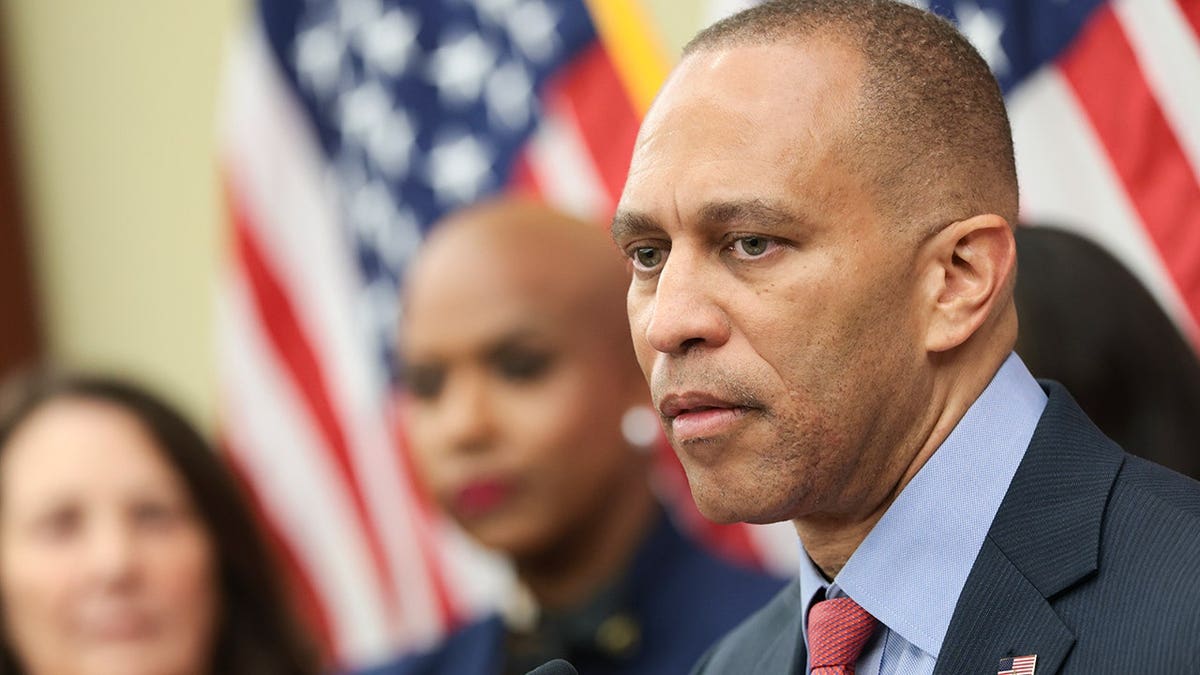
Hakeem Jeffries is balancing party unity with mounting concerns that Democratic Socialists of America-backed candidates could complicate Democrats’ efforts to win swing districts. (Anna Moneymaker/Getty Images)
But another Democrat familiar with the House caucus, who has been aligned with the progressive wing, offered me an opposing view. “The reality is that the energy of the party in primaries is anti-genocide, anti-billionaire and for Medicare-for-all. Many centrists and House Democratic members are having a hard time coming to terms with this. But that’s where voters primary are. They are unfortunately jamming Jeffries unnecessarily instead of letting him embrace the progressive wing.”
Whether Chevalier’s comments are viewed as youthful activism, sincere ideological conviction or political malpractice, they guarantee one thing: the questions will not stop.
Republicans understood immediately that they had been handed a gift, and Democrats knew every candidate in a competitive district could now expect variations of the same questions: Do you agree with this? Is this your party? Does Chevalier represent today’s Democrats?
Jeffries undoubtedly knew exactly where this was heading. Yet on Saturday afternoon, he nevertheless offered an official welcome to Chevalier, Landler and Valdez with a celebratory post on X.
“Congratulations to our newest members of the NYC congressional delegation,” he wrote. “From public servants to union organizers to community activists, the path is different but the work is the same. We must decisively address the affordability crisis and crush far-right extremism!”
With this statement, Jeffries conceded that his paramount job is to elect a majority, despite the risks to his own reputation, digital and otherwise.
“Jeffries is doing what he needs to do to keep his Democratic caucus as whole as he can,” a veteran Democratic political operative in New York told me. “That means making sure the tent is seen as broadly as it needs to be while moving it into a (hopefully) governing coalition come January. There is no win by holding out and claiming these folks are socialists and therefore not our people. They are going to vote for Jeffries [for Speaker] and we will need their votes for that and much more going forward. And the folks who didn’t get that in last year’s election for Mayor also paid a real price for not recognizing it.”
Even so, moderate Democrats have been urging Jeffries, publicly and privately, to draw sharper distinctions between the party’s mainstream constituency and its socialist wing. Those calls escalated dramatically after Tuesday.
When I asked a spokeswoman for Jeffries about the content and timing of the X post, and how he might respond to those calling for his repudiation of Chevalier and other controversial candidates, she only would say that Jeffries has put out similar congratulatory messages in virtually every race this cycle, on behalf of nominees from every state, background, and ideology.
But that hardly is sufficient for many of the most prominent voices in the party.
Rep. Josh Gottheimer, a leading moderate/centrist Democrat from New Jersey, told Jewish Insider that the socialists’ anti-Israel point of view is a “growing cancer, and we can’t let it spread, and we cannot ignore it.” He warned that the incoming DSA-aligned lawmakers will be coming to Washington to “wreak havoc in Congress” and will try to “hold the party hostage” to their socialist views. “It will lead to more gridlock and dysfunction, and hard-working families will pay the price for this,” he said. “The socialists have put their own personal hatred above our national security and our promises to our allies. And I think we’ve got to call out hate when we see it.”
“This is a bridge too far,” agrees veteran Democratic strategist James Carville, who cautions that embracing candidates whose politics fall well outside the party’s historical mainstream risks alienating precisely the voters Democrats need to regain strong, enduring governing majorities. He dismisses the political views of Chevalier as entirely anathema to the Democratic Party, insisting that “they should not seat her in the caucus. Her views are totally against anything that any Democrat has. We believe in pluralism, she doesn’t believe in interracial dating…Lady, I ain’t in the same party as you…She has attacked interracial relationships and the American flag.” Carville considers this a line in the sand. “I actually do think it’s time for Democrats to talk the S word,” he says. “Schism. I really do. Everybody’s always said, ‘No, no, we’re a coalition. We’re a big tent.’ And there’s some – there’s just some s— that I can’t be in the same tent with.”
Trump himself sees a similarly dire scenario. “The Democrat Party is in big trouble,” he said Friday at the Faith & Freedom Coalition’s policy conference. “Because this isn’t stopping with New York. This is the most serious threat to our country in its existence, in my opinion.”
Jeffries, meanwhile, understands that fear now runs in both directions inside the Democratic Party. Moderate Democrats worry about losing swing voters. Party leaders worry about losing their own base. The activists who dominate many Democratic primaries are intensely engaged, highly organized and deeply angry. They have shown they are willing to target incumbents they regard as insufficiently progressive. Jeffries must have felt a nervous little chill last week at the New York election night victory party. When his image appeared, the DSA celebrants put him on notice with the ominous chant, “You’re next!”
To be sure, this is not the first time Democratic leaders have confronted an insurgency from the party left.
During Donald Trump’s first presidency, Nancy Pelosi was faced with a similar complication with the rise of “the Squad.” New congressional members Alexandria Ocasio-Cortez, Ilhan Omar, Rashida Tlaib and Ayanna Pressley, independently and as a team, became media stars almost overnight, with their youth, charisma, modern brio, irreverence, and controversial views. Republicans tried relentlessly to define the entire Democratic Party through their most radical statements.
Pelosi’s response was remarkably effective. She did not attempt to defeat them ideologically, but instead, managed them institutionally. She reminded everyone who counted votes, controlled committee assignments, raised money, determined legislative priorities, and possessed the experience and power to turn slogans into laws. When necessary, Pelosi criticized “the Squad,” but more often, she simply outmaneuvered them.
Nancy Pelosi understood something that many ideological movements forget. In Congress, power is measured not by followers on social media but by the ability to assemble 218 votes.
Jeffries inherited Pelosi’s position, but he has not inherited Pelosi’s authority. He has never held the Speaker’s gavel, nor spent years disciplining a majority. He has not had to decide which members receive prized committee chairs while balancing dozens of competing factions. Most importantly, he has never governed with a razor-thin Democratic majority.
If Democrats capture the House this November by only a handful of seats, the arithmetic becomes brutal.
Every member and every vote will matter, as will every defection. A bloc of uncompromising ideological members can exercise influence wildly disproportionate to its size. Republicans know this because they lived through it, Kevin McCarthy learned this tough lesson, and Mike Johnson is enduring it now. Jeffries may soon discover it himself.
Which explains why this week’s story matters beyond a handful of New York primaries. The broader struggle inside the Democratic Party has been building for years.
Bernie Sanders demonstrated—twice–that democratic socialism has enormous appeal inside Democratic presidential politics. Alexandria Ocasio-Cortez transformed progressive activism into celebrity politics and brand name recognition. Mamdani, magnetic and unapologetic, has shown that the movement can capture America’s largest city.
What makes this movement especially potent is that it has found an organizing principle steeped in emotion that extends well beyond traditional left-right politics. For many younger activists, the Israeli-Palestinian conflict, especially conditions in Gaza, has become not merely a foreign policy issue but a moral litmus test. The language of “genocide,” “apartheid” and “settler colonialism” has moved from campus protests into Democratic primaries, online pressure campaigns, and frequent heckling at live events, creating an intensity that traditional establishment politicians often struggle to comprehend. Whether those characterizations are accepted or fiercely disputed, whether they veer into glib virtue signaling, the political reality is undeniable: arguments over Gaza have become a powerful engine of grassroots activism and candidate recruitment in ways that few Democratic leaders anticipated.
Each DSA victory expands the movement’s confidence and makes compromise less attractive, while increasing pressure on Democratic leaders who must somehow persuade suburban voters that none of this defines the party while simultaneously assuring activists that it absolutely does.
That balancing act has grown more difficult every election cycle, and is teetering on the unsustainable.
And this is not simply Hakeem Jeffries’ problem. Chuck Schumer faces his own version of the same challenge. As the Democratic leader in the Senate, he must deal with his socialist-aligned (and acutely flawed) nominee in Maine, Graham Platner, and with the frontrunner in the August Senate primary in Michigan, Abdul El-Sayed, another Sanders disciple with controversial views.
In many respects, Jeffries and Schumer are tackling what Joe Biden and Kamala Harris sidestepped during their administration. As progressive cultural politics and increasingly strident anti-Israel sentiment spread through elite institutions, universities, activist organizations and social media, the Biden White House generally sought accommodation rather than confrontation. The result was that ideas once largely confined to activist circles migrated steadily, unchecked, into Democratic primaries—not only in New York, but in blue cities, college towns and even pockets of some of America’s reddest states. Leaders who decline to police the boundaries of a coalition eventually discover that someone else has redrawn them.
Perhaps Jeffries hopes the controversy fades.
Washington is certainly capable of changing the subject. Trump is still able to absorb all the oxygen in any room, in any crisis. Inevitably there will be other international emergencies, budget showdowns, political and cultural shiny objects. Jeffries has a few potential lifelines, such as the natural evolution of his peers. AOC, for example, has in recent years become less of a bomb-thrower and more of a legislator. She still sits firmly on the left flank of the party, but she has learned the value of coalition-building, party discipline and picking her spots. Jeffries can reasonably hope that today’s firebrands eventually follow a similar trajectory. The gamble, of course, is that this new generation may conclude that AOC moderated and matured too much. There are already indications of that sentiment.
So, while politics has an extraordinary capacity to move on, this DSA controversy probably won’t. The views of some of these new candidates are simply too extreme, too genuinely insulting to a majority of Americans, too unsavory for citizens who want calm, not drama; common sense, not gauzy, faddish ideology.
There will be more archived posts. More old videos. More awkward interviews. More Republican ads. More questions shouted down Capitol hallways. More uncomfortable television appearances. More brash and polarizing statements. And, if Democrats win the House, more difficult internal negotiations between party leadership and members who see compromise not as governing but as surrender.
JEFFRIES WELCOMES DEMOCRATIC SOCIALISTS INTO THE FOLD AS CRITICS WARN PARTY IS REVEALING ‘EXACTLY WHO IT IS’
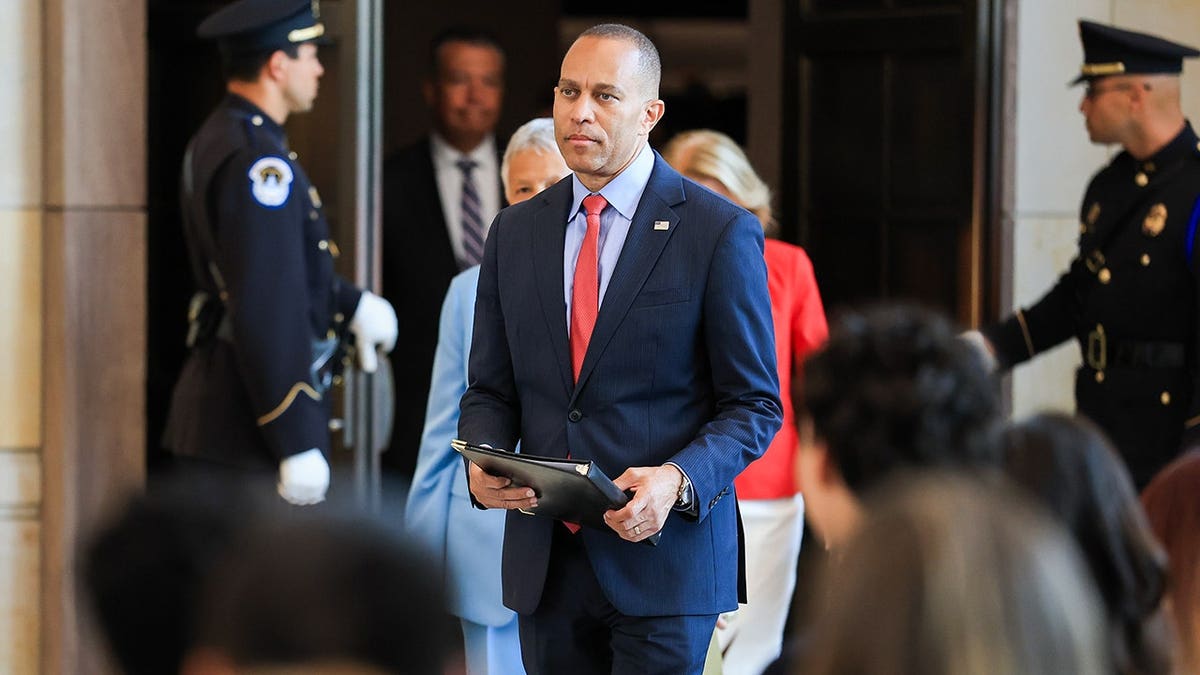
Democratic socialist victories in New York have intensified debate over the Democratic Party’s future and presented Jeffries with a difficult political test. (Anna Moneymaker/Getty Images)
The larger lesson extends beyond Jeffries. Political parties can survive disagreements and factions, even bitter internal fights. But what presents a deeper threat is the pretense that people who march beneath the same wide banner all are ultimately headed toward the same destination.
The Democratic Party today contains centrists who want to make capitalism work better, progressives who want to regulate it much more aggressively, and democratic socialists who openly question whether capitalism itself should remain the organizing principle of American life. Those are not merely policy disagreements. They are competing visions of the country.
Jeffries knows this.
He also knows that House elections are not won in Park Slope, but in places where swing voters often pay little attention to Congress until a thirty-second television advertisement flashes across the screen showing the most controversial quote imaginable beside the words “Democrat for Congress.” And he knows, that for others, the Democratic establishment and its officeholders are now more unpopular than socialism.
CLICK HERE TO DOWNLOAD THE FOX NEWS APP
Sometimes leadership is less about choosing between good options than about choosing between bad ones. This week, Hakeem Jeffries, faced with nothing but bad options, chose rhetorical party unity.
It is too soon to say if Jeffries’ choice was clever statesmanship — or simply the first compromise in what assuredly will be a very long negotiation over the future of his party.

- Admin
- Coast Guard lieutenant gunned down in Washington state shooting as police launch search for killer August 29, 2026
- Tim McGraw takes hard fall onstage at Cincinnati concert after arriving 40 minutes late August 29, 2026
- Royce White wears blonde wig while sitting courtside at Fever game — days after WNBA bans him from draft August 29, 2026
- Paul Goldschmidt delivers with clutch blast in rare Yankees start August 29, 2026
- Two teens, 13 and 18, shot on NYC street August 29, 2026