Venezuela's deadly quakes put its U.S.-backed government to the test

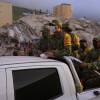
A person searches for victims on June 27 amid debris of a collapsed building after powerful earthquakes struck Venezuela, in Los Corales, Venezuela.
Edilzon Gamez/Getty Images
hide caption
toggle caption
Edilzon Gamez/Getty Images
LOS CORALES, Venezuela — A backhoe is digging through the ruins of a 12-story building that collapsed in this town on Venezuela’s Caribbean coast during last week’s back-to-back earthquakes. But the government backhoe operator never showed up, so local residents passed the hat for donations to pay for one.
Such delays are costing lives, says Rosalia Bustamante, who lost several friends who were inside the building.

“There were people in the ruins responding when we called out to them,” she says. “But now, they are dead.”
Frustration is growing in Venezuela following the powerful twin quakes that the government says have killed at least 1,719 people. Critics claim the response from the country’s U.S.-backed government has been slow and inept, leaving it largely up to people in the disaster zone to save themselves and recover the dead.
Such is the scene in Los Corales, in La Guaira, the state which the government says was hit the hardest by the disaster.
Neighborhood volunteers have pulled more than a dozen corpses out of the 12-story building. But lacking body bags, they resort to garbage bags and plastic sheets. There are no refrigerated containers to store the bodies and in the tropical heat, the stench is overpowering.
Venezuela has thousands of police and army troops. But they have been slow to arrive and some have been accused of looting. They’ve also set up roadblocks and are demanding government permits from doctors and rescue workers.
Julio Meléndez, who owns a Caracas construction company, tried to bring in a badly needed jackhammer to help break up debris and search for survivors. But the process took two days because police wanted to see his permit as well as the sales receipt for the jackhammer.
“The only thing the authorities do is get in the way,” he says.
Politics also got in the way the last time this part of Venezuela faced disaster.
In 1999 after mudslides killed at least 10,000 people, then-President Hugo Chávez rejected help from the U.S. Army Corps of Engineers to rebuild roads and bridges. He instead relied on help from his communist allies in Cuba.
Now, aid workers are arriving from all over the world. And Venezuela was already in bad shape before the earthquakes. People here have endured an economic meltdown plus a crackdown on their democracy. All this has prompted more than a quarter of the population to flee the country, including large numbers of health workers and engineers.

Alejandro Palomino, center, with the Los Angeles County Fire Department, checks his radio during a search and rescue mission in Catia La Mar, La Guaira state, Venezuela, on Sunday. The Los Angeles County Fire Department’s international urban search and rescue team was working in neighborhoods devastated by Venezuela’s back-to-back earthquakes, as part of the scramble to find survivors.
Carlos Becerra/Los Angeles Times via Getty Images
hide caption
toggle caption
Carlos Becerra/Los Angeles Times via Getty Images
Retired Venezuelan Army Gen. Antonio Rivero says Rodríguez could have immediately deployed the country’s armed forces with trucks, generators, portable lights and water systems. That didn’t happen.
Rather than helping people, Rivero says, the security forces are trained to view them as a threat that could rise up against the country’s repressive government. Indeed, they have spent much of the past decade putting down opposition protests and arresting activists.
“How is it possible that during the worst earthquake in our history, the armed forces are a no-show,” Ángel Rangel, a former head of Venezuela’s civil defense agency, told local journalists. “They are prepared for riots but not natural disasters.”
After U.S. troops seized President Nicolás Maduro in January, he was replaced by his vice president, Delcy Rodríguez. She held a variety of high-ranking posts in his authoritarian regime and has kept many Maduro hard-liners in her government.
She’s widely blamed for the government’s haphazard response to the earthquake.
Phil Gunson, who is based in Caracas for the International Crisis Group, says authoritarian regimes sometimes react faster than democracies during crises because they oversee vertical command systems. But he says Venezuela failed to maintain its civil defense capabilities and lacks ambulances, firefighting gear, and other basics.
“So, you have the worst of both worlds: an authoritarian system without any of the benefits,” he says.
Meanwhile, the crisis has allowed Rodríguez to further delay a transition to democracy. The political opposition, led by Nobel Peace Prize recipient María Corina Machado, has been demanding new elections after voter tallies indicated that Maduro stole the 2024 election. But now, the earthquake and recovery efforts are center stage.
“No one is seriously talking about elections anymore. That is all postponed indefinitely now,” says Orlando Pérez, a Latin America specialist at the University of North Texas at Dallas.
He warns, however, that earthquakes can upend governments, as was the case in Nicaragua. Its dictator, Anastasio Somoza, and his cronies stole so much relief aid after a 1972 earthquake that it gave a boost to Sandinista rebels who eventually toppled him.
“That quake really was the beginning of the end of the Somoza regime,” Pérez says.
In Venezuela, even before last week’s earthquakes, polls showed that acting President Rodríguez’s approval rating was sagging and now, in the disaster zone, the anger is palpable.
“They are damned dogs,” says tearful woman who lost a nephew when the 12-story building collapsed. “I hope they rot in hell.”
Nearby, volunteers continue to improvise as they search for signs of life. At one collapsed building, they attach a cable to a chunk of concrete then hit the gas to try to remove it.
But it barely budges.

- Admin
- Former GOP Rep. David Rivera sentenced to 10 years in prison for secret Venezuela lobbying October 3, 2026
- Trump announces $90 checks for 20 million ‘wonderful seniors’ to help cover Medicare premiums October 3, 2026
- Golden State Valkyries erase 16-point deficit, stun Dallas Wings to reach WNBA semifinals October 3, 2026
- Pitt coach puts top-25 voters on blast to ‘wake their ass up’ after huge win over Virginia Tech October 3, 2026
- Zach Bryan wears ‘Free Palestine’ shirt during concert at Robert Kraft’s Gillette Stadium — after Macklemore controversy October 3, 2026