The US healthcare system is in crisis. A Supreme Court ruling could make things worse
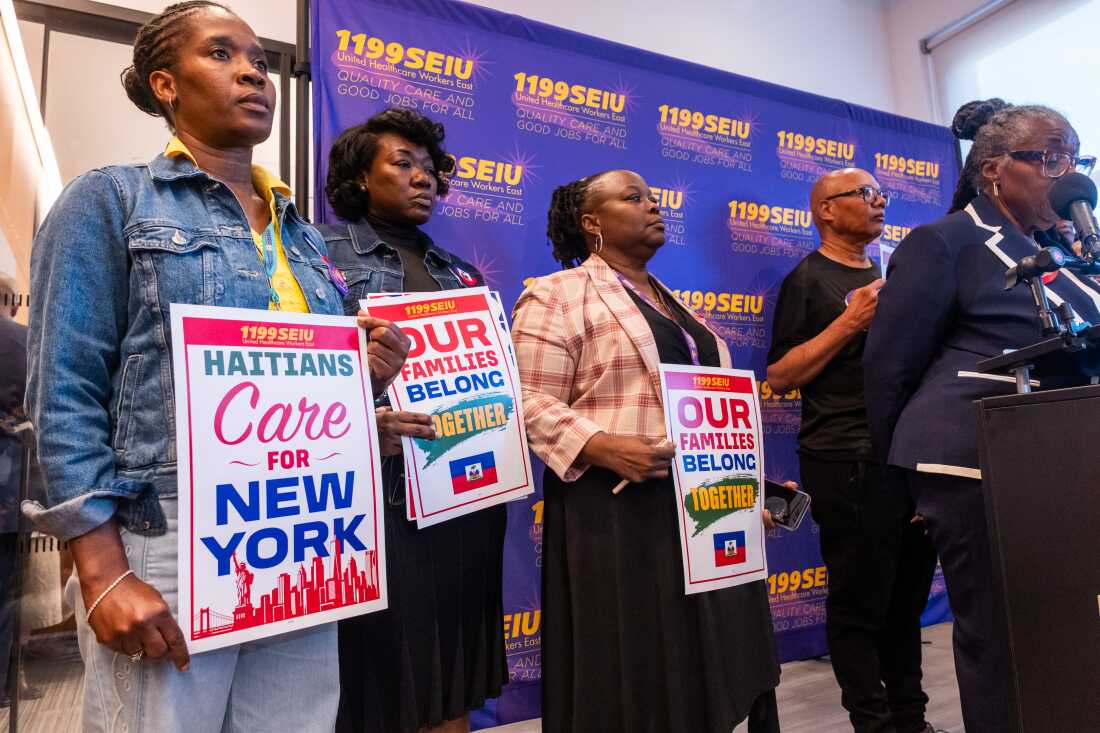
Health care workers rally at a Manhattan union headquarters to show her support for the Haitian and Syrian communities after the U.S. Supreme Court ruled that the Trump administration could end the Temporary Protected Status for potentially millions of foreign nationals from countries experiencing conflict and violence. The decision means that over 330,000 Haitians and Syrians could lose their work authorizations and ability to remain in the country.
Spencer Platt/Getty Images/Getty Images North America
hide caption
toggle caption
Spencer Platt/Getty Images/Getty Images North America
Amid the flurry of consequential Supreme Court decisions that have come down recently, it’s the one about Temporary Protected Status that has America’s health care sector the most worried.
The ruling last week cleared the way for the Trump administration to cancel TPS for Haitians and Syrians. Experts say deporting Haitian TPS recipients will have a catastrophic impact on the nationwide health care workforce crisis — a workforce that is hugely dependent on immigrant labor.
The pain will be felt across hospitals and emergency rooms, which already operate under persistent staffing shortfalls, but it’s the long-term care sector, including senior care facilities and home care, that will suffer the greatest disruptions, said Steffie Woolhandler, a distinguished professor of health policy at City University of New York at Hunter College and a faculty member at Harvard Medical School.

“It’s going to be a disaster in the Boston area, where a lot of our nursing home and home care aides are Haitian,” Woolhandler told NPR. But beyond that, she added, “If the United States becomes inhospitable to noncitizens, which I think Trump is doing, we’re going to have a lot of problems staffing our entire healthcare system.”
Massachusetts has the third largest population of Haitians with TPS (19,000), behind Florida (158,000) and New York (40,000) respectively.
Woolhandler is one of three authors of a 2025 report analyzing the impact of Trump’s mass deportation plans, including the potential effects of stripping TPS protections from people from the 17 countries which the federal government deemed eligible. The status is meant to protect individuals from those countries who are living in the U.S. from having to return to places where armed conflicts, natural disasters or other conditions make living there unsafe. Pulling from Census Data, the research team found that roughly 50,000 physicians in the U.S. are noncitizens, the category that includes people with TPS protections. That’s about 9% of all doctors in the U.S. Another 145,000 are registered nurses.
FWD.us breaks down the numbers even further, estimating that 21,000 Haitian TPS holders are in hard-to-fill jobs as nursing assistants and caregivers.

The dearth of qualified health care workers is already putting existing institutions under tremendous strain. Woolhandler said two-thirds of hospitals report they’ve had to close beds because they don’t have enough staff and about half of nursing homes similarly say that they can’t take new admissions because they don’t have enough personnel.
“The thing that has to be said is that the healthcare of everybody is going to be compromised by this. If you start throwing out workers that play a key role in the whole continuum of care … it tends to create a bottleneck or a backup,” she said.
If a family can’t find a bed in a nursing home or home aid caregiver, then those people may end up stuck in a hospital or in emergency rooms, Woolhandler said.

Katie Smith Sloan, president and CEO of LeadingAge, which represents more than 5,300 aging service providers nationwide, called the ruling a direct threat to the delivery of much-needed care and services.
“It puts older adults and the providers who care for them in an untenable position,” Sloan said in a statement. “Staff and caregivers who support older adults every day — legal employees who in some of our communities represent 8% or more of the entire workforce — can now lose their jobs overnight.”
The legal limbo has communities wracked with worry, particularly in Springfield, Ohio, where 1 in 4 residents is of Haitian descent. Hours after the ruling, dozens of panicked TPS holders were calling Viles Dorsainvil asking for advice. The 40-year-old is the co-founder and executive director of Haitian Support Center, a nonprofit that provides a range of services to Haitian nationals and refugees, including legal assistance.
“They’re wondering if they can still keep their assets or money at the bank, if they can still go to work because TPS came with the work permit, and with the drivers license privilege,” Dorsainvil told NPR. “The community is devastated.”
The Trump administration has released little information about how it will withdraw protections under the program for more than 330,000 Haitian and 4,000 Syrian TPS holders affected by the high court’s ruling last week. On Wednesday, the Department of Homeland Security announced that existing Employment Authorization Documents, which permit TPS recipients to legally work in the county, will expire on July 10.
Dorsainvil said he’s advising people the most important step they can take is to sign a power of attorney to someone they trust. Parents with American-born children should also plan to sign over guardianship of their kids, in case DHS pursues family separations, he said.
For now, he said, he’s got little else to share with the people calling but he shares their anxiety.
Dorsainvil is also a TPS recipient, but unlike those who fled the destruction of the 2010 earthquake, he came to the U.S. in 2020 on a visitor visa. At the time he did not intend to stay more than six months. But during his stay, Haiti’s already fragile political system devolved into unrest and violence that led to the assassination of President Jovenel Moïse, and continues to today.
“There was no way I could go home,” Dorsainvil said, adding that it was the Biden administration’s extension of the TPS program for Haitians that allowed him and his brother to stay in the country. It wasn’t until 2024, when Trump first set his eyes on ending the TPS program for Haitians, that Dorsainvil and his sibling, a former doctor in Haiti who now works as a nurse in Chicago, both applied for asylum. Those applications have still not been resolved.
Over the next few weeks, he said, he’s forging ahead with his life, trusting that somehow things will work out. He’s trying to finish his graduate studies at Wright State University in Dayton, Ohio — he’s in a dual masters degree program for international relations and public administration.
When he first decided to stay in the U.S. phone calls home to his mother and daughter revolved around the dangers of the armed gangs that have taken over much of the country because of the political vacuum that exists. Now, they spend most of their calls talking about the political turmoil in the U.S.
“When I was outside of the U.S., the way they sell it to you, you would believe that if you came to this country everything would be okay. But it’s totally different,” he said.

- Admin
- Geraldo Perdomo leaves Diamondback game after getting drilled by line drive in scary scene September 7, 2026
- Pilotless cargo aircraft could change how packages move September 7, 2026
- Everything To Know About ‘Slow Horses’ Season 6 September 7, 2026
- Canada’s Retaliatory Tariffs Set to Take Effect as Trump Threatens to Escalate September 7, 2026
- Discovery beneath soccer field reveals massive medieval convent lost for centuries September 7, 2026