How federal prison guards stop lawsuits before they start
Michelle Mildenberg Lara for The Marshall Project
This much is undisputed: On Nov. 2, 2023, a guard and a prisoner at a federal penitentiary in California got into it over a straw sunhat that the officer had confiscated. The man — identified in court records by his initials, J.M. — walked out of the office, as Officer Sandra Munagay followed him. When he stopped and turned around, Munagay “cocked back … and punched me in my face,” he said in an interview. That is on camera. Munagay admitted to the assault and pleaded guilty this January to falsifying records about it.
But the more severe harm came after, J.M. said, in a hallway without security cameras. As Munagay kicked and hit him, she shouted to other officers that J.M. had attacked her. According to a lawsuit, at least three other guards then rushed in, forced him into a blind spot, and pinned him face-first to a wall. With J.M.’s hands cuffed, he says an officer then sexually assaulted him with an unknown object.
That night, J.M. was transferred to another prison, where a nurse noted bleeding and tenderness in his rectum, medical records show. That gave J.M. more proof than most people behind bars in his situation.

But guards still had near-total control over whether he could file a complaint, or someday sue over what happened to him. J.M. knew they could destroy his paperwork, claim it got lost, or simply deny him the forms he needed. And like he had experienced in other federal prisons, he says, they might punish him for even trying to speak out.
It’s the same dilemma presented to anyone who faces violence in federal prison: Try to file an administrative grievance and risk opening yourself up to retaliation — or stay quiet, endure the abuse, and forgo your chance to someday bring your case to court.
Under federal law, people in prison must go through the facility’s own grievance process before they can attempt to sue. That gives prison staff a “chokehold over access to the courts,” said Colin Prince, a civil rights attorney and former federal defender who is representing J.M. in his lawsuit.
“The guards functionally have power over whether a prisoner can sue them for their own misconduct,” he said. “The entire system is layer upon layer of bureaucratic insulation against accountability. It simply prevents prisoners from getting access to the courts.”
An attorney for Munagay said he and his client declined to comment. A spokesperson for the Bureau of Prisons, Randilee Giamusso, said she could not discuss individual cases or ongoing litigation.
An investigation by The Marshall Project and NPR found that less than 2% of grievances filed in federal prison in 2023 were granted. A majority were rejected for procedural errors or “administratively closed” for other reasons. The findings were based on a federal database, published by the Data Liberation Project, containing nearly 1 million federal prison grievance cases dating back to 2000.
But that data only includes instances where incarcerated people were able to file a complaint at all. An unknown number of cases, especially those involving physical and sexual violence, go unreported, as the same officers accused of abuse can silence those trying to seek help, according to court records, lawsuits, and interviews with attorneys, incarcerated people, advocates and former bureau officials. A recent report by the Government Accountability Office found that fear of retaliation was a major impediment to reducing and reporting sexual abuse in federal prisons.
Prison officials said bureau policy prohibits retaliation of any kind, and that they review and investigate allegations of abuse. In an email, Giamusso wrote that the remedy system is “a safeguard intended to foster resolution within the system, not a barrier to court access.” She noted that remedies related to sexual abuse can be submitted in other ways, such as “third-party reporting and [Prison Rape Elimination Act]-specific channels.”
But many prisoners disagree. “The grievance system is a joke,” said Jimmy Hodge, who was released from federal prison in early 2025. Hodge says he was abused in multiple federal penitentiaries, but was frequently blocked from filing complaints about it. “If you’re grieving over abuse, they’re going to harass you, they’re going to assault you, but you’re never going to get relief.”
Since the passage of the Prison Litigation Reform Act 30 years ago, which required incarcerated people to file grievances before attempting to sue, the rate of civil rights cases filed from prison has dropped significantly.
Lawmakers at the time were concerned about “frivolous” lawsuits from prisons overwhelming federal courts. Politicians pointed to one case where a person had allegedly sued over whether he received chunky or creamy peanut butter. (The case was actually about not getting a $2.50 refund for peanut butter returned to the commissary, which is the equivalent of hours of prison labor.)
“People talk a lot about prisoners filing frivolous lawsuits,” said professor Margo Schlanger of the University of Michigan Law School, who has studied prison litigation across the U.S. “But a huge number of prisoner cases are about really, really serious matters. They’re about abysmal medical care and awful conditions and failures to protect them from harm by staff or by other prisoners. They’re about sexual violations.”
Attempts to significantly reform the law have gone nowhere, Schlanger said. “Having a system that stands in the way and says, ‘You know what, because you filed that grievance after three days instead of after two, you are out of luck and out of court’ — that is a shocking betrayal of justice.”
People who are blocked from filing grievances can sometimes convince a court that the remedy system was unavailable and their lawsuit should proceed. But that is a high bar that may require documentation and the help of an attorney, which many people filing from prison don’t have.
As is, the law fails to account for all the ways prison staff can thwart someone’s attempts to follow the remedy process, attorneys say.
To submit a complaint, someone must obtain a form from their counselor or another prison employee and then return the completed form to staff. According to bureau rules, an incarcerated person must file on their own behalf, unless it is regarding sexual abuse — whether they are in the infirmary or solitary confinement or have a disability. They can receive assistance with their filing from “trained inmate aides,” someone on the outside or a staff member, Giamusso wrote.
For people in isolation, filing a complaint is even harder. “You can’t just walk over to a box on the wall that says grievances and put it in the slot,” said attorney John Boston, co-author of the “Prisoners’ Self-Help Litigation Manual.” “You’ve got to hand it to the correctional officer. And that right there is a prescription for mischief.”
Multiple people in federal prison said officers refused to provide the forms they needed. “I have had difficulty in obtaining the initial grievance form because the unit counselor who issues the forms was friends with the officer whom the complaint was about,” wrote Erick Hobbs, now incarcerated in federal prison in North Carolina. According to Giamusso, if someone can’t get a form, they can ask for help from any staffer, “proceed to the next step in the remedy process, or report concerns through alternative channels.”
Even if you can get a form, there’s no guarantee the paperwork will be filed. “I have had officers doing a ‘random shakedown’ of a cell, and remedy papers go missing,” wrote William Batton, from a federal prison in Massachusetts. Many said prisoners were often transferred to a new facility and lost their paperwork in the process. That halts a case, as any appeal requires copies of every previous response and filing.
People in federal prison have just 20 days after an incident to file a complaint. Those regarding sexual abuse are supposed to be exempt from deadlines, under the federal Prison Rape Elimination Act. There is no such exemption for physical violence.
“People who are the most hurt are often the least equipped to describe it and file a grievance promptly,” Schlanger said. “Requiring them to very speedily figure out exactly what they’re complaining about can be a very, very high hurdle.”
By the time J.M. was assaulted in California, he had served time in some of the country’s most notorious federal prisons. In 2020, he was held at Big Sandy penitentiary in Kentucky, where officers had an unofficial policy: If someone requested protective custody because they feared other prisoners, guards would beat the person asking for help. Then the guards worked together to cover up the attacks, according to court records. Six staff members at Big Sandy were convicted for their role in the abuse.

J.M. tried to report the abuse he received at Big Sandy penitentiary in 2020 to the Eastern District Court of Kentucky. The highlighting and redactions were done by The Marshall Project.
PACER
hide caption
toggle caption
PACER
When J.M. tried to report the abuse he said he suffered at the hands of Big Sandy staff, it only brought more mistreatment. “I have an 8th-grade education, I don’t understand law,” he wrote to a federal court in 2020. “I have been targeted, retaliated and abused for trying to exhaust my remedies. Big Sandy [staff] told me if I keep filing these remedies that I won’t ever leave.” In his letter, J.M. described being chained to a chair for 12 to 18 hours at a time with no “food water or bathroom.”
“Nobody should get chained to no bed for … hours for filing a piece of paper, no matter what,” J.M. said in a recent interview.
His plea to the court, like several others filed from Big Sandy at that time, went nowhere.
In one case reviewed by The Marshall Project, an incarcerated man reported being pepper-sprayed, choked, beaten with a baton and repeatedly called racial slurs by Kentucky officers who were later convicted. He tried multiple times to file grievances about the attacks but received no response before he was transferred to another prison, according to a legal complaint. When he sued in court, his case was thrown out: He hadn’t completed the final two levels of the bureau’s remedy process.
By 2021, J.M. was transferred from Big Sandy to Thomson penitentiary in Illinois, then one of the most violent federal prisons in the country. Bureau officials closed the high-security Special Management Unit there in 2023, after an investigation by The Marshall Project and NPR exposed a culture of abuse and multiple homicides.
In his legal complaint, J.M. said officers at Thomson also refused to provide him with grievance forms. In a survey of over 120 people who had been held at Thomson, conducted by legal advocacy group The Washington Lawyers’ Committee, many reported the same interference. “I’m gonna break your fucking hands since you like to write us up,” one man said he was told, after an officer confiscated his stamps and legal documents.
There are supposed to be other avenues for incarcerated people to report their abuse. But in a setting where no communication is truly anonymous, and the fear of retaliation is prevalent, even reaching out to the Inspector General felt risky, J.M. said. And it was hard to trust another government agency. “It’s like being in a house, and your mother or father is abusing you,” he explained. “And then you go and try and tell your mother or father, ‘Y’all abusing me.’ It didn’t make sense.”
In the U.S. Government Accountability Office report, published in May, investigators found that most surveyed prisoners said they could experience retaliation from staff if they reported sexual abuse. Less than half said they would feel comfortable reporting to the warden or a corrections officer. And many of the surveyed people didn’t know they had other options to report a sexual assault, like calling a rape crisis center or asking a family member to report on their behalf. The bureau agreed with the recommendations laid out in the report.
Fear of being targeted can hide systemic problems. At FCI Dublin in California, which closed in 2024 over widespread sexual abuse, officers frequently punished people for trying to file complaints, said Aron Laureano, who spent two years at the facility.
“They made it literally impossible for anybody to say anything,” she said. The first time Laureano filed a grievance, an officer came to her cell and quoted from her written complaint in front of everyone. “And that’s why they got away with it for so long.”

According to a federal lawsuit, officers retaliated against Laureano by placing her in solitary confinement, taking away her visits and phone calls, and confiscating her property. In one bizarre form of punishment, Laureano said, an officer made her walk around the prison yard, gather the eggs and baby hatchlings of geese who were roosting on the grounds, and stuff them in a trash bag.
Laureano came home from prison in 2024. “You went from one monster to another,” she said of navigating her time at Dublin. “You didn’t have anywhere to go. And I think that’s the worst feeling in the world. I told myself I would never put myself in a predicament like that again, ever.”
After the 2023 assault at Atwater penitentiary in California, J.M. was transferred to a different federal facility and locked in solitary confinement for making threats, insolence, and refusing to obey an order. In her official retelling of the incident, Officer Munagay had claimed that J.M. “walked toward me in an aggressive way” and that she “feared for [her] life.”
What happened with Munagay and the other officers followed J.M. to the new facility. “Everybody knew about the situation, it was funny to them,” he said of the guards there. “I had officers come and tell me, ‘Hey, drop the case, she’s got three kids.'” Staff also began threatening him, according to J.M.’s complaint. They told other prisoners he was a snitch, he said, and locked him in four-point restraints for hours, where each limb was chained to a concrete slab.
It wasn’t just the guards he was worried about. J.M. had seen employees turn prisoners against each other, he said, as payback for writing someone up. “If I file a remedy … my unit team is going to come … take everybody’s stuff, trash everybody’s cells, and say, ‘We’re doing this because [J.M.] complained,'” he said. “Now the other inmates are mad, ‘Oh, it’s your fault.’ Your life is in danger.”

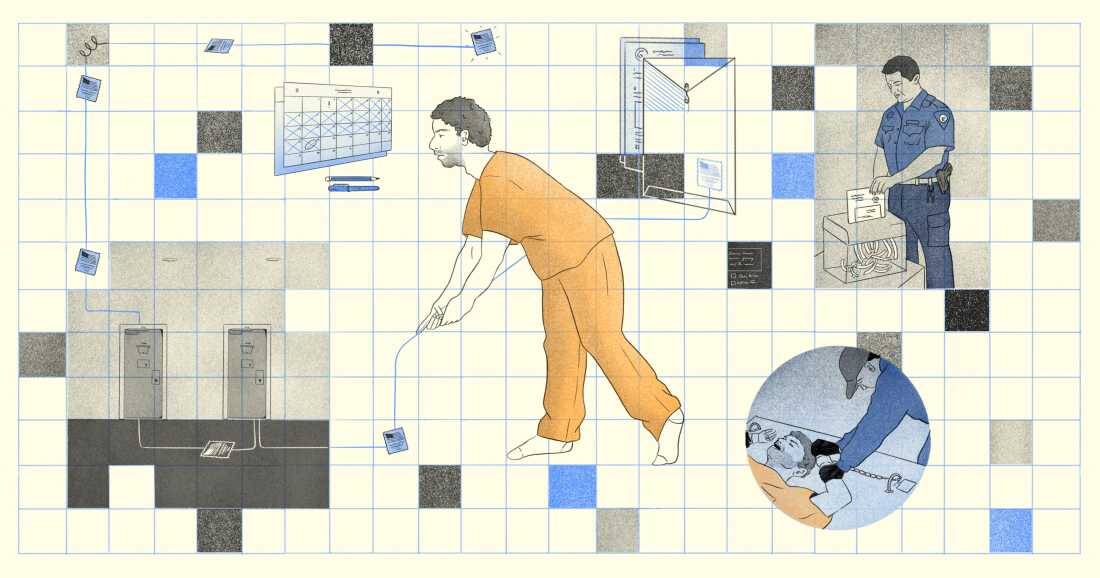
Federal prison policy required J.M. to file his complaint at the institution level first, unless it was regarding a “sensitive” issue. Then he could mail a claim directly to the regional director. J.M. didn’t have enough postage, so he fashioned a fishing line out of plastic wrappers, and used it to trade food for stamps with other men on the tier.
His grievance was rejected. The bureau did not consider his issue “sensitive,” according to a federal database, and required him to file again at the prison level. When J.M. went to file an appeal, prison staff seized and destroyed his paperwork, his lawsuit says.
“He had been assaulted, isolated, trapped, and could not tell anyone who would listen,” his complaint states. “By mid-January 2024 … JM was expressing ‘suicidality’ to the mental-health department because he could not ‘participate’ in the ‘Administrative Remedy Process.'”
Nearly six months after his attack, prison staff dropped the disciplinary charges against J.M., as video footage showed Munagay had punched him. Federal prosecutors filed criminal charges against Munagay six months later. In June, she was sentenced to four months in prison. J.M.’s lawsuit is ongoing.
No charges have been filed regarding the sexual assault J.M. says he experienced. In 2024, there were 32 allegations of sexual abuse by staff reported at Atwater penitentiary.
J.M. has since been moved to another federal penitentiary out of state. His struggles with the grievance system continue. He’s trying to appeal a grievance he filed about not receiving his allotment of postage stamps, but he doesn’t have enough stamps to mail the paperwork.
“I’m resilient. I’m not going to give up just because other people failed,” he said about his commitment to keep trying to use the system. “I’m going to keep filing no matter how small or big the situation is, and hopefully something will change. These are the rules I gotta follow. This is the only way I got to fight.”

- Admin
- A Turkish Doughnut Maker Whose Sweets Honor the Dead September 29, 2026
- US Hits Canada With Ban on Some Dairy and Liquor Products September 29, 2026
- Prime Minister Andy Burnham’s Labour Conference Speech Will Aim to Reset UK Mood September 29, 2026
- Spencer Jones at center of outfield decisions Yankees face entering wild-card series September 29, 2026
- Case Keenum's performance in win over Eagles should tell Bears this: Don't rush back Caleb Williams September 29, 2026