Some states will ask voters to make it harder to pass constitutional amendments
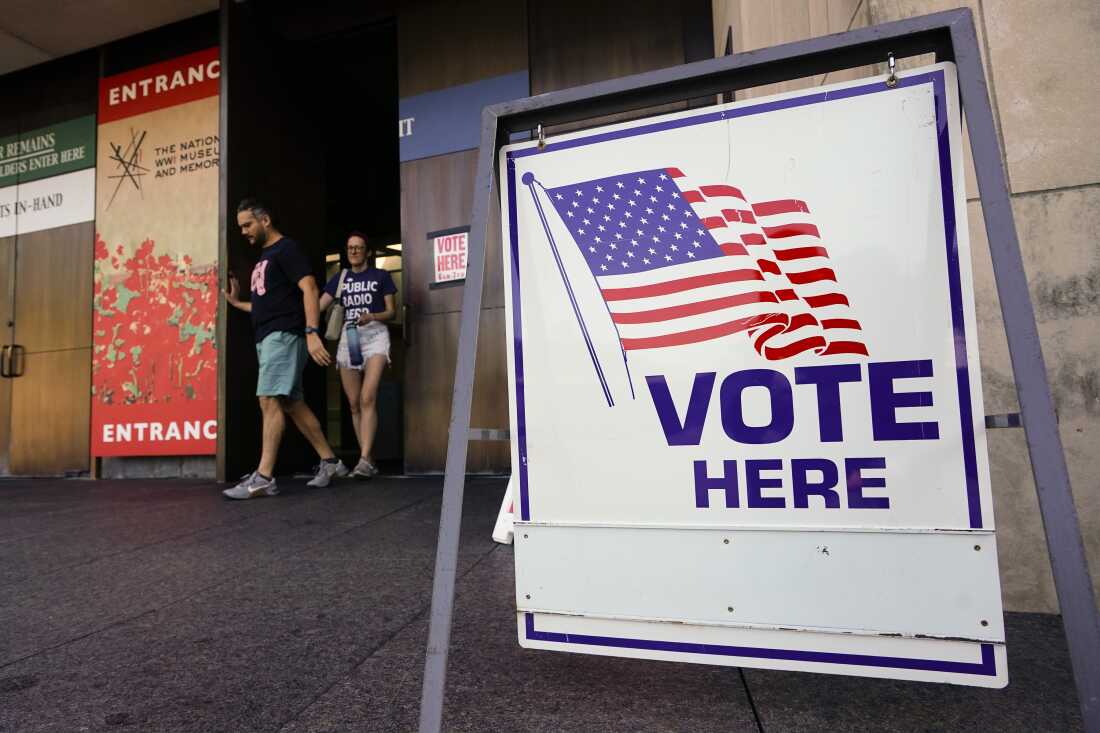
Voters leave their polling station in Kansas City after voting in the Missouri primary election on Aug. 2, 2022. In 2026, Missouri is one state considering tougher thresholds for enacting state constitutional amendments.
Kyle Rivas/Getty Images
hide caption
toggle caption
Kyle Rivas/Getty Images
Voters in a handful of states will weigh in on ballot measures this year that could raise the thresholds needed to pass state constitutional amendments, making it significantly harder for voters to enact policy changes themselves.
Voting rights advocates warn these measures could stifle direct democracy and give minority views outsized power.
Kelly Hall — executive director of the Fairness Project, a nonprofit that backs ballot measures that promote social and economic justice — said severe limits on constitutional amendments have become a trend.
“The theme of 2026 is the battle over direct democracy availability itself,” she told NPR. “This is a really powerful tool … and one of the most frequent topics that we will see voted on this November is, can voters continue to exercise that right meaningfully?”
But Republican lawmakers pushing for these changes say a simple majority threshold makes amending their state constitution too easy — and thus too frequent of an occurrence.

In North Dakota, South Dakota and Utah, voters will consider measures to raise the threshold for approval of a constitutional amendment from a majority to 60% of the vote. In Utah, the change would only apply to tax-related proposals. (California will also vote on a measure to raise the approval requirement for certain local tax issues.)
Quentin Savwoir — the director of programs and strategy at the Ballot Initiative Strategy Center, which works to pass progressive ballot measures — said these efforts to raise vote thresholds are the “antithesis of democracy.”
“What we all learn in our American public education system is that our democracy is anchored in majority rule,” he said. “I understand ‘majority’ to be 50% plus one. But when extremist lawmakers decide that they don’t like progressive policy, when they decide that they don’t like the thing that’s going to materially enhance someone’s life, then they start to change the goal posts.”
Currently, 26 states allow citizens to place ballot measures before voters. But only one — Florida — requires 60% approval for amendments.
This higher threshold has kept various measures from passing in Florida, including an effort in 2024 that would have enshrined the right to an abortion in the state constitution. That year, the measure got approval from 57% of voters, but failed.
In recent years, Republican-led states have enacted new limits on the initiative process, including restrictions on citizen-led groups that gather signatures for petitions to get proposals on the ballot. These latest efforts create longer odds for measures that do manage to make it on the ballot.

In Missouri’s upcoming August primary, voters will consider Amendment 4, which would require that any constitutional amendment pass in each of the state’s congressional districts. The higher threshold would not extend to any measure sent to the ballot by lawmakers, which would still only require a simple statewide majority to pass.
Since 2020, Missouri voters have approved measures that raise the minimum wage, expand Medicaid coverage to more people in the state and grant a statewide right to reproductive health care, including abortion access. All these measures won a majority of the statewide vote, but did not meet a majority threshold in all congressional districts.
“In Missouri … they voted for Donald Trump and [Republican Sen.] Josh Hawley at the top of the ticket while concurrently overturning an abortion ban, agreeing to increase the minimum wage and saying, ‘hey, we need paid sick days,'” Savwoir said. “Missouri is not the only example of that. There have been other examples of people deciding issues over party.”
“Cluttered up” state constitutions
State lawmakers who are pushing for these higher thresholds argue that constitutional changes have gotten out of control.
Republican state Rep. Robin Weisz, who’s led the effort to increase North Dakota’s approval threshold, said the state’s constitution is being “cluttered up” with items he said are “trivializing” it.
“We’re seeing a lot of issues that to me don’t belong in the constitution,” Weisz told NPR. “North Dakota is a small state. It doesn’t take a lot of money to influence an issue.”
Weisz said many issues that have been added to the state’s constitution would have been better suited as a statutory-initiated measure, which allows citizen-led groups to change state law. Unlike constitutional amendments, state lawmakers can later change any statute passed by the voters.

An election worker moves early voting ballots at the Salt Lake County election offices in Salt Lake City, Utah, on Nov. 4, 2024.
George Frey/AFP via Getty Images
hide caption
toggle caption
George Frey/AFP via Getty Images
In South Dakota, Republican state Rep. John Hughes said during a hearing on a bill that would raise the approval threshold in that state that he thinks voters are misinformed on the types of ballot proposals.
“Sadly, our citizens don’t understand the significance of a constitutional amendment versus an initiated measure that enacts a statute,” he said. “Statutes can be changed readily as conditions change. The constitution is relatively static.”
Weisz said he is also frustrated that amendments become “frozen in the constitution” and lawmakers have no recourse to tweak anything that he argues should be changed.
“The [state] constitution to me is basically a sacred document,” he said. “To me, part of the job of the constitution is to protect the rights of the minority to make sure a simple majority cannot override and, you might say, punish the minority, much like our U.S. Constitution.”
“We need to trust our voters”
Zebadiah Johnson with the Voter Defense Association of South Dakota told lawmakers last year they are exaggerating how often constitutional amendments are passing. He said that since 2002 the vast majority of proposed amendments have failed. Out of 37 amendments in South Dakota, only 15 have met the simple majority plus one threshold.
“Despite the rhetoric surrounding this resolution, South Dakotans are not amending our constitution every election cycle and do not take these proposed amendments lightly,” he said. “We need to trust our voters to make the correct decisions for our state with the principle of majority rule.”

Hall, of the Fairness Project, said a distrust of voters is driving many arguments in favor of limiting direct democracy.
“We are constantly seeing quotes from state lawmakers saying that voters don’t know what they’re doing, that they can’t be trusted, that it really shouldn’t be a democratic process in this way in their state. Voters should just trust their politicians to act in their best interest,” she said. “It’s patronizing. It’s infantilizing. It doesn’t respect the core of our democracy, which is the power of the people.”
Instead, Hall said lawmakers in these Republican-led states are pushing for changes because they simply “disagree with their voters” on popular issues like reproductive rights, raising wages and paid sick leave.
She said her group is working to make sure none of these higher thresholds pass, because it would be hard to get majority rule rights back.
“When we lose the ability to make change at the state level and when we lose a tool like direct democracy that allows voters to have a check on power,” she said, “we lose it for good.”

- Admin
- Knicks’ Josh Hart details gruesome reality of damaged finger October 2, 2026
- Michigan decision forces removal of disgraced sports doctor Larry Nassar from sex offender registry October 2, 2026
- Joey Porter Jr. felt ‘disrespected’ by Steelers before trade to Cowboys October 2, 2026
- Yankees show they can win with more than power in wild-card triumph October 2, 2026
- Angel Reese's Defensive Player of the Year win looks like WNBA media rewarding its own hype October 2, 2026