Japan revises law to ensure supply of (male) heirs to the imperial throne
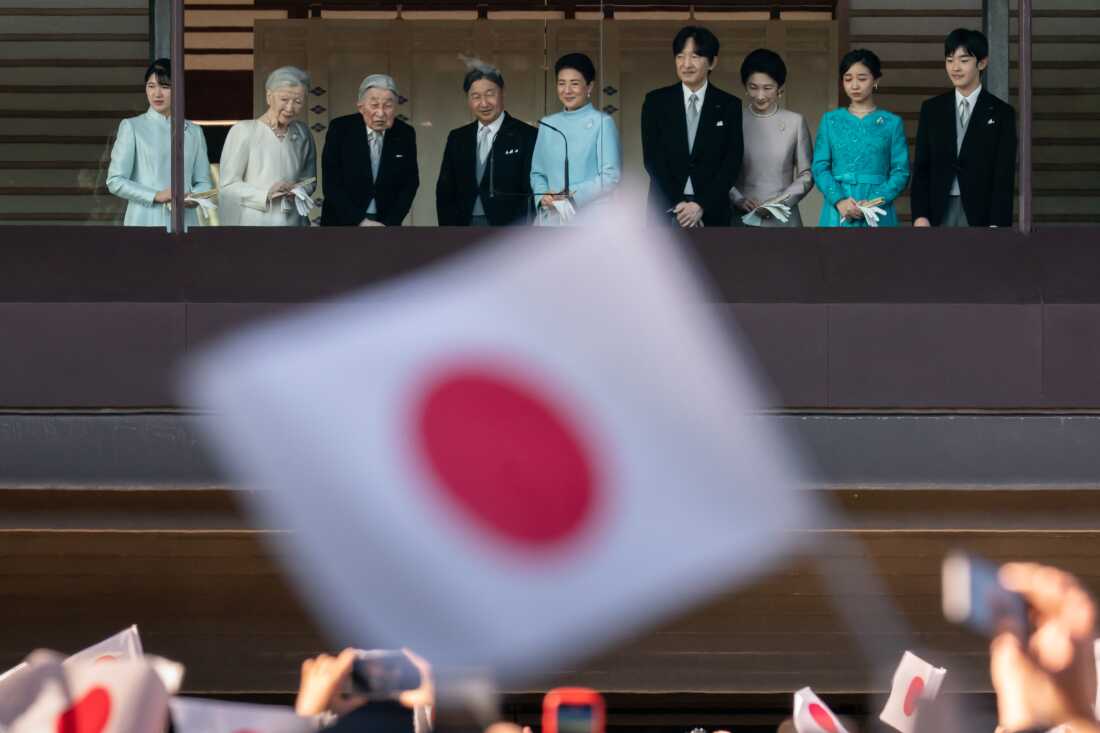
Japan’s Emperor Naruhito leaves following a ceremony to proclaim his enthronement to the world at the Imperial Palace in Tokyo in 2019.
Tomohiro Ohsumi/Getty
hide caption
toggle caption
Tomohiro Ohsumi/Getty
Japan’s upper house of parliament has voted to pass controversial revisions to a law governing who can inherit the throne in the world’s oldest continuous hereditary monarchy, just days after the lower house of parliament voted it through.
The revision’s stated aim is to secure the number of imperial family members, and maintain their public duties and activities, as the family’s ranks dwindle and age.
But to critics, the revision has another “very clear objective: to prevent the future emergence of a female emperor,” says Seiichiro Noboru, a former Japanese diplomat with ties to the imperial family.
Public support and the political stability of Japan’s constitutional monarchy matter, as the country casts off post-war restraints on its military, and portrays itself as a reliable defender of a rules-based international order.
The revisions allow princesses to remain in the imperial family after they marry a commoner. It also allows the imperial family to adopt male-line descendants from former branches of the imperial family.

Japan’s Emperor Naruhito leaves following a ceremony to proclaim his enthronement to the world at the Imperial Palace in Tokyo in 2019.
Issei Kato/Pool/Anadolu Agency via Getty Images
hide caption
toggle caption
Issei Kato/Pool/Anadolu Agency via Getty Images

Japan’s Emperor Naruhito leaves following a ceremony to proclaim his enthronement to the world at the Imperial Palace in Tokyo in 2019.
Issei Kato/Pool/Anadolu Agency via Getty Images
Princesses would be allowed to remain the royal family after marriage, but would have to perform royal duties without any chance of inheriting the throne.
The adopted men—having been born as commoners—could not inherit the throne either, but any of their future male offspring would be eligible.
The imperial family is down to its last young heir, 19-year-old Prince Hisahito, the nephew of Emperor Naruhito, who is 66.
This has led to a public sense of crisis about the future of the imperial family.
“The crucial point is that if a female emperor were recognized, we wouldn’t need to resort to such a complex adoption line,” argues Noboru.
PRINCESS’S POPULARITY DRIVES SUPPORT FOR REFORMS
The obvious candidate is Princess Aiko, Emperor Naruhito’s 24-year-old only child. She has a degree in Japanese literature, and now works full time for the Japanese Red Cross Society. Thrilled crowds often turn out for her public appearances.
Noboru says Princess Aiko is one reason most Japanese support the idea of female emperors, with polls showing 60% to 90% in favor of it.

FILE – Japan’s new Prime Minister Sanae Takaichi speaks during a press conference at the prime minister’s office in Tokyo, on Oct. 21, 2025.
Eugene Hoshiko/Pool AP
hide caption
toggle caption
Eugene Hoshiko/Pool AP
But that number does not include Japan’s first female prime minister, Sanae Takaichi.
“The unparalleled historic fact that the imperial line has been maintained through the male line for 126 generations is the foundation of the emperor’s authority and legitimacy,” she told a party convention in April.
In fact, in nearly twelve centuries, Japan has had eight female emperors, descended from the male line, in other words, the child or grandchild of a male emperor, just like Princess Aiko.
ORIGINS OF MALE-ONLY IMPERIAL SUCCESSION
This practice ended in 1889, with the first Imperial Household Law, passed by the Meiji government.
Its leader saw emperors as the commanders-in-chief of imperial armies, the patriarchs of a “family-state,” and the semi-divine descendants of Shinto deities.
Married women, by contrast, were classified by the Meiji civil code as legally powerless, unable to own property or sign contracts without their husbands’ consent.
The Meiji government also wrote a safety valve into the imperial house law: concubines.

Japan’s Princess Aiko attends the New Year’s appearance by the Japanese imperial family at the Imperial Palace on January 02, 2026 in Tokyo.
Tomohiro Ohsumi/Getty
hide caption
toggle caption
Tomohiro Ohsumi/Getty
Due to high rates of infertility, infant and maternal mortality rates, male heirs were few, and many never survived to adulthood. Nearly half of Japan’s 125 emperors were born to concubines, or as a 2005 report by a government advisory panel put it, “of illegitimate descent.”
Noboru, the former diplomat, argues that barring women from the throne today violates constitutional guarantees against gender-based discrimination.
And the constitution, he adds, is clear about where the emperor’s authority comes from.
“What the government is attempting to do clearly runs counter to public opinion,” he says. “Article 1 of the Japanese Constitution states that the Emperor is the symbol of the nation and that his position is determined by the will of the people.”
Japan’s constitution gives sovereignty to the people. As a figurehead, the emperor is not supposed to weigh in on politics. But he did on this issue, albeit very carefully.
“I hope the discussions about securing an adequate number of imperial family members can gain the understanding of the people,” he told a press conference last month.
Chie Kobayashi contributed to this report in Tokyo.

- Admin
- AIPAC Is Spending Millions to Elect Friends. It’s Also Making Enemies. October 2, 2026
- Gypsy Rose gushed over her ‘forever’ love with Ken Urker 1 year before partner’s shocking death October 2, 2026
- Cornell rape case gets special prosecutor. And, Renee Good's family sues the government October 2, 2026
- China’s Push into A.I. Has Led to a Problem: Too Much Usage October 2, 2026
- Kyrsten Sinema’s ex-bodyguard allegedly said he’d ‘take down’ former pol — a month after destroying her home October 2, 2026