At the World Cup, has 'VAR' gone too far? Some fans say it's ruining the tournament
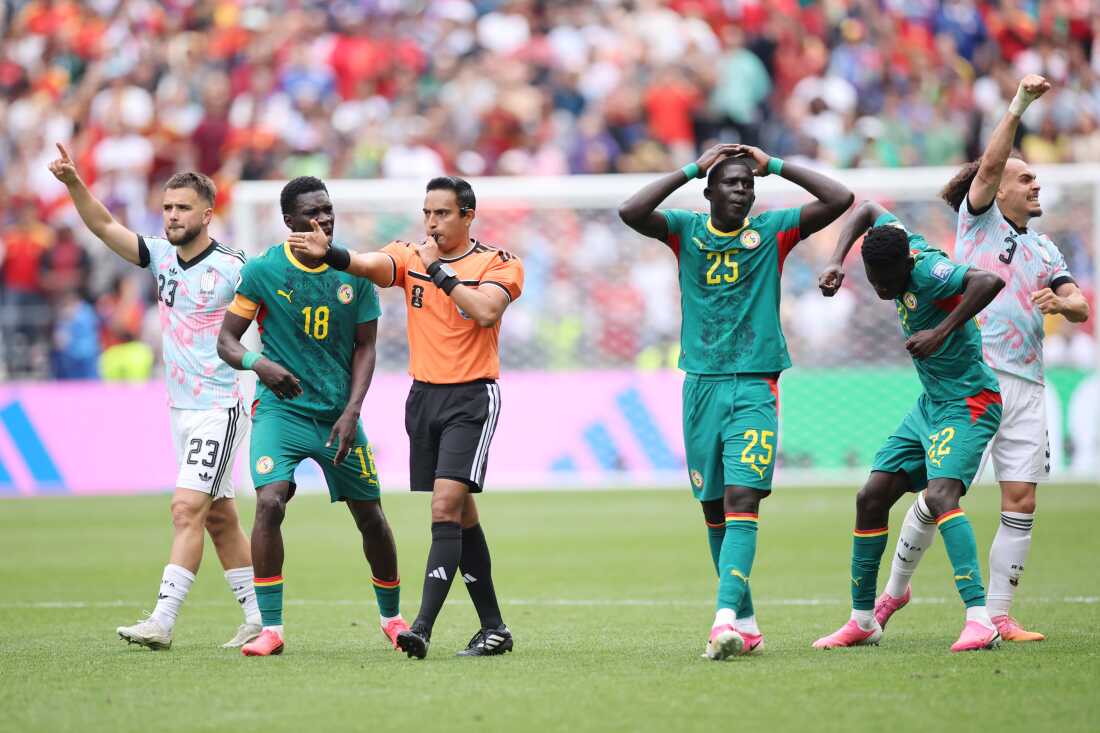
Players react to FIFA referee Said Martinez as a penalty kick is awarded to Belgium after the VAR review during the World Cup round Of 32 match between Belgium and Senegal in Seattle on July 1.
Alex Grimm/Getty Images
hide caption
toggle caption
Alex Grimm/Getty Images
It seems to have become part of the World Cup viewing experience: you’re watching the game. Your team makes a goal. You celebrate, tentatively: because before you know it, VAR, the video assistant referee, is checking, and there’s a chance the goal is getting annulled.

The ubiquitous use of VAR has been one of the great controversies at this year’s World Cup. FIFA argues it’s making the game fairer; many fans and teams say it’s getting out of hand.
The VAR was not always the villain of soccer.
In fact, there was a time when fans and players clamored for it. It all goes back to the 2009 World Cup qualifiers, to a match between France and Ireland. Thierry Henry, a forward for France, assisted on a goal. To many, on the field and watching on TV at home, it was obvious that Henry had touched the ball with his hand. But the referee never called a foul.
This was hardly the first time that it happened: fútbol lovers will point to the infamous Argentina-England game in the 1986 World Cup, featuring a hand goal by Argentine soccer legend Diego Maradona (commonly referred to as “The Hand of God”). The difference was that by 2009, the technology was available to review the play right then and there, and make a better decision.
FIFA, soccer’s ruling body, is incredibly reluctant to change its rules. Up until 1970, teams weren’t allowed to make substitutions. That was the same year in which red and yellow cards were introduced (previously, a referee would simply issue a warning or send a player off for bad behavior).

FIFA referee Clement Turpin watches a VAR replay screen to check for a possible penalty during the World Cup quarterfinal soccer match between Norway and England in Miami Gardens, Fla., Saturday, July 11.
Chris Carlson/AP
hide caption
toggle caption
Chris Carlson/AP
When FIFA does intend to make a change, it often first tests it out in the U.S.
“A lot of innovations in soccer, just even putting names on the back of jerseys started in the United States,” says Professor Chris Davis at Adelphi University. Davis, who studies soccer history, says American fans are typically not so caught up in soccer traditionalism and are more rapid adopters of technological change. This is how VAR came to be tested in 2014 and 2015 during Major League Soccer games.
It was officially introduced at the 2018 World Cup. Here’s how it works: there’s a referee crew on the field, and a separate crew watching the game on video with replays showing many angles. For the most part, Davis says, fans liked it when it was introduced. “Clear instances were being corrected, and I think that was the beauty of it: we had clear instances of protecting the integrity of the game.”
Davis notes that although audiences appreciated the new technology, it wasn’t used very often. Fast forward to 2026, and referees checking VAR has become ubiquitous — from reviewing potential missed fouls in the penalty area to offside.
The offside rule is over 150 years old, has 45 clauses and is around a thousand words long. It’s one of soccer’s most complex and misunderstood laws. It’s hard to explain succinctly, but here is a shot: the law states that a player is offside when in the opponent’s half of the field, and closer to the opponent’s goal line than both the ball and the second-last opponent. It matters where the player is when the ball is struck, and whether they’re involved in active play. It’s designed to prevent lingering around the opponent’s goal to make an easy score.
In this World Cup, referees have often stopped the match on multiple occasions to check VAR for offside, sometimes issuing rulings that fans and teams consider ludicrous.

Ehsan Hajisafi #3 of Iran protests to referee Dario Herrera after a VAR review disallowed an Iranian goal during a World Cup match against Belgium on June 21 in Inglewood, Calif.
Stu Forster/Getty Images
hide caption
toggle caption
Stu Forster/Getty Images
Consider the Iran match against Belgium, in which an Iranian goal was taken away because VAR determined an Iranian player’s butt was offside. A few days later, a Colombian goal was annulled when an attacker’s toe was offside.
“It is completely interrupting what the game state is”, says Felipe Cardenas, senior writer with The Athletic. “One of the best and most special moments in a football match is a goal and the goal celebration. Now there are times when the players have to wait until the referee gets the right decision and he hears from the VAR.”
VAR is at the center of one of the most controversial games in this Cup: Egypt vs. Argentina.
A recap: for most of the game, Egypt dominated. They scored a second goal in the 67th minute. The VAR pointed to a questionable foul that had happened in the lead-up to that goal, all the way across the field. The referee reviewed the video, and disqualified Egypt’s goal. Argentina went on to win. Later, Egypt complained and said they were robbed during the World Cup. The whole incident led to further questioning of so much technology in the tournament, and whether it’s being deployed properly.
At the end of the day, the debate over the use of VAR and technology in soccer echoes many conversations happening in society today: where is the line between tech helping and going too far? If the technology is being handled by humans, is there not an inherent bias?

Cardenas says he thinks the answer lies somewhere in the middle. “As fútbol fans, you should live with human error at times. It’s OK for a referee to make a mistake. We’re getting to the point where it is taboo if a referee makes a mistake.“
In other words, sometimes you just have to accept the referee’s decision. No ands, butts… or toes.

- Admin
- DoorDash reveals launch timeframe for delivery drones in Northern California October 1, 2026
- What New York’s Rape Laws Mean for the Cornell Case October 1, 2026
- Fetal tissue supplier billed $765 procurement fee per organ, warn paperwork could imply illegal sales: records October 1, 2026
- Pennsylvania records fifth measles death as country sees worst outbreak in 35 years October 1, 2026
- California superintendent candidate calls out teachers union, says she's a 'real threat' to 'socialist agenda' October 1, 2026