Years after storms, clean-up crews meticulously separate the sentimental from the wreckage
Hayden Cheek cleans debris out of the North Toe River in Western North Carolina nearly two years after Hurricane Helene hit the area.
Juan Diego Reyes for NPR
hide caption
toggle caption
Juan Diego Reyes for NPR
Two years after Hurricane Helene, piles of debris linger in Jeannine Robertson’s front yard in western North Carolina. Pieces of mangled sheet metal overgrown with weeds, motor oil jugs and pieces of decking with rusty nails sticking out. A porch umbrella. A tube of toothpaste, full of mud.
“There was a big water hole, and [my grandchildren] were in the water all the time when they were here,” Robertson says, choking up as she points at a shallow and shady tributary of the Cane River, which runs near the house in Yancey County, N.C. “I mean, this is where generations have done this.”
Debris remains scattered along the banks and in the sandy river bottom. “It is so heartbreaking,” she says. “[To see] something that you’ve watched for so many years be a safe haven, and it’s just cluttered with parts of people’s homes.”
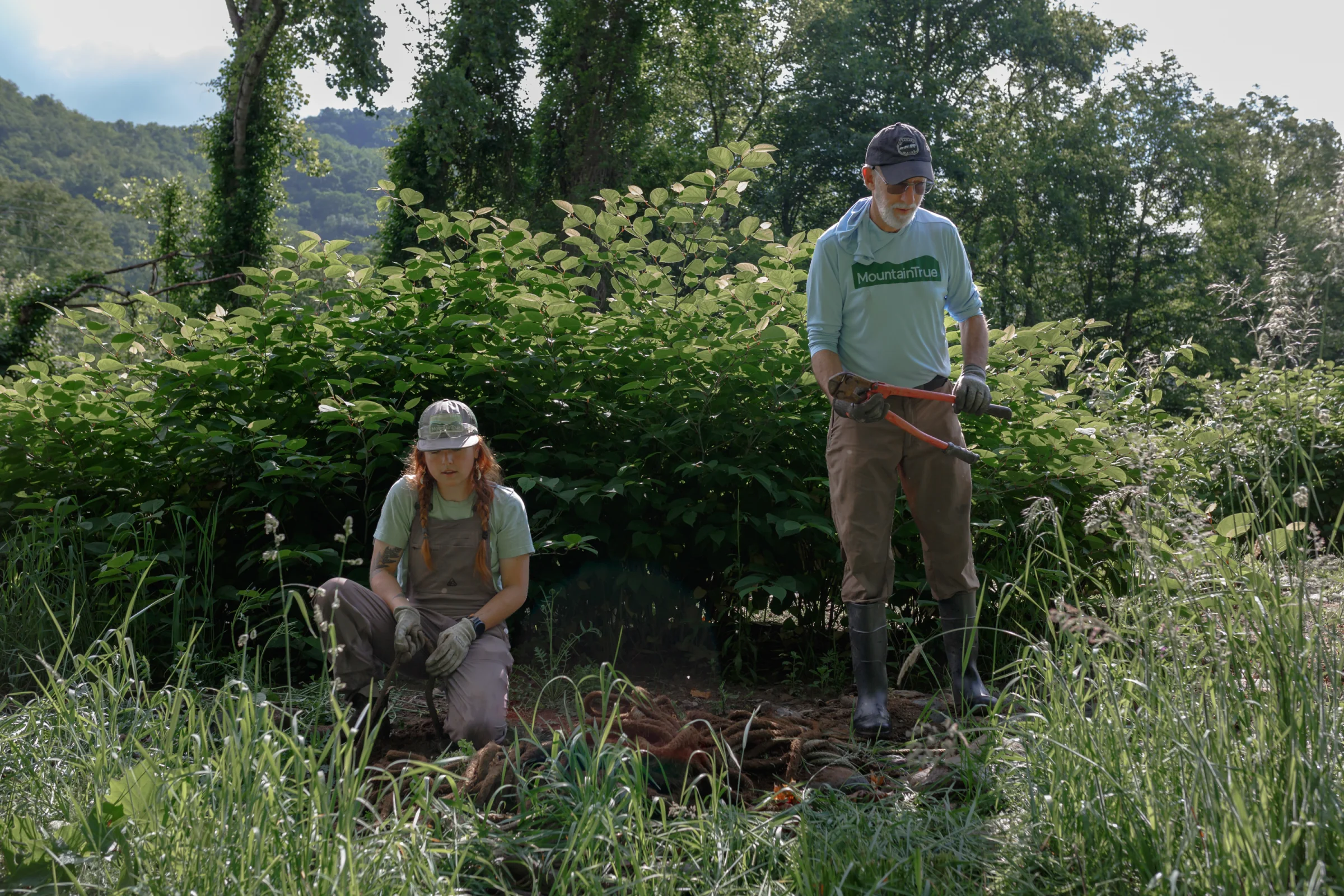
Haley Smith, left, and Michael Crooks, right, remove garbage and debris from the banks of a creek north of Asheville, N.C. Both are experienced outdoor recreation professionals who have turned to debris cleanup since Hurricane Helene hit the area in 2024.
Juan Diego Reyes for NPR
hide caption
toggle caption
Juan Diego Reyes for NPR
In late September 2024, Hurricane Helene dumped more than 30 inches of rain in some parts of Western North Carolina, setting off massive flash floods and landslides that killed at least 250 people in multiple states and damaged or destroyed tens of thousands of buildings. Millions of tons of debris were strewn over thousands of square miles.
The clean-up has been costly, emotionally painful and logistically challenging. After two years and more than $600 million dollars in public spending, crews still regularly pull scrap metal, PVC pipes and other trash out of the waterways. Western North Carolina’s jagged and mountainous terrain makes that work even more difficult. In one section of the Toe River, crews relied on helicopters to haul away golf carts and trailer frames from the riverbed.

Flood damage from Hurricane Helene on October 8, 2024 in Bat Cave, N.C. Crews are still cleaning up rivers in the area two years later.
Mario Tama/Getty Images
hide caption
toggle caption
Mario Tama/Getty Images
Such massive and costly cleanup efforts are increasingly common across the U.S. as climate change drives more intense weather disasters. Nationwide, the Federal Emergency Management Agency (FEMA) has spent more than $37 billion on debris removal in the last 25 years, according to publicly available FEMA records analyzed by NPR.
As debris cleanup becomes a troubling reality for more and more disaster survivors, there’s a growing network of people who reunite people with lost objects in places like California, Texas and Arkansas, where disasters have destroyed thousands of homes. Across the country, people are digging through rubble, mud and ash to find photographs, jewelry, stuffed animals, quilts and old yard signs, and return precious items to survivors.

Clean-up crews from the nonprofit group MountainTrue often find personal items among the debris. Here, a photo album waits to be returned to its owners.
Juan Diego Reyes for NPR
hide caption
toggle caption
Juan Diego Reyes for NPR
‘Something more than just a ring’
For many volunteers, it’s a sacred act to clean items, restore them, and work to reunite them with their original owners.
“When we call it debris, we box it up; we contain it in this idea that it’s discardable. And some of it is,” says Dondi Persyn, who runs the volunteer network, FOUND on the Guadalupe River.
But she maintains that, “there is a space for humanity in the midst of disaster.”
Persyn lives near the shore of the Guadalupe River in Texas, where in 2025, flash floods claimed 136 lives and countless possessions. This summer, the river flooded again, bringing another wave of death and loss. Her volunteer network has collected more than 10,000 items – and returned around 8,000, including an heirloom ring that belonged to someone’s great-grandmother.
“The fact that it even survived changes the story of the person who received it back,” she says. “Because it survived and she survived. And it becomes symbolic. It becomes something more than just a ring.”

Kyle Cresap clears debris tangled in fallen logs outside of Burnsville, N.C. in May 2026.
Juan Diego Reyes for NPR
hide caption
toggle caption
Juan Diego Reyes for NPR
Millions of pounds of debris, hiding treasures
In Western North Carolina, the post-Helene cleanup has been professionalized. The nonprofit MountainTrue runs the largest ongoing cleanup effort with nearly 100 employees pulling debris out of rivers every day. Since the 2024 storm, the group has cleaned up more than 5.7 million pounds from hundreds of miles of waterways.
“We’re nowhere near done,” says the group’s operations director Jon Stamper. “There are still sections of river that we haven’t been able to access.”
Such debris removal work is expensive. In addition to the more than $37 billion spent on debris removal by FEMA, other federal agencies, including the National Park Service and U.S. Army Corps of Engineers and state governments have contributed additional funds. In North Carolina, the state legislature has allocated at least $20 million for debris removal work since Hurricane Helene.

After two years and more than $600 million dollars in public spending for Hurricane Helene recovery efforts, crews in North Carolina are still regularly pulling scrap metal, PVC pipes and other trash out of waterways. They often find objects that have sentimental value and try to reunite them with their original owners.
Juan Diego Reyes for NPR
hide caption
toggle caption
Juan Diego Reyes for NPR
Many of the people who work for MountainTrue are former professional river guides, who turned to cleanup work after Hurricane Helene devastated the local recreation economy. Their experience working in boats in remote watersheds, and their ability to work while wet and cold, make them very effective at debris cleanup work, says Stamper.
“It’s useful anytime you’re on the water, understanding the flow and dangers and things,” says Michael Crooks, who has worked as a professional raft guide for decades and now works on a debris removal team. “It’s just my environment.”
Even trained professionals can’t always recover everything that was swept away in a flood. That’s particularly true in areas that are remote or dangerous for cleanup crews to access.

The cleanup challenges in Western North Carolina are echoed in other flood-prone parts of the country, where flood debris pollutes ecosystems. For example, coastal homes that are destroyed by flooding often send large debris into the ocean, where it is impossible to clean up.
“You’re talking about very large and, in some cases, hazardous building debris. Pilings, washers, dryers, jacuzzis,” says David Hallac, the National Park Service superintendent for the Cape Hatteras National Seashore, where sea level rise, stronger storms and natural erosion threaten hundreds of beachfront homes. “If it sinks, it’s on the ocean floor, and it does not get removed,” says Hallac. “If it floats away from the shore, it’s not removed, and it stays out in the ocean.”

Mandy Wallace of MountainTrue in North Carolina works to reunite lost objects with their owners. ‘”I try to approach it from ‘What would I have hoped, you know, if my home had been washed down a river and I’d lost everything?'” Wallace says. “And this is what I hope someone would do.”
Juan Diego Reyes for NPR
hide caption
toggle caption
Juan Diego Reyes for NPR
A ‘Nancy Drew’ for hurricane debris
Cleanup crews retrieve sentimental items. But it’s volunteers who reunite those items with their owners. In the aftermath of Hurricane Helene, MountainTrue has elevated the pursuit to a salaried position: artifact recovery technician.
Mandy Wallace runs a lost-and-found program for MountainTrue. She believes it’s the first state-funded program of its kind. Her office, near Asheville, N.C., is full of evocative and eclectic objects that the MountainTrue crew has found in the waterways. There is a silk kimono, a unicycle and one bedazzled children’s shoe. On a table, a multi-page love letter is magically still legible.
The work of reuniting objects with flood survivors is painstaking. Wallace uses special solutions and tools to clean the items and restore moldy and mud-caked photos. She runs stuffed animals through the washer and dryer. She uses public records and Facebook groups to track people down. Sometimes, she’ll call a community general store to see if they have any leads about who an object might belong to.

Items that are washed away by floodwaters sometimes emerge surprisingly unscathed, as with these photographs recovered after Hurricane Helene struck North Carolina.
Juan Diego Reyes for NPR
hide caption
toggle caption
Juan Diego Reyes for NPR
“I try to approach it from ‘What would I have hoped, you know, if my home had been washed down a river and I’d lost everything?'” Wallace says. “And this is what I hope someone would do. I would hope that they would return things that were special to me, things that were special to my family. You know, even if it’s only one item.”
In the year and a half she’s been doing this work, Wallace has reunited families with a Reba McEntire coffee mug, baby albums and ball caps.
In early June, she reconnected one of the first objects she ever pulled from the river: a vinyl record produced by Moon Caravan Records, a former indie record label in the small river town of Marshall, N.C. The building was swept away by Helene, leaving only the foundation. After finding a muddy album down the river, Wallace spent months of detective work to find its owner, JoLeigh Bowden, who ran the label with her husband.
When Helene ripped through the building, Bowden lost nearly everything, including the hundreds of copies of Deerfrance albums she had just produced for an artist friend based in New York City. At the time, Bowden considered putting out a bulletin for all the missing merchandise, including the album, but ultimately decided it felt too painful to list everything she had lost.
On a sunny afternoon this summer in Marshall, just a stone’s throw away from the now-calm French Broad River, Wallace returned the mud-stained album to Bowden. Only moments after saying hello, they hugged, as all of the emotions from Helene sunk in.

The work of reuniting objects with flood survivors is painstaking. Mandy Wallace uses special solutions and tools to clean the items and restore moldy and mud-caked photos in her office outside Asheville, N.C.
Juan Diego Reyes for NPR
hide caption
toggle caption
Juan Diego Reyes for NPR
“I’m so thrilled to get it,” Bowden said, holding her hand to her heart. “There’s layers of meaning behind this.”
Bowden said she’s taking the record’s return as a sign to produce more music, and as a reminder that for all Helene has taken away, it has also given something back.
“We’ve lost a lot. Emotionally, monetarily and all that – but we’ve also gained a lot,” Bowden said. “What we’ve gained from this whole experience is priceless. The value of the people we didn’t realize, who came out of the woodwork.”
Bowden and her husband are planning to open another recording studio in Marshall this year.
This story was edited by Sadie Babits, with additional editing by Neela Banerjee and Shula Neuman.

- Admin
- Hacker claims 7.49M customer records stolen from American utility company September 25, 2026
- Inworld shares the hidden math behind every AI app you use for free September 25, 2026
- Fox News ‘Antisemitism Exposed’ Newsletter: Bibi in the Big Apple September 25, 2026
- Frat leaders arrested after cops found dozens of nearly-naked teens in dingy basement in suspected hazing incident September 25, 2026
- Trump and Xi strike cordial tone at summit. And, Netanyahu gives defiant UNGA speech September 25, 2026