The AI safety debate is confusing. Here's our guide to the different factions
Clockwise from top left: former Google AI research scientist Timnit Gebru, Anthropic Co-founder and CEO Dario Amodei, White House AI and crypto czar David Sacks, Steve Bannon, computer scientist and cognitive psychologist Geoffrey Hinton, researcher Fei-Fei Li.
AFP via Getty Images/Collage by Emily Bogle/NPR
hide caption
toggle caption
AFP via Getty Images/Collage by Emily Bogle/NPR
The debate over the potential benefits and safety risks of accelerating artificial intelligence development reached a crescendo this month, as supporters and critics of the technology clashed over warnings that increasingly powerful AI could pose existential risks to humanity.
On September 8, Jacob Coxon, a researcher-turned-whistleblower, publicly resigned from major AI firm Anthropic after a previous stint at OpenAI, accusing the companies of “racing straight to self-improving superintelligence and gambling with our lives.”

Coxon’s claims supercharged an ongoing debate over the potential damage AI could wreak on society and prompted Anthropic CEO Dario Amodei and other AI CEOs to call for a slowdown in AI development.
Over the past two months, companies including OpenAI and Anthropic disclosed multiple incidents in which their AI agents accessed the internet when they weren’t supposed to and carried out unapproved activities. In OpenAI’s case, swarms of agents worked together to hack the open-source software platform Hugging Face and OpenAI itself, without alerting humans.
The debate over the safety of AI and whether and how it should be regulated is not a simple clash between two opposing sides. There are multiple factions with a variety of goals and assessments about the technology’s promise, dangers and how it should be governed. Here are the main arguments shaping that debate.
Effective accelerationists and the tech right
Those who have an aggressively optimistic worldview of AI are often referred to as effective accelerationists (sometimes shortened to e/acc) – a term reflecting their belief that AI should be rapidly advanced.
People belonging to the faction are emphatically optimistic about AI and its future benefits to society. They believe that the technology can propel medical advancements, boost economic productivity, increase living standards, and automate dangerous or undesirable work. To achieve this, they argue that AI development should be accelerated, not restricted.
Effective accelerationists’ ideology overlaps with that of the “tech right”, in that both camps wholeheartedly believe in accelerating AI development and deployment and minimize critics’ concerns over safety and security.
However, the tech right takes a more nationalistic stance, championing U.S. dominance in the global AI race. Like effective accelerationists, they believe that AI research and deployment should be unencumbered by regulation, arguing that could slow innovation or allow adversarial governments such as China to overtake the U.S. in the AI race.
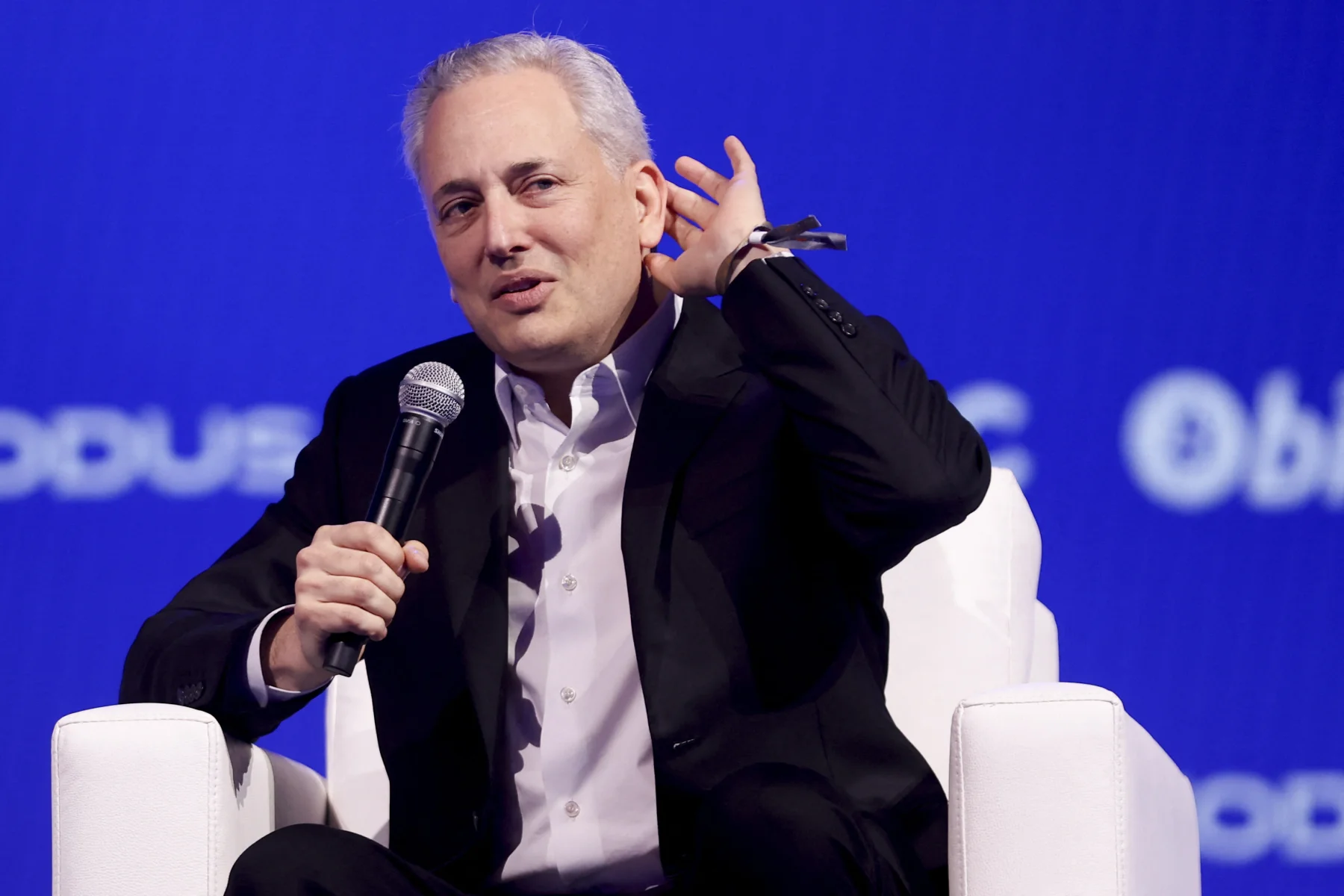
Venture capitalist David Sacks is one of the leading accelerationist voices in the AI safety debate and was President Trump’s AI and cryptocurrency advisor.
Ian Maule/AFP via Getty Images
hide caption
toggle caption
Ian Maule/AFP via Getty Images
The tech right’s philosophy is represented by figures such as former White House AI and cryptocurrency advisor David Sacks, whose views remain influential with the Trump administration. Other significant players include venture capitalists Marc Andreessen and Ben Horowitz, and OpenAI president and co-founder Greg Brockman. The three founded the Leading the Future super PAC to support pro-AI political candidates, and campaign against those who advocate for regulation.

Andreessen also penned a 2023 widely-read blog post titled “Why AI Will Save the World,” in which he claimed that fears of AI triggering mass unemployment are overstated. He argued that previous waves of automation ultimately created more jobs and economic activity than they eliminated, and the fears of existential risk are overblown.
Recently, Jensen Huang, the CEO of Nvidia, whose chips are used by most AI companies, has emerged as one of the industry’s leading voices pushing back against calls for a slowdown and urging a light regulatory approach.
Populist right
AI has exposed an ideological split within President Trump’s political coalition. While Trump and his advisers overwhelmingly favor accelerating AI, parts of his MAGA base believe the powerful corporations he has aligned himself with could undermine the U.S. economy.
Figures including former Trump strategist Steve Bannon and former Fox News host Tucker Carlson have been vocal about potential job losses, the tech industry’s political power, child safety and threats to traditional social and religious values.

This month, Bannon formed an unlikely partnership with independent Vermont Sen. Bernie Sanders, a socialist, to call for significant restrictions on AI development, government oversight and corporate accountability at the Pro-Human Assembly conference in Washington, D.C.

Former Trump adviser Steve Bannon has sharply broken with the Trump administration around AI policy.
Saul Loeb/AFP via Getty Images
hide caption
toggle caption
Saul Loeb/AFP via Getty Images
Still, the two have differing stances on what any of those measures should look like. Sanders called for an immediate pause on AI development until clear safety rules are established by scientists, a permanent ban on the development of artificial “superintelligence” (AI systems that are more intelligent than humans in all domains), and an international treaty with China in an effort to avoid an AI arms race. Bannon, meanwhile, argued for slowing the pace of AI development, the formation of a national regulatory organization and for cutting off China from U.S. AI technology.
“So why are we letting the Chinese Communist Party drive us? Oh, we have to do this or China wins,” said Bannon in his speech at the event in Washington. “We should quarantine now every aspect of the ecosystem of artificial intelligence away from the Chinese Communist Party today. We should cut them off.”
Safetyists
Safetyists are primarily concerned with the potential risks of the rapid advancement of AI. Their worries center on the possibility of catastrophic or existential outcomes, such as the death of humanity at the hands of autonomous machines.
High-profile members of the safetyist community include Geoffrey Hinton, who is commonly referred to as the “Godfather of AI” because of his pioneering work in deep learning that helped launch the modern era of AI. In recent years, Hinton, who previously worked at Google, has issued a series of warnings about existential risks associated with AI, particularly if an AI model surpasses human intelligence and becomes autonomous.

Another vocal AI safetyist is Daniel Kokotajlo, a former researcher at OpenAI and co-author of AI 2027, a paper published last year that discusses how super-intelligent AI could lead to human extinction by the mid-2030s.
Effective altruists
Effective altruists (often shortened to “EA”) generally believe in maximizing humanity’s long-term welfare. The movement originally focused on material ways to reduce global poverty. But more recently, many EA thinkers have focused their concerns on the possibility of existential risks from advanced AI and other potential societal-scale disasters such as nuclear war, climate change and pandemics. They particularly worry about the consequences for future generations. People from the EA camp prioritize AI safety, alignment – which is the science of making sure AI systems behave in a way that is reflective of human values and in line with safety rules – and reducing the probability of catastrophic outcomes.
The key difference between EAs and safetyists is that EAs generally provide funding for AI safety research and risk mitigation, whereas safetyists are researchers and advocates undertaking AI safety work and publicly calling for regulation.
Other AI factions often derisively describe effective altruists as so-called “AI Doomers.” EA has also become a focus of criticism from the Trump administration since Coxon’s resignation from Anthropic.
“Americanism, not effective altruism. The United States will continue to be AI DOMINANT!” said one Defense Department post this month.

Anthropic CEO Dario Amodei is associated with the effective altruists and argues for stronger regulations on AI.
Benjamin Fanjoy/Getty Images
hide caption
toggle caption
Benjamin Fanjoy/Getty Images
Well-known people in the EA movement include Eliezer Yudkowsky, co-founder of the Machine Intelligence Research Institute (MIRI), which focuses on mathematical approaches to making advanced AI systems safe. He is also the author of Harry Potter fan fiction that helped popularize ideas associated with EA. Holden Karnofsky, an American entrepreneur and philanthropist, founded Coefficient Giving (formerly Open Philanthropy), an organization that funds causes central to the EA mission, including AI and biosecurity. Anthropic CEO Dario Amodei is considered to be aligned with effective altruism. Karnofsky also works at Anthropic and is married to Daniela Amodei, who is a co-founder of Anthropic and the sister of Dario Amodei, the CEO.
Another high-profile supporter of the EA movement is Sam Bankman-Fried, who founded major cryptocurrency exchange FTX. In 2023, he was convicted of seven counts of fraud and conspiracy related to the misuse of customer and investor funds and is currently serving a 25-year prison sentence.
AI ethics
The AI ethics camp argues that society should focus on the harms AI is already causing, rather than on hypothetical existential risks. Some proponents contend that emphasizing existential threats from a hypothetical future superintelligence can serve as a distraction from the more immediate harms and accountability issues surrounding AI today.
AI ethicists’ concerns include how AI systems can be biased due to the content of their training data, for example, the ways in which AI facial recognition or job application systems might perpetuate existing societal biases. They are also concerned with how AI could be used to exploit workers and to enable mass surveillance, as well as about the environmental costs of data centers, autonomous weapons, and the concentration of power among technology companies.
A notable voice of the AI ethics faction is Timnit Gebru, a computer scientist and former co-lead of Google’s Ethical AI team. Gebru left the company in 2020 because of a dispute with the company over a research paper she wrote exposing problems with large language models (LLMs), including their tendency to generate harmful or misleading language.
AI as a normal technology
People belonging to the “AI as a Normal Technology” group reject both the utopian and dystopian narratives about AI. Instead, this faction sees AI as a powerful but ultimately normal technology, comparable to the internet or electricity. They believe the focus should be on understanding and regulating specific applications and harms instead of treating AI as an unprecedented threat or as a path to inevitable superintelligence.

Fei-Fei Li is a computer scientist and co-director of the Stanford Human-Centered AI Institute. She and others in her faction argue that AI is more like a typical technology than others in the field believe.
Big Event Media/Getty Images
hide caption
toggle caption
Big Event Media/Getty Images
Notable people associated with this worldview include Fei-Fei Li, a computer scientist and co-director of the Stanford Human-Centered AI Institute. Li is famous for creating ImageNet, a vastly large dataset of images which provided the training data for large neural networks, which led to several major developments in AI.
Katie McQue’s reporting is supported by the Tarbell Center for AI Journalism, which is a grantee of Coefficient Giving. Neither Tarbell nor Coefficient have any editorial input into her work.

- Admin
- At Summit, Xi Sought to Tilt Trump’s Stance on America’s Place in Asia September 26, 2026
- You Get an Eagle, and You Get an Eagle: Xi Takes Home Trump’s Go-To Gift September 26, 2026
- Two powerful federal courts face push to break free from DC bubble as unlikely duo steps in September 26, 2026
- Power out? This Jackery station can keep essentials running and it’s under $500 September 26, 2026
- Heroine or Public Enemy? The Israeli Blocking Much of Netanyahu’s Agenda. September 26, 2026