Riley Gaines' lawsuit vs NCAA dismissed by Biden-appointed judge, appeal planned
Fighting the transgender sports ban is ‘utterly misogynistic’: Riley Gaines
Fox News discusses the Supreme Court’s decision to uphold transgender sports bans. Former NCAA All-American Riley Gaines states it’s ‘insane’ to challenge biological sex in sports, asserting boys should not compete in girls’ sports. She calls the opposing movement ‘misogynistic,’ advocating for female athletes’ rights and fair competition, a view echoed by Education Secretary Linda McMahon. This highlights the contentious issue in women’s sports.
FIRST ON FOX: A federal judge dismissed Riley Gaines’ lawsuit against the NCAA on Monday after concluding that the evidence did not establish the NCAA as a recipient of federal financial assistance subject to Title IX. Gaines and the Independent Council on Women’s Sports (ICONS) plan to appeal.
Gaines and more than a dozen other current and former female college athletes filed the lawsuit in March 2024, alleging the NCAA violated their Title IX rights by adopting and enforcing policies that permitted biological males to compete in women’s events and use women’s locker rooms.
“This momentary setback will not deter me or other women athletes in the least,” Gaines said in a statement. “Rest assured, we will be appealing this decision. We are on the side of truth. I am confident Americans will rally to our side to fight the NCAA.”
U.S. conservative political activist Riley Gaines speaks outside the U.S. Supreme Court as justices hear arguments in challenges to state bans on transgender athletes in women’s sports on Jan. 13, 2026, in Washington, D.C. (Oliver Contreras / AFP via Getty Images)
The plaintiffs have 30 days to file a notice of appeal with the U.S. Court of Appeals for the 11th Circuit,
U.S. District Judge Tiffany R. Johnson of the Northern District of Georgia granted the NCAA’s motion for summary judgment on the lawsuit’s remaining Title IX claims. Johnson was nominated to the federal bench by former President Joe Biden in 2024.
Johnson found that the NCAA and the Defense Department maintained separate funding streams for the research. Both contributed money to Indiana University, but the department’s money went to the university and other research participants rather than to the NCAA, according to the order.
The judge also rejected the athletes’ arguments that the NCAA indirectly received federal funding, controlled entities that received the money or became a federal-funding recipient through reimbursements for certain employee travel expenses.
“Here, there is no evidence that the NCAA ever received, or could have received, federal funds,” Johnson wrote. “Thus, Plaintiffs’ Title IX claims cannot proceed.”
The ruling turned on whether the NCAA qualifies as a recipient of federal financial assistance, a prerequisite for liability under Title IX. It did not decide whether the NCAA’s former transgender-athlete policy constituted sex discrimination.
The case centered heavily on the 2022 NCAA Division I Women’s Swimming and Diving Championships at Georgia Tech, where former University of Pennsylvania swimmer Lia Thomas became the first openly transgender athlete to win an NCAA Division I championship.
Gaines, then swimming for the University of Kentucky, tied Thomas for fifth place in the 200-yard freestyle final. Gaines has also said she and other female swimmers were required to share a locker room with Thomas during the championships.
The lawsuit named athletes from multiple sports, including swimmers Kylee Alons, Reka Gyorgy, Kaitlynn Wheeler and Grace Countie, former San Jose State volleyball player Brooke Slusser and former Roanoke College swimmer Lily Mullens.
Johnson previously dismissed the plaintiffs’ constitutional and bodily-privacy claims, as well as their claims against the University System of Georgia, Georgia Tech and other state defendants. However, in September 2025 she allowed the Title IX claims against the NCAA to survive temporarily, finding that the athletes had plausibly alleged that the organization received federal assistance through a concussion-research partnership with the Department of Defense.
The court then authorized limited discovery specifically addressing the NCAA’s relationship with the Defense Department.
RILEY GAINES AND WOMEN’S SPORTS ACTIVISTS SHARE HONEST REACTIONS, EMOTIONS TO SCOTUS TITLE IX RULING
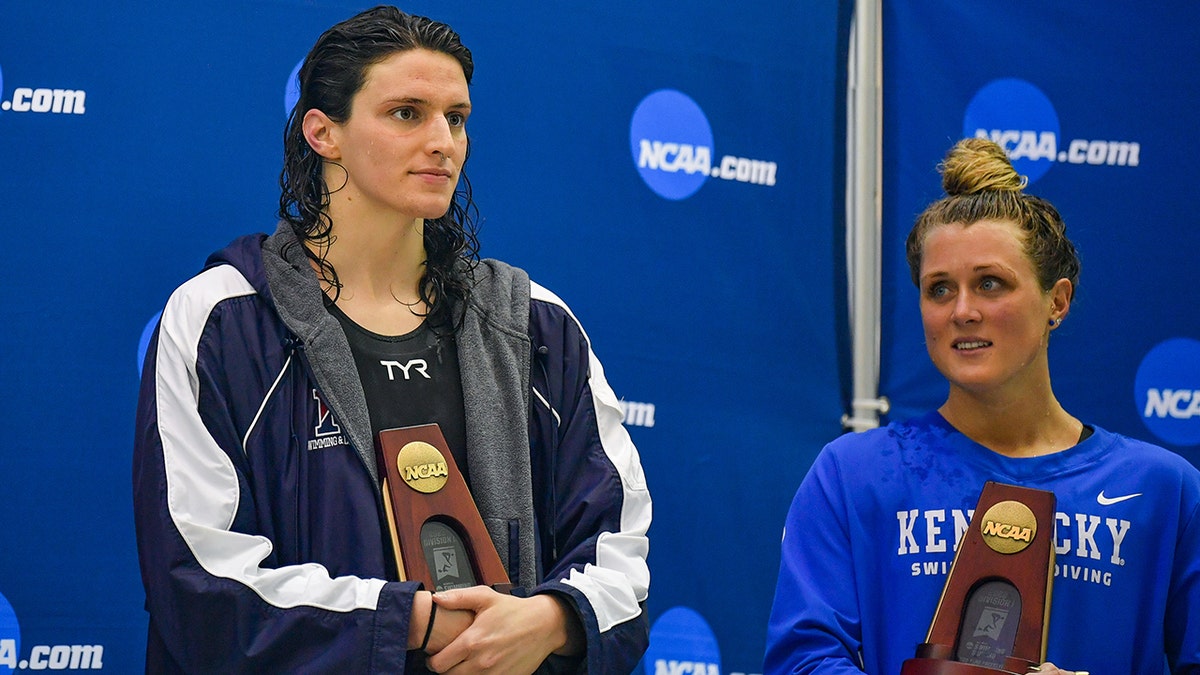
University of Pennsylvania swimmer Lia Thomas and Kentucky swimmer Riley Gaines react after finishing tied for fifth in the 200 freestyle finals at the NCAA Swimming and Diving Championships on March 18th, 2022 at the McAuley Aquatic Center in Atlanta, Georgia. (Rich von Biberstein/Icon Sportswire via Getty Images)
The decision follows the framework established by the Supreme Court’s 1999 ruling in NCAA v. Smith. In that case, the high court held that the NCAA was not subjected to Title IX merely because it collected dues from member institutions that received federal funds.
ICONS co-founder Kim Jones said the organization believes Johnson erred and predicted the appeals court would conclude that the NCAA, which governs more than 1,100 member colleges and universities, is covered by Title IX.
“We will not give up our fight for women and girls’ rights in sports,” Jones said. “ICONS will support an appeal by Riley Gaines, Brooke Slusser, Kylee Alons, Reka Gyorgy, Kaitlynn Wheeler, Grace Countie, Ainsley Erzen, Lily Mullens and the many other young women who depended on the NCAA to protect their equal opportunities but were let down by the NCAA.”
The NCAA no longer uses the eligibility policy challenged in the lawsuit. In February 2025, following an executive order from President Donald Trump, the organization changed its rules to prohibit athletes assigned male at birth from competing on women’s teams. Such athletes may still practice with women’s teams and receive certain benefits associated with practicing.
ICONS co-founder Marshi Smith responded to Monday’s decision by urging members of Congress to oppose the Protect College Sports Act, a sweeping bill backed by the NCAA that would establish national rules governing athlete compensation, transfers and eligibility while providing certain antitrust protections to the NCAA, conferences and schools.
The Senate passed the legislation Monday by a 77-22 vote, sending it to the House. The bipartisan proposal is led by Sens. Ted Cruz, R-Texas, and Maria Cantwell, D-Wash.
“The NCAA’s refusal to recognize its responsibility to uphold women’s rights means the NCAA cannot be trusted to regulate anyone’s sports — men’s or women’s,” Smith said.
Smith argued that Congress should not grant the NCAA additional authority after the organization successfully maintained that it was not covered by Title IX.
“The NCAA cannot be trusted to receive broad new powers that it will only use to inflict further harm upon women,” she said.
CLICK HERE TO DOWNLOAD THE FOX NEWS APP
The NCAA did not immediately respond to a request for comment.

- Admin
- Aaron Judge, the Yankees rotation and four playoff series worth watching and wagering on this week September 29, 2026
- US ban on Canadian imports takes effect — the goods that can no longer cross the border September 29, 2026
- Fanatics Sportsbook Promo Code FOXNEWS350: Bet $20, Get $350 on Game 1 of Braves vs Phillies September 29, 2026
- Accused killer grandma attacked trans NYT exec when his son started wearing sister’s dresses: explosive court docs September 29, 2026
- Hollywood actress upset her son isn't gay fumes in bizarre spectacle at Human Rights Campaign gala September 29, 2026