Iran fires on its Gulf neighbors, retaliating for U.S. strikes after a monthlong lull
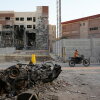
Damage is seen at a building that Iranian media said was hit in a U.S. strike in Kuhestak, southern Iran, early Wednesday.
Masoud Mohammadi/Tasnim News Agency via AP
hide caption
toggle caption
Masoud Mohammadi/Tasnim News Agency via AP
DUBAI, United Arab Emirates — Iran fired on U.S. allies in the Gulf early Wednesday following a night of American bombardment that Iranian officials say included a deadly strike on a wedding party.
The latest violence came after a monthlong lull in fighting. The six-month war has led to a spike in oil prices, roiled the global economy and posed increasing political problems for U.S. President Donald Trump’s Republican Party ahead of November midterm elections.
Fighting has escalated since the American military hit Iranian rocket launchers on an island in the Strait of Hormuz over the weekend, saying Iran was planning to use them to shoot mines into the waterway. Iran retaliated by firing missiles at American bases in Jordan that were intercepted.
American military resources are stretched and political pressure in Washington is mounting, while Iran’s economy falters. Iran’s currency hit another record low on Wednesday, with traders in Tehran exchanging 2.20 million rials for one U.S. dollar, a 10% hike from last week’s record.
Neither side can continue indefinitely between full-scale war and a truce, said Hamidreza Azizi, senior Iran analyst at the Crisis Group, an international think tank.
“At some point, one of the sides may see a need to escalate in order to break this cycle,” he cautioned. “So that could bring the two sides to a point that they have been trying to avoid until now, which is a full-scale war.”
The struggle is focused on the Strait of Hormuz and oil prices
The latest flare-up in violence came as the standoff seemed to be shifting slightly more in the U.S.’ favor, with the price of oil around $80 a barrel and Iranian leaders talking about growing economic hardships, said Sascha Bruchmann, an analyst with the International Institute for Strategic Studies’ Middle East office in Bahrain.

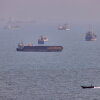
A boy walks on shallow water as commercial vessels are anchored in the Strait of Hormuz off Bandar Abbas, Iran, Monday.
Razieh Poudat/ISNA via AP
hide caption
toggle caption
Razieh Poudat/ISNA via AP
Last week, U.S. Central Command’s Adm. Brad Cooper said the strait had been secretly cleared of mines and that the U.S. Navy had helped nearly 1,500 commercial vessels carrying some 750 million barrels of oil pass through in recent months — still far below prewar levels.
“He basically told the world oil is flowing out and Iran is not capable of restricting the U.S.’s approach,” Bruchmann said. “The U.S. is trying to reinstall some kind of confidence into the global oil markets … and the Iranians had to respond to that by reinserting insecurity and doubt.”
Since the fighting resumed, the price of Brent crude oil, the international standard, has climbed to around $95, up more than 30% from the start of the war.
U.S. allies in the region fend off Iranian attacks
Following the strikes at Jordan, Kuwait and Bahrain said they had also come under attack, without reporting any casualties.

“You will soon see that Iran’s new strategy on the battlefield, in diplomacy, and in confronting the economic blockade will shatter your foundations,” the recently appointed head of Iran’s powerful Supreme National Security Council, Mohsen Rezaei, said on X.
In Iraq, where Iranian-backed forces are active, Kurdish authorities said they had intercepted 10 drones laden with explosives in the Irbil area. Iranian television reported that American bases in Irbil had been targeted.
Israel’s military also said that Iran-backed Hezbollah fired two explosive drones at its soldiers in southern Lebanon, without causing casualties.
The U.S. Central Command said Tuesday’s strikes focused on Iranian military targets, including air defense sites, radar systems and maritime assets.
Casualties in Iran include people at a wedding party
One U.S. strike hit a home hosting a wedding in Kuhestak, a small coastal town overlooking the Strait of Hormuz, according to Iranian media.
Four people were killed — two women and two children, aged 4 and 16 — and at least 68 were wounded, the state news agency IRNA and state TV said Wednesday. Just after the strike, Ahmad Nafisi, the province’s deputy governor, had told Iranian state television that five people were killed. There was no explanation for the change.

A woman walks past anti-U.S. graffiti and images depicting the late Iranian Supreme Leader Ayatollah Ali Khamenei painted on a wall along Islamic Revolution street in downtown Tehran, Iran, on Aug. 29.
Vahid Salemi/AP
hide caption
toggle caption
Vahid Salemi/AP
Several heavy explosions shook Kuhestak, with fireballs that lit up the night sky, according to security camera footage carried by the semiofficial Fars news agency.
Images from Iran’s semiofficial Tasnim news agency showed several hospitalized children being treated for injuries at a hospital in the nearby town of Minab, where a U.S. missile strike on the opening day of the war hit a primary school, killing more than 100 children.
Footage from the Iranian Red Crescent showed rescue workers entering a damaged home in the wake of the strike. It showed a hole in the roof of one house in a neighborhood of densely packed homes.
Experts say a “very precise” weapon appears to have been used
Two weapons experts told The Associated Press that images of fragments of a missile, which Iranian media said was used in the strike, were from a U.S.-made SLAM-ER cruise missile.
Trevor Ball, conflict researcher at the investigative group Bellingcat, said the SLAM-ER was “developed as a very precise weapon” that can be retargeted in flight by a human operator watching by infrared camera.
N.R. Jenzen-Jones, director of Armament Research Services, said the air-launched missile is also used by the United Arab Emirates and Saudi Arabia. Neither has reported carrying out any recent strikes on Iran.
“Make no mistake: these crimes will not go unpunished,” Ebrahim Azizi, chairperson of the Iranian parliament’s National Security and Foreign Policy Committee, said on X.
U.S. Central Command spokesman Capt. Tim Hawkins said the U.S. military was “aware of the reports, which originated from Iranian state media, and we are looking into them.” He would not say if CENTCOM had launched a formal investigation.
Separately, Iran has said four members of its paramilitary Revolutionary Guard and 10 members of the Guard’s volunteer Basij forces died in the U.S. attacks.
The Strait of Hormuz remains largely shut down
During last month’s lull in fighting, the U.S. ramped up economic pressure on Iran as Washington sought to fully open the Strait of Hormuz.
About a fifth of the world’s traded oil was shipped through the key waterway before Israel and the U.S. attacked Iran on Feb. 28 and Iran largely shut it down in response. Despite many pronouncements from Washington that the strait is open, only a handful of ships are making the passage each day and Iran has regularly attacked vessels.
On Wednesday, Saudi shipping company Bahri said two Filipino sailors were killed in an attack late Monday as their vessel transited the strait.
A ceasefire deal reached in June quickly fell apart amid exchanges of strikes that same month. Mediator Pakistan has been working to restart talks.
Late Tuesday, Trump said he would not force Iran to the bargaining table.
“I couldn’t care less if they sign a worthless, to them, agreement. I like our position now much better, with almost total control of the Hormuz Strait, and their economy totally collapsing. They are just playing out the inevitable. When are the Iranian people going to rise up and fight?” Trump wrote on social media.

- Admin
- Will the Giants go for Jonathan Taylor? Where they can turn for a true lead running back October 24, 2026
- Son, 48, dies after falling into father’s grave while attending friend’s funeral October 24, 2026
- MSG uses Knicks championship rings as bait in phishing test, calls the lure 'an unfortunate mistake' October 24, 2026
- California voters’ major shift on billionaire tax revealed in new poll October 24, 2026
- Brooklyn groups rally against Mamdani-backed ballot measure and demand halt to bike, bus lanes October 24, 2026