As climate change damages streets and highways, the road ahead may be expensive
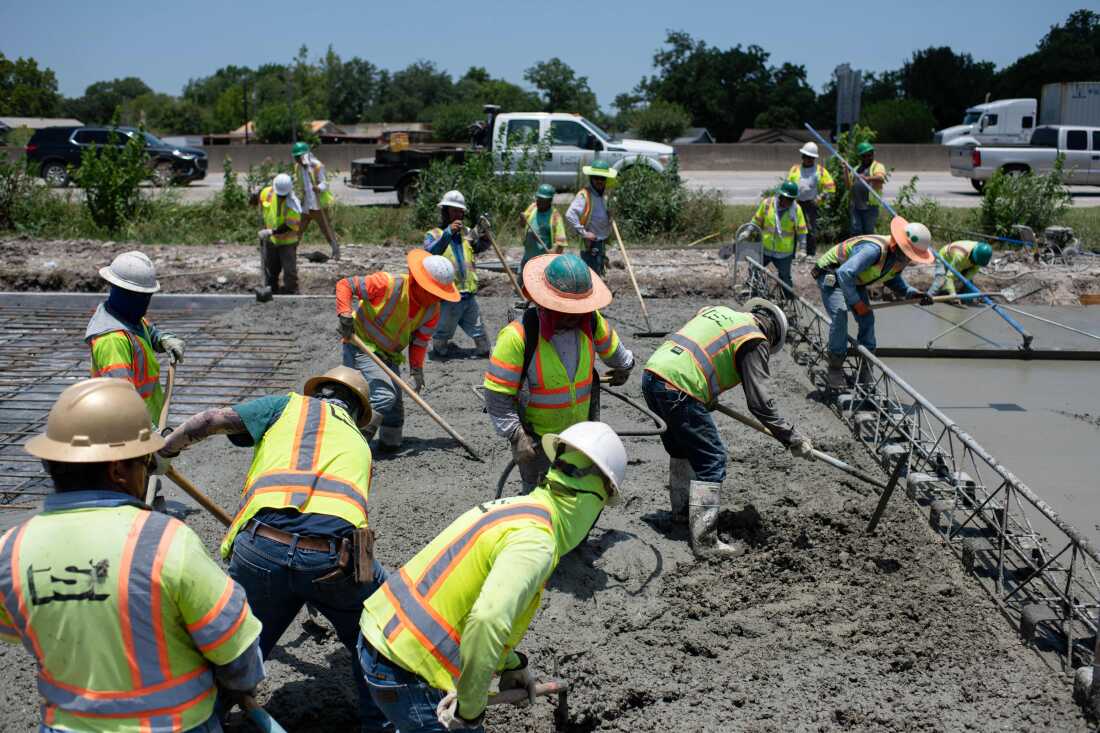
Construction crews on June 27, 2023, work to repair a Houston road that was damaged from the heat. Roads were similarly damaged during the July Fourth weekend heat wave this year.
Mark Felix/AFP/Getty Images
hide caption
toggle caption
Mark Felix/AFP/Getty Images
A heat wave scorched much of the eastern United States over the Fourth of July weekend, bringing extreme temperatures that caused roads to buckle, snarling holiday traffic.
Nowhere was this more dramatic than on a stretch of concrete-paved Interstate 97 south of Baltimore, where one lane of traffic suddenly warped, forcing its closure. A city street in Chicago experienced a similar, though less dramatic, pavement failure, and several state departments of transportation warned motorists to watch for additional heat-related road damage.
Scientists say such heat waves are becoming more common and more intense. Climate change is driving more extreme temperatures, along with heavier rainfall. Both can contribute to pavements expanding and cracking, making roads temporarily impassable as they await expensive repairs. It raises the question: Are the nation’s roads ready to meet the challenge of a warmer, wetter future?
Civil engineers say the answers aren’t entirely straightforward.

What is happening to the nation’s roads?
Heat-related road failure occurs when moisture-weakened pavement gets hot, expands, buckles and warps — especially if the high temperatures last for several days, according to Charles Marohn, founder and president of the Minnesota-based Strong Towns, a nonprofit that advocates for more resilient and safer urban areas.
When water gets underneath a roadway, “it’ll get a little bit squishy, and instead of being firm, it’ll start to move a little bit,” Marohn says. That weakens the pavement — and when it expands, it breaks.
“You take that prolonged period of just intense heat, a lot of traffic on top of it, and that’s when you have something like this happen,” Charlie Gischlar, a spokesperson for the Maryland Department of Transportation, says about the I-97 incident in Baltimore.
Amit Bhasin, a professor of civil, architectural and environmental engineering at the University of Texas at Austin, says it’s typically a problem with concrete — also known as rigid — pavement. To account for expansion, steel rebar or expansion joints between concrete panels can be added, he says.
But as anyone who has driven down such highways can attest, the rhythmic clack-clack sound of expansion joints built into the pavement can be annoying for motorists.
“You don’t want to provide too much of it because then you affect ride quality,” says Bhasin, who is also the director of the university’s Center for Transportation Research. But too little means “it expands more than what it’s designed for, [so] it’s going to buckle.”
Asphalt, the sticky, black substance used to coat many roads, acts differently. “What you see is [that] … ruts form, especially in slow-moving traffic areas,” he says. “It tends to be … like a liquid under a hot summer afternoon.”
Marohn says asphalt is typically less durable, but easier to repair, while concrete has a longer service life before failing. But when concrete does fail, he says, “it goes really bad, really quick.”

What can be done?
While concrete highways typically cost more to build, they tend to last longer and require less maintenance over their lifetime, Bhasin says. Asphalt roads, by contrast, are less expensive up front but generally need more frequent repairs and resurfacing.
“Any time you design an asphalt or concrete mix, you’re designing for a certain range of temperatures,” Marohn says. Extreme events expose the limits of those assumptions,” he says. Under normal conditions, a pavement might perform just fine, but when temperatures fall outside the expected range, problems start to appear.
For some roads, a more durable — and more expensive — blend of asphalt might be the solution, engineers say. For rigid roads, “if you’re using reinforced steel, then you would want to consider different percentages of steel reinforcement,” Bhasin says. “If you’re applying joints, then perhaps [engineers could use] … a slightly different joint spacing … or changing the size of the panels themselves.”
The biggest problem is weather and climate data — or a lack thereof — but “if there is a trend that predicts different kinds of extreme event scenarios, then those should be incorporated into the pavement design,” Bhasin says. “Engineers have figured this out, and they can design it. They just need to know what to go off of.”
Anyone can design super-robust roads, he says. “We could be very conservative and say, ‘OK, let’s design for extreme events,'” he says. But the cost would be higher. “So you have to make the call that ‘I’ll be OK if 99% of the time this works and maybe 1% of the time the traffic is disrupted.”

“In many ways, we’ve designed our infrastructures over decades, if not centuries, for temperatures that have been relatively milder,” Mikhail Chester, a professor of engineering at Arizona State University, told NPR’s All Things Considered recently. “Now, as temperatures are hotter, you’re starting to see the dynamics of those extremes take hold, exceeding the design thresholds of those infrastructures and their particular assets.”
Chester says the way the country has approached infrastructure, such as roads, in the past “doesn’t seem to be sufficient” for the future. What’s needed is a pivot. “And that’s going to require us to innovate, which we are doing. It’s going to require us to share that knowledge, which we’re starting to do.”

- Admin
- Knicks turn page on championship summer with complacency challenge looming at training camp September 27, 2026
- VoteVets Spends Millions to Elect Democrats, Shaping Midterms September 27, 2026
- Former UK Prime Minister Tony Blair warns Europe ‘we don’t win’ in war without US support September 27, 2026
- Tom Brady lost nearly 20 pounds, became ‘empty shell’ as Gisele Bündchen marriage imploded: insiders September 27, 2026
- What Happens if the A.I. Bubble Bursts September 27, 2026