Inspiration for Trump's arch was sparked long before the design was first approved
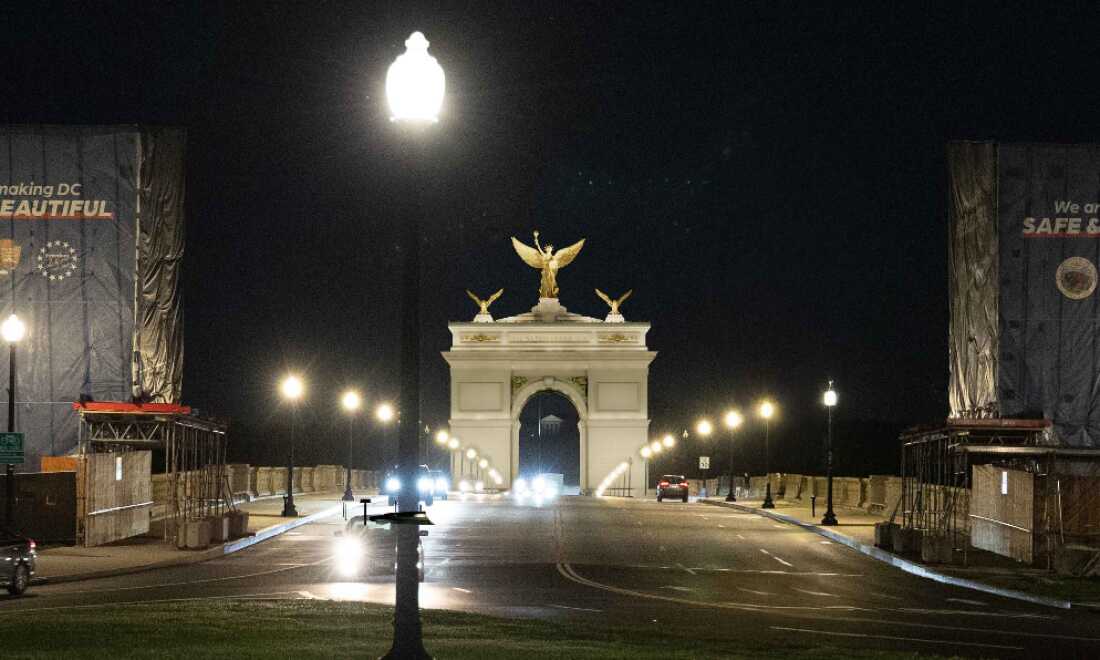
An image from Harrison Design, the studio involved in the 250-foot-tall arch project, shows what the arch could look like at night, framing Robert E. Lee’s house behind it.
Harrison Design
hide caption
toggle caption
Harrison Design
In April 2025, design critic Catesby Leigh proposed the idea of building an arch in Washington, D.C., on a conservative think tank’s website.
The president should build the arch in the nation’s capital to commemorate the country’s 250th birthday, suggested Leigh, who included two sketches of arches to illustrate the concept. One of those sketches was submitted by a local architect, Nicolas Charbonneau, and the other by an organization led by Rodney Mims Cook, Jr., a developer President Trump had nominated to lead the Commission of Fine Arts, a federal agency that reviews memorial proposals in Washington.
“And let’s hope President Trump mandates an Independence Arch that shows them the way,” Leigh wrote.

In April, Nicolas Charbonneau, an architect for Harrison Design studio, posted his sketch that appeared in Leigh’s article to Instagram.
hide caption
toggle caption
Months after Leigh suggested the arch, specifying it could be built on Memorial Circle, the traffic circle between the Lincoln Memorial and Arlington National Cemetery, Trump showed off designs for an arch in the same place, made by the architecture firm Charbonneau works for. Cook, who had contributed the other sketch in Leigh’s piece, later voted to approve the arch project in his capacity as head of the Commission of Fine Arts, despite the fact that the arch hadn’t been reviewed earlier by other stakeholders or Congress, as federal laws require.
“We’re the only important and major city that doesn’t have one, we don’t have a triumphal arch,” Trump said in May. “We don’t need anything from Congress.”
A small group of classical design proponents close to Trump, many without formal architecture training, have played an oversized role in the arch’s quick approvals, NPR has found. But designs for new memorials near Washington’s National Mall are not meant to be dictated by only a few people, and the quick review process the arch has undergone has defied centuries of planning precedent and broken laws, some historians say.
“It’s a small little club of people that have a fairly narrow lens for what they’re interested in,” said Charles Birnbaum, a landscape architect and founder of The Cultural Landscape Foundation, a nonprofit that advocates for public education about design. “We’re seeing a complete avoidance of public review and public process that has underpinned this type of work since the Commission of Fine Arts was created in 1910.”
For more than 200 years, open competitions have selected the architects who have gone on to design some of Washington’s iconic memorials. The Washington Monument’s architect, Robert Mills, was picked to design the obelisk on the National Mall after his sketches won an open design competition in 1814. In 1981, Maya Lin won an open competition to design the Vietnam Veterans Memorial on the Mall while she was still an architecture student.
But there was no widely-advertised, open competition that led to the selection of Harrison Design, the studio that has been designing sketches of the arch shared by Trump and the National Park Service (NPS), NPR found. Since Memorial Circle is federal land managed by NPS, the agency has been obtaining permissions for the arch.
The White House did not answer questions about the architect selection process submitted by NPR. But posts on social media offer clues about how the firm started to become involved with the arch’s design.

Charbonneau posted a second sketch of a taller arch in September that included a golden Lady Liberty and two birds on top.
hide caption
toggle caption
On April 7, 2025, days after Leigh’s article was published, Charbonneau took to Instagram to post his sketch that had appeared in the piece. In the caption, Charbonneau, who works for Harrison Design, a national firm with a Georgetown office that specializes in classically designed homes, said the studio had “created a proposal for a triumphal arch along the axis of Arlington National Cemetery and the Lincoln Memorial.” In September, Charbonneau posted another sketch of an arch in Memorial Circle, saying it was “a closer study of what the #America250 arch could be.” This time, his arch was drawn with a tall golden Lady Liberty statue on top, flanked by two grey birds.
By October, Trump was showing a room full of donors in the White House drawings of arches with Lady Liberty and two grey birds on top, stamped with Harrison Design’s logo.
“Small, medium and large,” Trump said, holding three models of the arches in his hands. “I happen to think the large one’s more fun.”

The model President Donald Trump showed at a fundraising dinner at the White House looked similar to a design Nicolas Charbonneau posted to Instagram one month prior to the event.
Kevin Dietsch/Getty Images
hide caption
toggle caption
Kevin Dietsch/Getty Images
At the Commission of Fine Arts’ meeting on April 16, 2026, Interior Secretary Doug Burgum introduced Charbonneau to the commission as the “lead designer on this project.” By then, the sketches from Harrison Design showed the arch as 250 feet tall, to match America’s 250th anniversary, and featured gold, rather than grey, birds.
With a black “Make Design Great Again” hat positioned on the table next to him, Cook, the developer Trump had appointed to chair the commission, listened to Charbonneau’s presentation about the arch.
But Cook was already familiar with the concept and a proponent of arches himself. Not only had his organization, the National Monuments Foundation, contributed the second arch sketch to Leigh’s article, but that organization had previously built a classically designed, 82-foot-tall arch of its own in Cook’s home state of Georgia.
Trump had also nominated every other member of the seven-person commission. Although the group has historically been staffed by some of the country’s most prominent architects, only one of Trump’s selections was trained in architecture. That person, James C. McCrery, II, was responsible for developing initial designs for the White House ballroom and co-founded a nonprofit that advocates for classical design with Leigh, the critic who authored the arch article.
Other Trump appointees include a former radio talk show host and Trump’s 26-year-old longtime executive assistant and current White House aide, Chamberlain Harris, who spoke up during the presentation.
“To be consistent with other Western capitals that have arches, I would just urge my fellow commissioners to move forward with the concept approval of this project,” said Harris, after seeing Charbonneau’s presentation of what the arch could look like.

An image of the proposed triumphal arch for Memorial Circle is presented at a public meeting of the Commission of Fine Arts in mid-April. At 250 feet, including the sculptures on top, the arch would be more than twice as tall as the Lincoln Memorial.
Andrew Harnik/Getty Images
hide caption
toggle caption
Andrew Harnik/Getty Images
Others were not as receptive to the idea. Months before the commission’s April meeting, in February, a group of Vietnam War veterans filed a federal lawsuit to block construction of the arch on Memorial Circle, saying the arch would “dishonor their military and foreign service” by intruding on the view of the Arlington National Cemetery, which they regularly visit. The Commission of Fine Arts received nearly 1,700 public comments, overwhelmingly negative, about the arch, including from architects and engineers who said the design was too big, did not fit the location and could endanger pedestrians.

But although they were not shown a budget for the project or more finalized drawings for the arch at the meeting, the commissioners unanimously approved the arch. Then, on June 4, a second federal planning agency, the National Capital Planning Commission, also voted to move the project forward. Trump’s three nominations to that second board of 12 members include the chairman of the commission, the White House deputy chief of staff, a White House staff secretary and a director of the Office of Management and Budget – none of whom are architects.
The National Capital Planning Commission is expected to meet again on Thursday to approve site and building plans. But the lack of wide public and professional input the arch design received before it was reviewed by commissioners is unprecedented for memorials in Washington, historians critical of the process said.
“The whole idea is you’re at least given a chance to try to affect the decision making and to protect the National Mall,” said Judy Feldman, an art historian who chairs the National Mall Coalition, a nonprofit that advocates for public input in Washington’s statues and buildings. “But the problem is, he’s put people in the Commission of Fine Arts, in the National Capital Planning Commission, whose job is essentially to say he’s right, let’s give him what he wants.”
National Park Service broke laws, experts say
Federal laws require agencies interested in carrying out projects that could affect historic landmarks, like the Lincoln Memorial and Arlington National Cemetery, to consult with multiple groups about their designs, including state historic preservation officers, local governments and tribes, “early in the undertaking’s planning.”
But only in June, after the two federal commissions had already voted to move the arch forward, did the NPS reach out to a handful of historic preservation and planning groups.
Additional organizations that have typically been consulted about NPS projects near the Mall, like the National Mall Coalition and The Cultural Landscape Foundation, requested to be consulted, emails reviewed by NPR show. But as of July, the groups had not been invited to participate.
“That process seems to have entirely just been shortchanged,” said Edward Stierli, the regional director for the National Parks Conservation Association, one of the groups that wasn’t invited to participate. “This is being jammed through.”
The NPS told the few groups the agency had invited to provide feedback that they would have 10 calendar days to comment on over 180 pages of materials, meaning the review would have to be conducted faster than usual.
Two of the organizations that were consulted said that wasn’t enough time, and they should have been contacted sooner.
An expedited consultation was not appropriate, “given the scale, visibility and effects of the proposed Federally funded monument on historic properties,” wrote David Maloney, the D.C. State Historic Preservation Officer in a letter to the National Park Service on June 15.
Roger Kirchen, director of the Virginia Department of Historic Resources and State Historic Preservation Officer, also wrote a letter to the agency on June 15, saying that in just 10 days, his office wouldn’t be able to verify the accuracy of the information about the arch and its impacts on other monuments in the documents that NPS had shared. And it was inconsistent with the law for his organization to be consulted “after all or a majority of the federal agency’s decisions have been made and the project is planned for imminent start of construction,” Kirchen wrote.
But Kirchen did leave some comments for the agency in his letter. When viewed from the Lincoln Memorial, the arch would frame the Arlington House, he wrote, referring to the mansion where the Confederate general, Robert E. Lee, had kept dozens of enslaved people, and would disrupt the visual connection between the Lincoln Memorial, Arlington National Cemetery and Lee’s house.
“It injects an incongruous and conflicting imperialistic symbol into that space,” Kirchen said, adding that the bridge that connects the Lincoln Memorial to Arlington was designed to symbolically reunite the North and the South after the Civil War. “These adverse effects are intentional and inherent in the design of the arch; it is intended to dominate the surrounding landscape.”

Feldman, of the National Mall Coalition, said that’s what happens when a few people are allowed to make decisions without more outside input.
“You put that arch there, you are breaking that vista and that meaning,” said Feldman. “In a way, it’s like the South has won. The triumphal arch is on the southern side and the South is separating itself out.”
Asked for comment about how some people found the arch’s framing of Lee’s mansion offensive, the White House provided NPR with the same statement it made to other news outlets about the arch.
The arch would “enhance the visitor experience at Arlington National Cemetery for veterans, the families of the fallen, and all Americans alike,” White House spokesperson Davis Ingle said, “serving as a visual reminder of the noble sacrifices borne by so many American heroes throughout our 250 year history so we can enjoy our freedoms today.”
NPR would like to hear from people who work with the National Park Service and are involved with the process of the arch’s review and approvals. You can email the reporter of this article, Chiara Eisner, at ceisner@npr.org, or contact her on Signal here, username ceis.78.

- Admin
- New U.S. passports with Trump's image are available. Here's how to get (or avoid) one July 8, 2026
- Family of Man Fatally Shot by ICE Agent Calls for Independent Inquiry July 8, 2026
- McConnell faces fresh calls to come clean about health issues July 8, 2026
- Joe Rogan breaks silence on UFC fighter Josh Hokit’s Michelle Obama remark: ‘I get it and it’s smart’ July 8, 2026
- Appeals court denies President Trump's request to halt removing his name from the Kennedy Center July 8, 2026