The U.S. is set to reinstate a blockade over the Strait of Hormuz
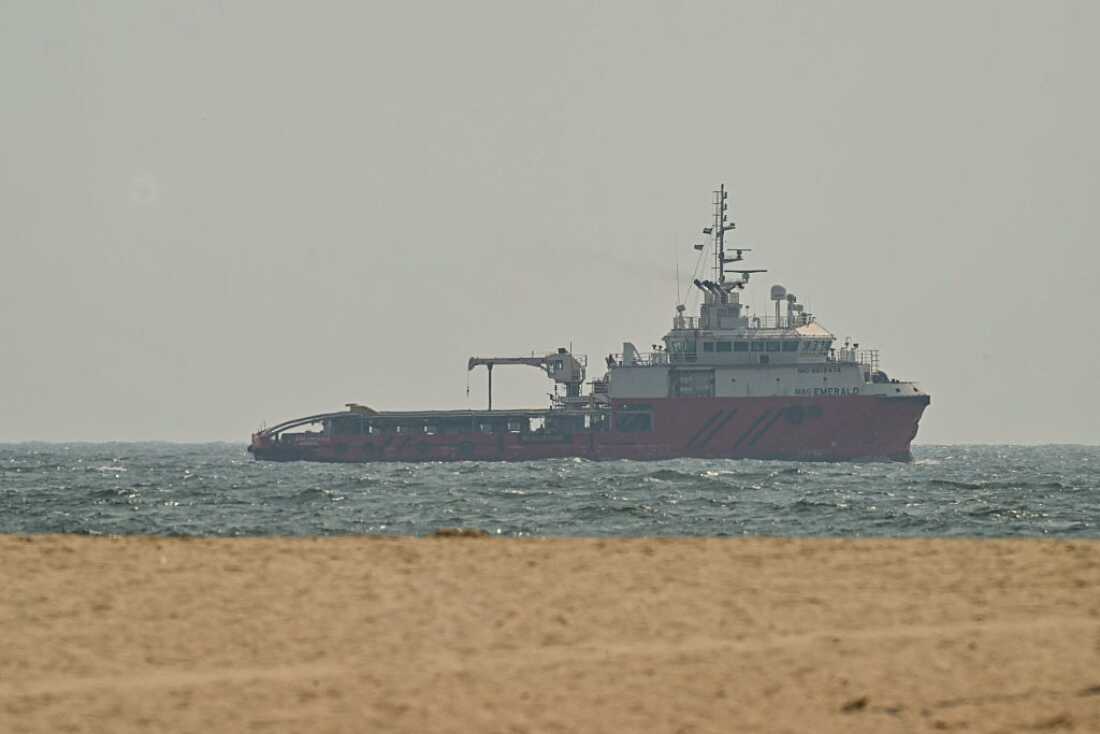
A ship sails off the coast of Ajman on July 10, 2026.
AFP via Getty Images
hide caption
toggle caption
AFP via Getty Images
The U.S. military announced it will begin its blockade of Iranian ships over the Strait of Hormuz on Tuesday, as Iran vowed to assert its own control over the critical international waterway.
CENTCOM said the blockade would begin on Tuesday at 4 p.m. ET. The U.S. military last worked to block maritime traffic to and from Iranian ports from April 13 to June 18.
The announcement came after an intensified exchange of strikes over the weekend, testing a shaky ceasefire and threatening a return to all-out war in the region.
On Monday, the U.S. launched another wave of strikes on Iran. The U.S. military said it struck Iranian defense systems, missile and drone sites and maritime capabilities to “degrade Iran’s ability to attack commercial shipping.”
The Iranian Revolutionary Guard said Tuesday that it had struck “two non-compliant” supertankers in the Strait of Hormuz, according to a statement in Iranian state media. Iran also said it launched missiles and drones against U.S. military infrastructure in Bahrain, which hosts the U.S. Navy’s Fifth Fleet, and U.S. military outposts in Jordan.
The United Arab Emirates’ defense ministry said two of its tankers were targeted by Iranian cruise missiles while transiting the shipping lane of the Strait of Hormuz in Omani waters, killing one person. Bahrain authorities reported that sirens were sounded and urged citizens to head to safe places. Jordanian state media said the country’s air defenses intercepted four Iranian missiles early Tuesday as they entered its airspace.
The escalation comes as the U.S. and Iran reach a half point in the 60-day ceasefire agreed in June, when the two sides signed a 14-point memorandum of understanding to work out the terms of a final deal and open the Strait of Hormuz.
During a NATO summit in Turkey last week, President Trump declared the ceasefire “over,” but didn’t rule out further talks.

The truce all but collapsed over the weekend as Iran attacked a commercial vessel moving through the Strait of Hormuz on Saturday and the U.S. retaliated with strikes in response.
Iranian Foreign Minister Abbas Araghchi told a news conference Monday that Iran was in touch with mediators including Oman, Qatar and Pakistan, saying their role was to de-escalate the situation.
But the status of negotiations with the U.S. was not clear.
Control over the Strait of Hormuz
Control over the Strait of Hormuz — a key shipping route for oil, gas and other goods — has emerged as the key point of contention between the U.S. and Iran. The passage through which roughly 20% of the world’s energy supplies move, has disrupted global trade and increased fuel prices across the world.

Mourners wave the Iranian flag on top of a building during the funeral procession for Iran’s slain supreme leader Ali Khamenei and members of his family, before he is buried at the Shrine of Imam Reza, Iran’s most revered place of worship, in Mashhad on July 9, 2026.
Atta Kenare/AFP via Getty Images
hide caption
toggle caption
Atta Kenare/AFP via Getty Images
This latest wave of strikes from both sides is already having an impact in traffic through the Strait of Hormuz, with Kpler, a data and analytics company that tracks global commodity and shipping markets, saying on Monday that crossings dropped to 22 ships last week — an almost 85% decrease from the pre-war traffic.
The Strait of Hormuz is considered an international waterway, but since the start of the war in Feb. 28, Tehran has claimed it’s in control and has insisted ships get permission and follow approved routes. Iran has been attacking ships if they did not comply with its orders.
Trump pushed back on Monday and said the United States would not allow Iranian ships to move through the strait. “We are reinstating THE IRANIAN BLOCKADE, so named because it is only stopping Iran’s ships or customers from entering or leaving,” he said in a post online.
Trump said other countries will be able to move through the waterway but the U.S. will charge a 20% toll on cargo as reimbursement for the U.S. doing “the job of providing safety and security to this very volatile section of the World.”
The U.S. will be known as “THE GUARDIAN OF THE HORMUZ STRAIT,” he wrote.
Until now, the U.S. had said there should not be any tolls or fees on shipping through the strait.
CENTCOM did not mention fees but said mariners approaching the Gulf of Oman and Strait of Hormuz should “contact U.S. naval forces on bridge-to-bridge channel 16.” It said, “Additional information will be provided to commercial mariners through a formal notice.”
Iran’s foreign minister responded to Trump’s announcement saying he was correct to note that providing safe passage should be compensated. But he wrote on social media, “Iran has always been the GUARDIAN of the Strait and will remain so FOREVER.”
Araghchi then appeared to haggle with Trump: “20% is of course too much. We will be fair,” he wrote.
Iranian leaders have been defiant that Iran controls the Strait of Hormuz, despite the Trump administration’s claims.
Different interpretations of the memorandum of understanding
Critics of the interim deal signed last month between Iran and the United States blame the lack of details in the agreement for the confusion over the management of the strait that led to renewed fighting.

Michael Singh, a Mideast specialist and the managing director of the Washington Institute for Near East Policy, says that one such example is paragraph five of the Memorandum of Understanding, which stipulates that Iran would make arrangements using its “best efforts for the safe passage of commercial vehicles.” Singh says the Trump administration and Iranian leaders differ in their interpretation of that commitment, with Iran considering it controls the strait.
“Here, I think the wording, you know, hews much more to what Iran wanted to get out of that understanding because it seems to place responsibility for the straits in Iran’s hands rather than reinforcing that this is an international waterway,” Singh adds.
Prior to its announcement of the reinstatement of its blockade of Iranian ships over the Strait of Hormuz, the U.S. had urged ships to use a southern route that hugs the coast of Oman. Iran said this violated the memorandum of understanding.
Iran’s Parliament speaker and negotiator with the U.S. Mohammad Bagher Ghalibaf, posted an image of the preliminary deal on social media, highlighting a section of Point 5 that says “Iran will make arrangements.” He wrote: “The era of one-sided deals is OVER.”
The U.S. has also accused Iran of breaching the memorandum.
The foreign minister of Qatar — a mediator in the conflict — had said ceasefire talks would continue after the multi-day funeral last week for Iranian Supreme Leader Ayatollah Ali Khamenei. The ayatollah was killed in U.S.-Israeli airstrikes at the start of the war in late February.
NPR’s Jackie Northam and Hadeel Al-Shalchi in Istanbul contributed reporting.

- Admin
- Cam Schlittler and Payton Tolle set up a potential pitching masterclass as MLB playoffs open at Yankee Stadium September 29, 2026
- Hot mic moment catches reporters thirsting over attractive NBA players as star’s wife reacts September 29, 2026
- Singer RAYE addresses Michael B. Jordan dating rumors after amusement park outing September 29, 2026
- Andy Cohen reveals what he pays babysitter to watch his 2 kids — and Jeff Lewis isn’t impressed September 29, 2026
- How SpaceX’s Starship engine failure could impact NASA’s moon mission September 29, 2026