Environmental groups sue government to stop a big change to the Endangered Species Act
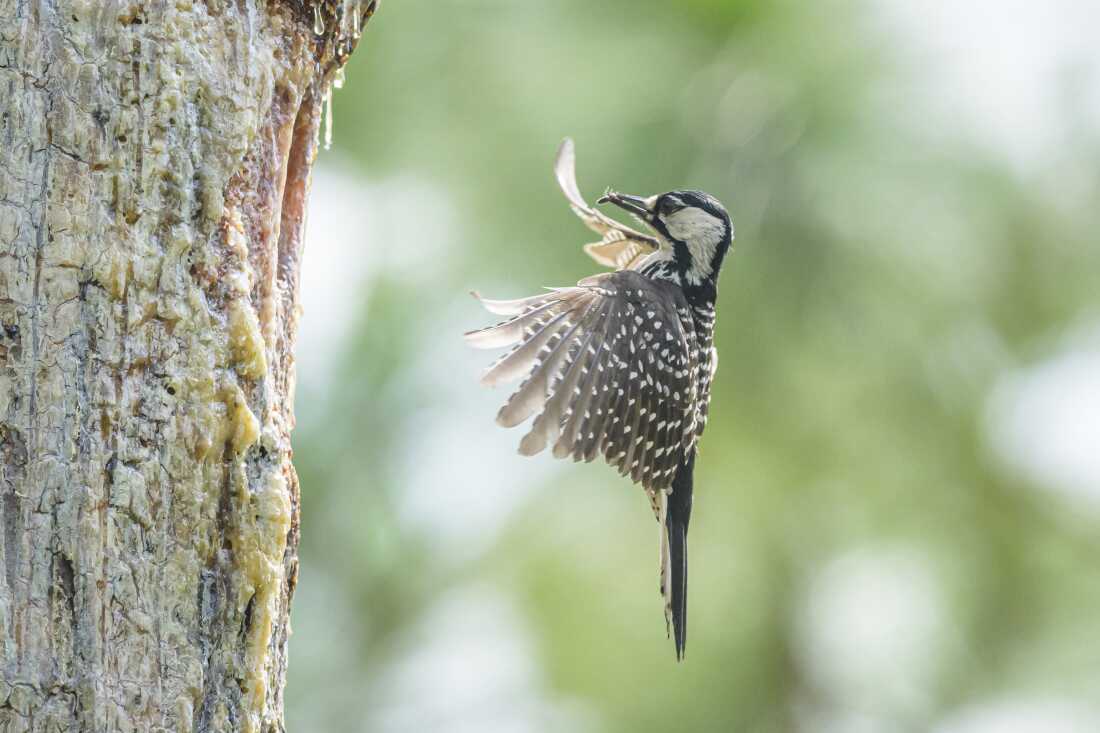
A Red-cockaded Woodpecker hovers momentarily before landing at its nesting cavity inside the trunk of a longleaf pine. This species is listed as threatened under the Endangered Species Act.
Jared Lloyd/Getty Images
hide caption
toggle caption
Jared Lloyd/Getty Images
By altering the interpretation of a single word in the Endangered Species Act, the Trump administration has made what could be a sweeping change to how wildlife is protected in the United States.
That word is “harm.” For more than 50 years, the U.S. Fish & Wildlife Service defined harm to refer to anything that injures or kills a protected organism, including “significant habitat modification or degradation” that might impact a species’ ability to feed, reproduce or seek shelter.
But now, the federal government has officially rescinded that definition — a move that is already being challenged in court.
“This action restores common sense, respects private property, provides much-needed certainty for landowners and follows the statute Congress actually passed,” Secretary of the Interior Doug Burgum said in a statement Friday, when the change was announced.
“The final rule will restore the definition of ‘harm’ to its original intent as written under the ESA, and will maintain protections for endangered species while reducing unnecessary or duplicative permitting requirements, cutting compliance costs, and eliminating confusion for Americans,” a representative for NOAA Fisheries said in an emailed statement Tuesday.
But environmental groups worry the rule change, which goes into effect on September 14, could destroy the wild places that endangered species depend on, undermining the protections that have helped sustain them.
Shortly after the new rule was published in the federal register Tuesday, the law firm Earthjustice, alongside more than half a dozen other environmental groups, filed a lawsuit in federal district court in Seattle against the U.S. Fish & Wildlife Service and NOAA Fisheries (also known as the National Marine Fisheries Service).
Kristen Boyles, an attorney with the group, told NPR that they’re contesting the change on various levels. “The agencies haven’t explained themselves adequately,” she says. “Making this kind of dramatic change doesn’t make any legal sense because it goes against the fundamental purpose and spirit of the statute itself. All of those things make it an unreasoned and unreasonable decision.”
In the short term, Boyles anticipates that countless individual projects will be held up in court as these two understandings of the word “harm” — the historic definition and the administration’s revised interpretation — duel for primacy.
“The one thing that this repeal of this rule is going to certainly do is cause complete confusion in the regulated community,” says Boyles. “And it’s going to cause an increase in litigation over each and every project that’s proposed that doesn’t protect habitat.”
The Swinomish Indian Tribal Community and the Squaxin Island Tribe have also filed a lawsuit in U.S. District Court against the federal government. They explain that habitat degradation has been primarily responsible for the loss of salmon stocks in Puget Sound. Given that, they write in their complaint, “the loss of long-standing protection for the habitat of ESA-listed salmon species will injure the Tribes and their members.”
Certain industry groups have weighed in to support the move. In public comments made last year when the rule change was initially proposed, a collection of oil and petroleum groups, including the American Petroleum Institute, wrote that the “proposal to rescind the ‘harm’ definition is justified many times over.” And the Associated General Contractors of America wrote that they “appreciate the administration’s efforts to reduce unnecessary regulatory burdens.”
In a statement after the rule change was announced on Friday, Holly Hopkins of the American Petroleum Institute said, “We remain committed to supporting commonsense ESA [Endangered Species Act] policies that both protect wildlife and support American energy leadership.”
The emergence of bold protections for species at risk
The Endangered Species Act has been a fixture of environmental regulation in the U.S. since the bipartisan bill was signed into law by President Richard Nixon in 1973.
At that time, says Holly Doremus, a professor of environmental law at UC Berkeley, Americans had grown worried that all kinds of wildlife, ranging from whales to wolves to whooping cranes, were in danger of being wiped out by commercial and development interests. The Endangered Species Act emerged that year as a kind of triage for species nearing extinction.
“Just as a patient would not be expected to spend the rest of their life in the emergency room,” says Doremus, “species were supposed to be given special medical attention and treatment to recover.”
In particular, the law prohibited the “taking” of members of an endangered species. The U.S. Fish & Wildlife Service delineated that the word “take” meant “to harass, harm, pursue, hunt, shoot, wound, kill, trap, capture, or collect.” And “harm” was defined to include the alteration or destruction of critical habitat.
Doremus says the agency wasn’t restricting the action of simply “shoot[ing] a critter. They wanted to be clear that if you, for example, removed the place where it nests, even if it was not there at the time, you would be hurting it.”
The thinking was that interfering with the place a protected species calls home would almost certainly be detrimental to the fate of that species.
“For most all species, the number-one driver of extinction [is] damage and harm to their habitat, whether that’s grazing, whether that’s pollution, whether that’s climate change,” says Tara Zuardo, a senior campaigner at the Center for Biological Diversity, one of the organizations that’s co-filing the lawsuit with Earthjustice. “So if you’re no longer counting that as harm under the law, you’re not going be able to protect any of the listed species.”
A history of “harm”
One of the biggest legal challenges to the Endangered Species Act came to a head in 1995.
The timber industry in the Pacific Northwest was at loggerheads with the federal government — unable to operate on certain swaths of private land that contained trees serving as critical habitat for the endangered northern spotted owl. They said the restrictions were causing them financial hardship, and so they sued.
The case, Babbitt v. Sweet Home Chapter of Communities for a Great Oregon, found its way to the Supreme Court. In a 6-3 decision, the justices upheld the notion that habitat modification does indeed constitute “harm” and runs afoul of the Endangered Species Act. Habitat destruction, they concluded, inevitably imperils a protected species.
Justice Antonin Scalia filed a dissenting opinion. He wrote, “To define ‘harm’ as an act or omission that, however remotely, ‘actually kills or injures’ a population of wildlife through habitat modification, is to choose a meaning that makes nonsense of the word that ‘harm’ defines.” He worried that such an understanding signified a “ruthless dilation of the word.”
Those who filed comments last year in support of the Trump administration’s proposal to alter its interpretation of the Endangered Species Act often cited Scalia. But given how the word “harm” has been defined and enforced for more than half a century, Boyles says the legal term for the recent change is “arbitrary and capricious.”
She argues that it’s plain that in order to secure the survival and well-being of a species, it’s crucial to protect the habitat it depends on. Anything else would be, in her words, “biological nonsense.”

- Admin
- Rite Aid names 6 more New Hampshire stores for closure as it winds down operations July 14, 2026
- Missing Canadian hiker found dead 2 weeks after vanishing during mountain trek in Washington July 14, 2026
- All US forces to withdraw from Iraq by Sept. 30: al-Zaidi July 14, 2026
- Missouri nurse found dead months after anesthesiologist husband admitted to assaulting woman July 14, 2026
- House DOGE panel boss demands testimony from National Museum of American History director over woke exhibits July 14, 2026