Oil companies are making billions. In the U.S., calls to tax their windfall are growing
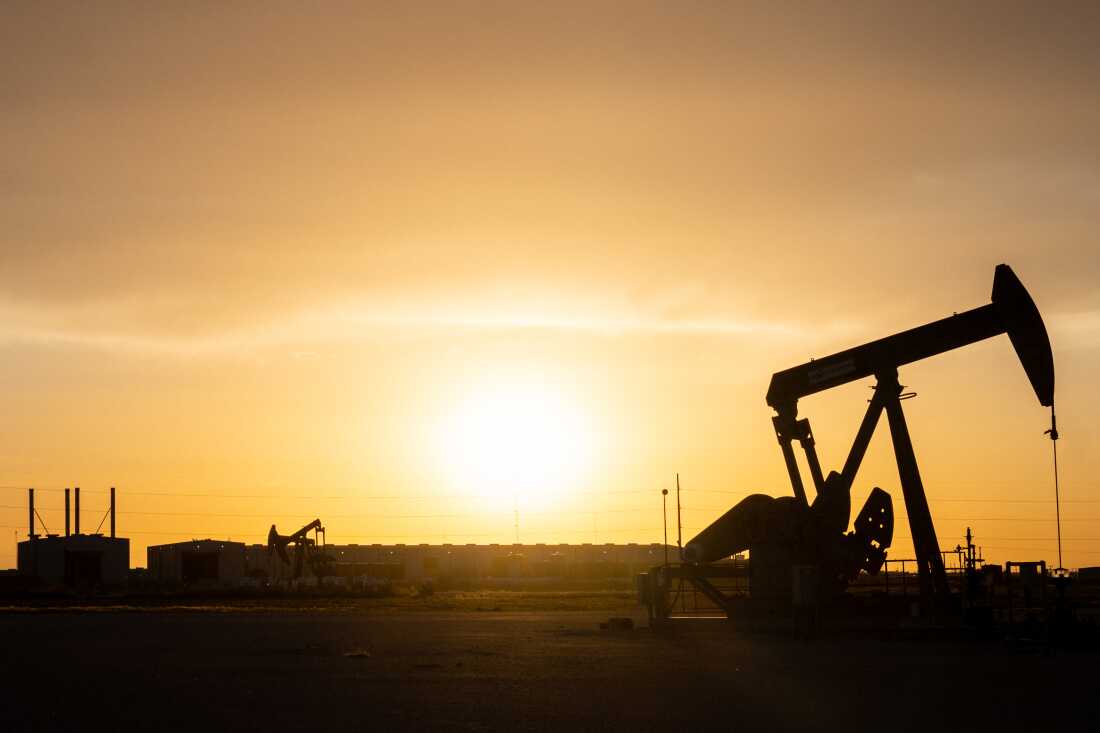
Oil prices have risen since the war began but the cost of actually producing oil hasn’t changed that much, according to the American Petroleum Institute. Some U.S. lawmakers want to tax oil companies’ windfall profits.
Brandon Bell/Getty Images North America
hide caption
toggle caption
Brandon Bell/Getty Images North America
Oil prices have surged in recent days amidst renewed fighting between the U.S. and Iran. Higher oil prices have meant U.S. consumers are paying more for gasoline at the pump.
And oil and gas companies are profiting.
The world’s top 100 oil and gas firms made $30 million every hour in excess profits during the early days of the U.S-Israeli war with Iran. That’s according to an analysis by the environmental nonprofit Global Witness and the Guardian.
“That’s as a direct result of oil prices spiking globally,” says Dominic Eagleton, who researches fossil fuels at Global Witness.
Yet for many oil companies the cost of actually producing oil hasn’t changed that much since the beginning of the war, according to the American Petroleum Institute, a trade organization for the U.S. oil and gas industry. This has led to windfall oil profits — unexpected profits as a result of the war.
Global Witness found that the top six European oil companies have made at least $22 billion dollars in the first quarter of 2026. That’s 43% higher than their profits in the first quarter of 2025, the nonprofit tells NPR.

The U.K. and the European Union started taxing windfall oil profits after Russia’s invasion of Ukraine in 2022. That tax continues to this day in the U.K. Now some U.S. lawmakers want to tax excess oil profits here.
Democratic Sen. Sheldon Whitehouse of Rhode Island proposed a windfall oil profit tax earlier this year.
“ We’re actually somewhat generous about letting [the oil companies] keep half of the excess profits,” Whitehouse says, “but we want at least half of it to go back.”
The U.S. oil industry is largely not a fan of this tax proposal, says Dustin Meyer, senior vice president with API.
“For investment in any industry,” Meyer says, “you need certainty. And proposals like this erode exactly the sort of certainty that is needed to make the investment that has brought the United States to such an unparalleled position of American energy leadership.”
Here’s what you need to know about the proposal for a windfall oil tax in the U.S.

Early on in the Iran war “we found that the companies were making $30 million per hour – and that’s in excess profits,” says Dominic Eagleton, who researches fossil fuels at Global Witness.
Scott Olson/Getty Images North America
hide caption
toggle caption
Scott Olson/Getty Images North America
How would the proposed windfall profit oil tax work?
Here’s how Whitehouse says the tax would work. He says you go back to before the war and look at the average price of a barrel of oil. Then you compare that to the price spikes today.
Then, Whitehouse says, you look at the profits on those barrels and “you split the difference.”
The oil companies would keep half of the excess profits, Whitehouse says. The other half would go into a fund to be redistributed to lower-income Americans through tax rebates.
Whitehouse and Democratic Rep. Ro Khanna of California initially introduced a version of this tax in a 2022 bill. They reintroduced it this March.
How do windfall taxes work in the U.K. and elsewhere?
The windfall oil tax in the U.K., which started after Russia’s invasion of Ukraine in 2022, raises taxes on domestic oil and gas production. The tax raised more than $12 billion from 2022 to the end of fiscal year 2025, the most recent year for which they have data, Eagleton says.
The European Union also had a temporary windfall oil tax following Russia’s invasion of Ukraine. The tax raised almost $30 billion over two years, Eagleton says.
“Those profits went mainly to support families that were struggling with very high energy bills,” he says.

Democratic Sen. Sheldon Whitehouse of Rhode Island co-sponsored the tax proposal in the U.S. “We’re actually somewhat generous about letting [the oil companies] keep half of the excess profits,” Whitehouse says, “but we want at least half of it to go back.”
Justin Sullivan/Getty Images North America
hide caption
toggle caption
Justin Sullivan/Getty Images North America
In April, ministers from Austria, Germany, Italy, Portugal and Spain wrote to the European Commission calling for another EU windfall tax.
Has the U.S. had a windfall oil tax before?
Yes. The U.S. put in place the windfall profit tax of 1980 following the high oil prices of the 1970s.
That tax didn’t raise as much revenue as the government projected largely because oil prices collapsed in the mid-1980s. There were other issues too, says Tyler Priest, historian of oil and energy at the University of Iowa.
One of them was that many oil companies sell the crude to their own refineries. Because the tax was enacted at the “point of sale,” oil companies “could lower the ‘transfer price’ of the crude oil it sold to its own refineries to reduce the excise tax,” Priest wrote in an email.

Oil companies would then make more money on the refining side, Priest says: “Companies were able to adapt in ways that shielded their profits.”
Whitehouse’s office says the proposed tax today will avoid some of the pitfalls of the 1980 tax by looking at the average price of oil overall, noting that individual companies can’t manipulate that.
His office also notes that while the 1980 tax only covered domestic oil production, the newly proposed tax would cover both imports and domestic oil to bring in more revenue.
What does the oil industry say?
This newly proposed windfall oil tax, like the 1980 tax, is “misguided,” Meyer of API says.
“ It’s just fundamentally misguided to penalize energy production, especially at this time, and that’s exactly what this proposal does,” Meyer says.
Whitehouse’s office says that this bill is targeted to impact larger oil companies that produce or import more than 300,000 barrels of oil per day. He says the bill would leave about 70% of U.S. oil production untouched.
Chevron, ExxonMobil and Shell did not respond to requests for comment about the proposed tax. BP referred NPR to API.

The U.S. oil industry is largely not a fan of this tax proposal, says Dustin Meyer, senior vice president with the American Petroleum Institute.
RONALDO SCHEMIDT/AFP
hide caption
toggle caption
RONALDO SCHEMIDT/AFP
What are the chances this becomes law?
About a dozen senators have signed onto Whitehouse’s bill — all Democrats along with Independent Bernie Sanders. Whitehouse says it’s going to be “an uphill struggle” to get the bill passed.

He ultimately hopes the tax proposal will put the spotlight on big oil industry profits — and also the fact that climate-friendly renewable energy is increasingly more cost-competitive than fossil fuels.
“ Wind, solar, and battery power, they’re not raising their prices,” Whitehouse says.

- Admin
- John Thune tells The Post about potential breakthrough on SAVE America Act — led by Lindsey Graham July 16, 2026
- Swalwell campaigns drop eye-popping sum to celeb defense attorney weeks after resigning July 16, 2026
- 'Gossip' had godly origins. Here's how it gained its sinful reputation July 16, 2026
- TSMC Adds $100 Billion to Its U.S. Spending Plan July 16, 2026
- BRET BAIER: Lindsey Graham was a true defender of America and a bridge builder July 16, 2026