No Asian team managed to go far this World Cup (again). What's holding them back?
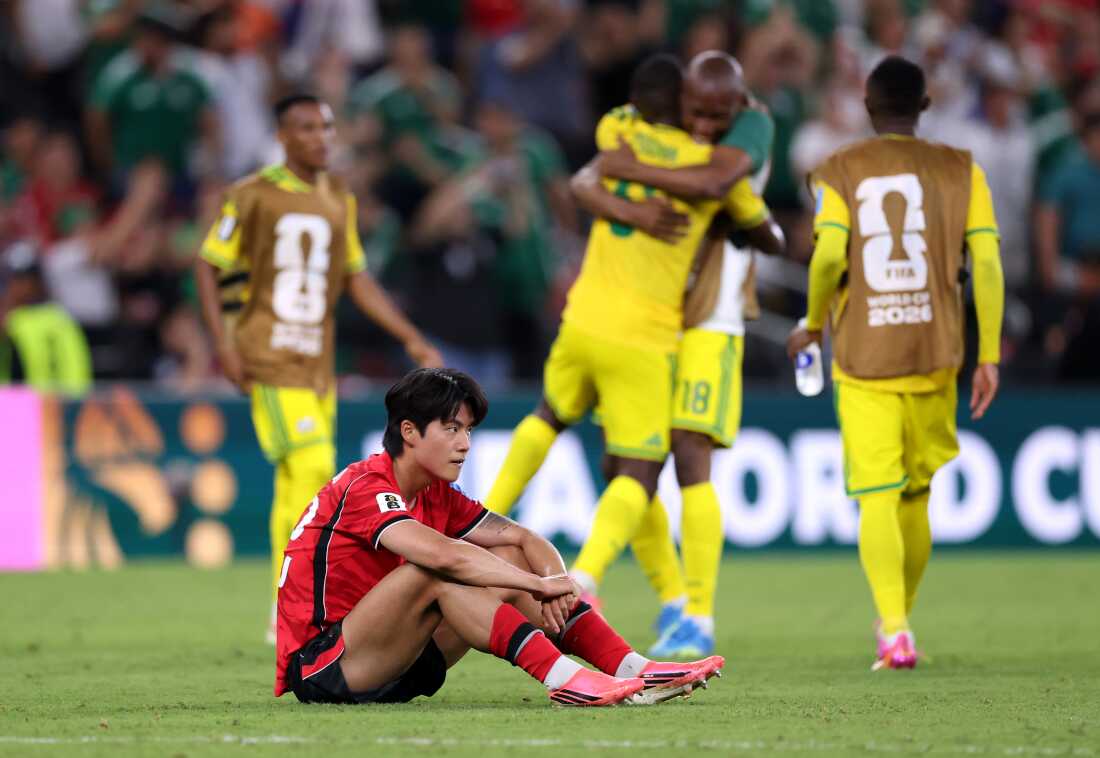
Seol Young-woo (#22) of South Korea reacts after his team’s 0-1 loss to South Africa at the 2026 World Cup on June 2 in Guadalupe, Mexico.
Luke Hales/Getty Images
hide caption
toggle caption
Luke Hales/Getty Images
For a brief moment, it felt like this would be a good summer for Asia.
The 2026 World Cup began with South Korea’s electrifying victory over the Czech Republic. Then, over the next four days, teams from the Asian Football Confederation (AFC) went undefeated, largely through draws.

Luck turned on the tournament’s sixth day. And when the losses rained down on Asia, they poured.
The World Cup’s expanded format made way for a record nine teams from the AFC. But after the group stage, seven were eliminated: South Korea, Iran, Iraq, Jordan, Qatar, Saudi Arabia and Uzbekistan. The last two, Australia and Japan, were sent home after the round of 32 — making the AFC the first significant confederation to see all of its teams eliminated at this World Cup (the Oceania Football Confederation, also eliminated in the group stage, was represented by one team, New Zealand.)

Teammates on Japan’s national team react at the end of the World Cup match between Brazil and Japan in Houston on June 29. Brazil won 2-1.
Ronaldo Schemidt/AFP via Getty Images
hide caption
toggle caption
Ronaldo Schemidt/AFP via Getty Images
It was not only a blow to the individual countries, but Asian football at large. Today, there are more Asian players in European club football, and more money and effort spent on the beautiful game in Asia. Yet when it was showtime on football’s biggest stage, AFC teams delivered only three wins out of 29. For the sixth World Cup in a row, no squad from the AFC could notch a victory in the knockout round.
“ What it showed is that Asian football can be competitive to a level, but there is still a gap that still needs to be bridged between Asia and the rest of the world,” says Paul Williams, who is based in Australia and is co-founder of the online news outlet The Asian Game.
So, what’s holding teams back? Or is it a matter of time until Asia has its moment in the World Cup like Europe, South America and most recently Africa?
Dissecting Asia’s World Cup performance
The biggest disappointment among AFC teams was South Korea, which was the second-highest ranked squad in its group. After their initial win, the Taeguk Warriors became increasingly disorganized and failed to deliver in their subsequent games against Mexico and South Africa.

A group of people hold a banner reading “South Korea football is dead” as they wait for the arrival of South Korea’s head coach Hong Myung-bo at Seoul-Incheon International Airport in Incheon on June 30. The best World Cup finish by an Asian nation was South Korea in 2002, when they placed fourth. Hong was part of South Korea’s squad at the time.
Jade Gao/AFP via Getty Images
hide caption
toggle caption
Jade Gao/AFP via Getty Images
“In truth, there were just so many reasons behind the Korean national team’s failure this time. The team couldn’t really come together as one, and their tactics and strategy were lacking,” says Han June, a sports journalist based in South Korea and founder of Football-Asian.com.
“The coach fell short, the players fell short, and the overall organization and management fell short,” he adds.
The quick exit has led to a reckoning within South Korea’s football world — fueled by intense anger over accusations of favoritism and cronyism involved in the appointment of coach Hong Myung-bo. South Korean President Lee Jae Myung has called for an investigation into what happened. Hong and the head of the Korea Football Association, Chung Mong-gyu, have since resigned.

Qatar and Saudi Arabia also fell short of expectations, especially considering both nations have invested heavily in football. World Cup debutants Jordan and Uzbekistan didn’t win any matches, but produced memorable moments like Jordan scoring against Argentina and Uzbekistan doing the same against Colombia.
For some teams, it was simply an unlucky draw. Iraq, who returned to the tournament after 40 years, competed against Senegal, France and Norway in arguably the toughest group. Japan, upon advancing to the round of 32, was set to face either heavyweights Morocco or Brazil, ultimately losing to the latter. After drawing with Egypt, Australia’s fate came down to a nail-biting penalty shootout.
Meanwhile, the U.S. war with Iran created significant challenges for the Iranian national team. At the start of the conflict in late February, Iran’s domestic football league was suspended, preventing many athletes from being able to play competitively for months, according to Japan-based Arya Nourizadeh, who is Iranian-Canadian and co-hosts the podcast Asian Football Show.

Iran’s Alireza Jahanbakhsh is challenged by Belgium’s Maxim De Cuyper during the 2026 World Cup match between Belgium and Iran on June 21 in Inglewood, Calif.
Dean Mouhtaropoulos/Getty Images
hide caption
toggle caption
Dean Mouhtaropoulos/Getty Images
When the World Cup began, U.S. travel restrictions related to the war forced the Iranian squad to travel back and forth from its training base in Mexico to the U.S. for its games. Many members of its support staff were denied visas and unable to accompany the team, Nourizadeh adds.
“ I would say the team that was probably the most underprepared and it breaks my heart to say this, I think is very obvious, it’s Iran,” he says.
All three of Iran’s matches ended in draws, showing their strength on the field. But in the end, it wasn’t enough to advance.
A shared love and shared struggle
Asia’s shortcomings in the World Cup aren’t the result of a lack of passion. Many countries, from Singapore to Indonesia, have a deep love and history with football, largely as a result of European colonialism spanning back a century.
That’s especially true among Gulf nations. Today, the region is football’s fastest growing market, according to Abdullah Al-Arian, an editor of Football in the Middle East: State, Society, and the Beautiful Game. He is also a history professor at Georgetown University in Qatar.
“ We’ve seen this emerge as the leading sport,” he says. “It was part of national identity formation, independence struggles. It was integrated in so much of the popular culture throughout the 20th century.”

A drone show is seen displaying the words “Welcome to Saudi 34” as Saudi Arabia is announced as the host nation for the 2034 World Cup on Dec. 11, 2024, in Riyadh, Saudi Arabia.
Christophe Viseux/Getty Images for Saudi Arabian Football Federation
hide caption
toggle caption
Christophe Viseux/Getty Images for Saudi Arabian Football Federation
But Ben Weinberg, a former sports researcher based in Germany who has written about the AFC, says despite football’s deep roots in Asia, the professionalization of the sport came relatively late in many of its countries.
“ Europe and South America accumulated generations of elite coaching, competition and football culture,” he says.
The AFC formed in 1954. Weinberg says the confederation has evolved immensely since then, shifting from simply managing competitions to actively trying to help develop football in the region. But it oversees 47 member associations — from China to Australia and Lebanon to Japan — and the sheer expanse is a unique challenge faced by the confederation.
“The economic, political, and footballing conditions thus vary enormously,” Weinberg says.

As a result, governing over and meeting the needs for each team can be complicated — it may be one factor behind the teams’ collective struggle to produce deep runs in the World Cup. For example, one question faced by the AFC is whether it wants to raise football standards across the board or prioritize a select few teams who have the most potential?
“ Those objectives do not always point in exactly the same direction,” Weinberg says. “Investing broadly across 47 member associations may actually reduce the resources available for high-performance programs focused on the continent’s leading nations.”
But ultimately, he adds, national associations develop the players and coaches. “Therefore, much of the sporting performance is determined at the domestic level,” he says.
A demand for more international experience
The journalists NPR spoke with say one thing is clear: To succeed on football’s biggest stage, Asian teams need experience outside of Asia. That’s important to cultivate both individual players and national teams.
Asian athletes have made inroads into European football leagues. But Williams from The Asian Game believes more players need experience in Europe and other top leagues in order to prepare for the World Cup.
“ You want to have international experience for your national teams, but your players improve by what they do at club level by playing against the best players every day, training against them,” he says.

Portugal’s Cristiano Ronaldo (left) fights for the ball with Uzbekistan’s Abdukodir Khusanov during the World Cup match between Portugal and Uzbekistan in Houston on June 23. Last year, Khusanov became the first Uzbek player to compete in the Premier League.
Paul Ellis/AFP via Getty Images
hide caption
toggle caption
Paul Ellis/AFP via Getty Images
Nourizadeh believes there could be more games between AFC member nations too. Currently, the confederation’s main tournament is the Asian Cup, which is held every four years with the top 24 teams. Compare that to a recently announced Nations League, where all 47 member nations would compete.
“ It would be good for the teams that are a bit lesser in quality,” Nourizadeh says. “I think they would love to play the bigger Asian teams a bit more often.”
Will we ever see an Asian team win the World Cup?
The AFC is stronger than ever, with teams showing more and more potential, Asian football experts say. The challenge, however, is that the same is happening around the world.
“The levels and the quality is just gonna keep getting higher,” Nourizadeh says. “ So teams have to adapt.”
As of now, the nation with the most promise is Japan, which vowed to win the World Cup by 2050. Although the team has yet to win a game in the knockout round, it has defeated giants like Germany and Spain in the group stage.

Kaishu Sano (#24) of Japan celebrates with teammates after scoring the team’s first goal during Japan’s match against Brazil on June 29 in Houston.
Lars Baron/Getty Images
hide caption
toggle caption
Lars Baron/Getty Images
In 1992, Japan laid out a 100-year-vision to strengthen football in the country. It grew the number of professional clubs and invested in youth programs and cultivating elite coaches. Williams sees it as a roadmap for other nations.
“ When you’re talking about football development, there’s no magic bullet,” he says. “It just requires investment in grassroots, it requires investment in coaching, and it requires patience.”
It may take time before a nation outside Europe and South America wins the World Cup, but Williams says it will be worth the wait.
“ The group stage is the best part of the World Cup because it’s where the entire world is,” he says. “ Whether it’s an African team winning a World Cup, whether it’s an Asian team winning a World Cup, something that’s outside the norm, I hope we see that.”

- Admin
- Trump wants to fence off the park closest to the White House, a popular protest spot July 16, 2026
- Insane Clown Posse's Violent J passionately declares 'there's nothing like pro wrestling in America' July 16, 2026
- Lionel Messi’s heroic run about to face World Cup’s toughest test in final July 16, 2026
- Can a Pro-Israel Democrat Still Win a Big Primary? She’s Going to Try. July 16, 2026
- Julia Garner and husband Mark Foster separate after six years of marriage July 16, 2026