Resource rich nation praises US ties amid Washington-Beijing critical minerals race

NEWYou can now listen to Fox News articles!
UNITED NATIONS — The Democratic Republic of Congo does not view growing American involvement in its critical-minerals industry as a contest with China, the country’s foreign minister told Fox News Digital, arguing that Kinshasa needs multiple partners to transform its vast natural wealth into prosperity for its people.
“I don’t like talking about competition. I like talking about complementarity,” Foreign Minister Thérèse Kayikwamba Wagner said in an exclusive interview at the United Nations.
CHINA’S GRIP ON RARE-EARTH MAGNETS COULD CRUSH US DRONE INDUSTRY BEFORE IT GROWS
U.S. President Donald Trump, Secretary of State Marco Rubio and Vice President JD Vance meet Democratic Republic of the Congo’s Foreign Minister Therese Kayikwamba Wagner and Rwanda’s Foreign Minister Olivier Nduhungirehe (not pictured) in the Oval Office at the White House in Washington D.C., June 27, 2025. (Ken Cedeno/Reuters)
“A country as big as the USA, but also a country as big as the DRC and as big as China, they do not develop just with one single partner,” she added. “They develop with different partnerships that respond to different needs and that bring different expertise to the table.”
The comments come as the Trump administration seeks to increase American access to Congo’s copper, cobalt, lithium, gold and other strategic resources, while reducing U.S. reliance on mineral supply chains dominated by China.
A strategic partnership signed by Washington and Kinshasa on Dec. 4, 2025, calls for increased economic cooperation, investment and the development of secure and transparent critical-mineral supply chains. The agreement accompanied a broader regional framework linking economic integration to efforts to end decades of conflict between Congo and Rwanda.
TRUMP ADMIN BACKS BOLIVIA STATE OF EMERGENCY AS LEFTIST EX-LEADER’S LOYALISTS FRACTURE NATION
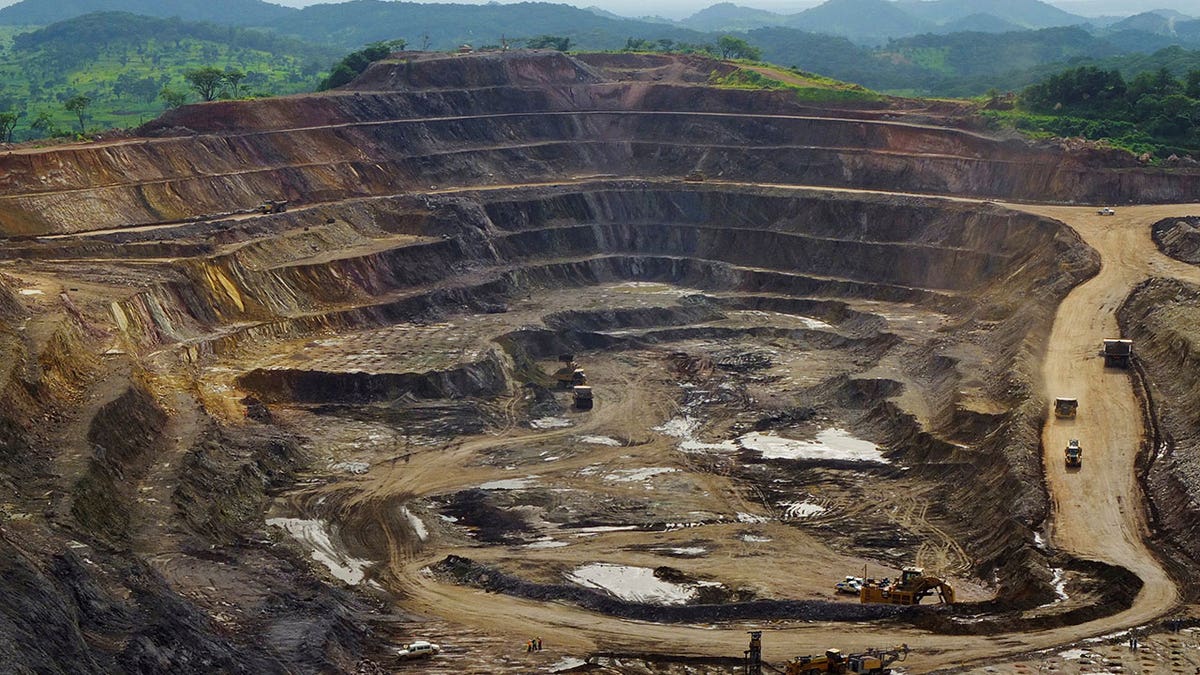
Excavators and drillers at work in an open pit at Tenke Fungurume, a copper and cobalt mine 110 km (68 miles) northwest of Lubumbashi in Congo’s copper-producing south, January 29, 2013. (REUTERS/Jonny Hogg/File Photo)
A separate arrangement involving DR Congo’s state mining company Gécamines and commodities trader Mercuria could give U.S. buyers priority access to some copper and cobalt supplies, Reuters reported on Dec. 5, 2025. The U.S. International Development Finance Corporation also expressed interest in taking a strategic stake in the partnership.
Kayikwamba Wagner said relations between the U.S. and DR Congo were taking “a more concrete shape” based on mutual economic interests.
She said Kinshasa welcomed “more U.S. interests in the DRC” that could help the country turn its mineral wealth into “tangible transformations for the lives of Congolese,” while also delivering benefits to American partners.
Speaking separately at a high-level U.N. meeting on critical minerals Tuesday, Kayikwamba Wagner warned that the global shift toward clean energy must not reproduce an economic model in which raw materials leave Africa while processing, technology and most of the profits remain elsewhere.
“The global energy transition must not become another extractive transition,” she said. “If it merely replaces one form of dependency with another, it will have fallen short of its promise.”
She called for foreign partnerships to support local processing, infrastructure, technology transfers, research, industrialization and access to financing — not simply secure supplies of raw materials.
CHILL COMING FROM TRUMP’S SUMMIT WITH XI IS PROOF OF A NEW COLD WAR WITH CHINA
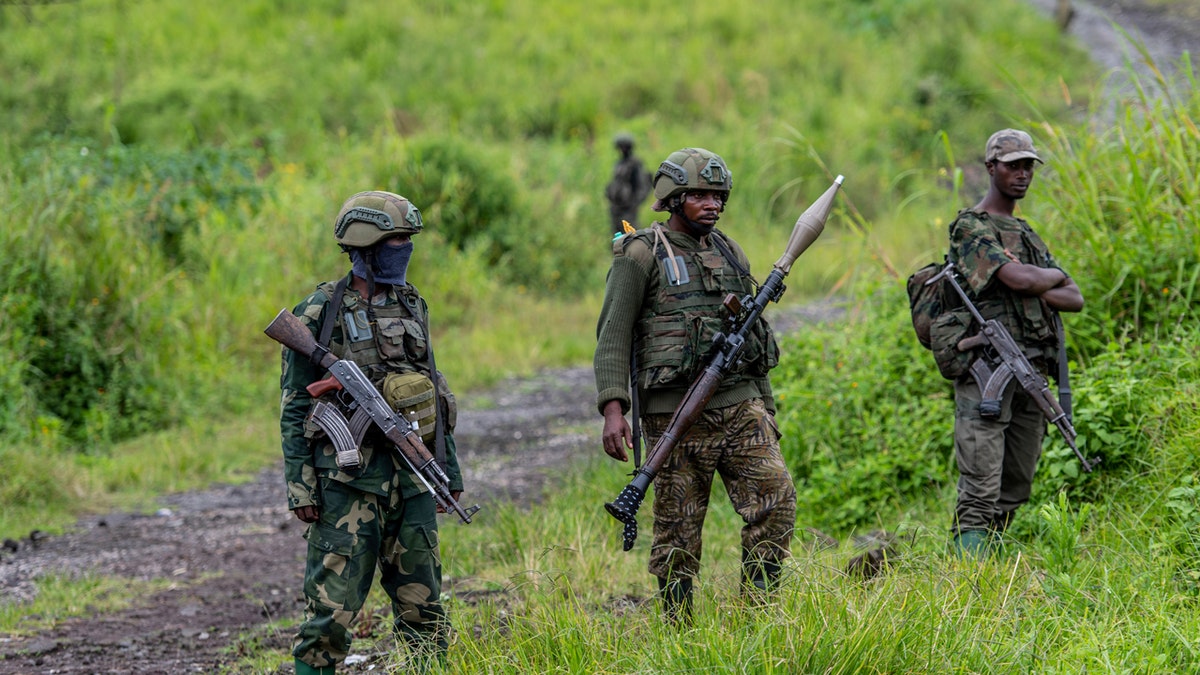
M23 rebels stand with their weapons in Kibumba, in the eastern of Democratic Republic of Congo, Dec. 23, 2022. M23, a rebel group with alleged links to Rwanda, has seized Rubaya, a mining town in eastern Congo known for producing a key mineral used in smartphones, the group said Thursday, May 2, 2024, in a statement. (AP Photo/Moses Sawasawa)
The minerals push is closely connected to the U.S.-mediated peace process between the DRC and Rwanda. The countries initially signed a peace agreement in Washington on June 27, 2025, before Presidents Félix Tshisekedi and Paul Kagame reaffirmed the deal and signed related economic agreements on Dec. 4. The framework was intended both to reduce fighting and attract Western investment to a region rich in cobalt, copper, tantalum and other minerals.
Kayikwamba Wagner acknowledged that the agreement had not ended the violence, but said Washington’s willingness to impose consequences for violations showed that the process remained meaningful.
“This is a 30-year conflict we’re dealing with,” she said. “It’s not going to happen overnight.”
She praised the administration for sanctioning the Rwanda Defense Force and senior Rwandan officials over what the Treasury Department described as their support for the M23 rebel group. Treasury said in March that the RDF had supported, trained and fought alongside M23 as it seized territory and strategic mining locations in eastern Congo. Rwanda has repeatedly denied supporting M23.
“I find it encouraging to see that we have with us a partner that is not willing to give up at the first obstacle,” Kayikwamba Wagner said.
She was in New York as the DRC, which holds the Security Council presidency for July, elevated the connection between natural resources, armed conflict and sexual violence.
Kayikwamba Wagner said rape and other forms of conflict-related sexual violence had risen sharply in areas held by M23 and Rwandan forces, affecting women and girls as well as men and boys.
Victims in occupied areas, she said, often lack access to courts, healthcare or other avenues for redress.
“This is also one of the reasons why we continue to be mobilized against this illegal occupation of eastern DRC,” she said, arguing that restoring state authority was essential to providing survivors with justice and medical care.
CLICK HERE TO DOWNLOAD THE FOX NEWS APP
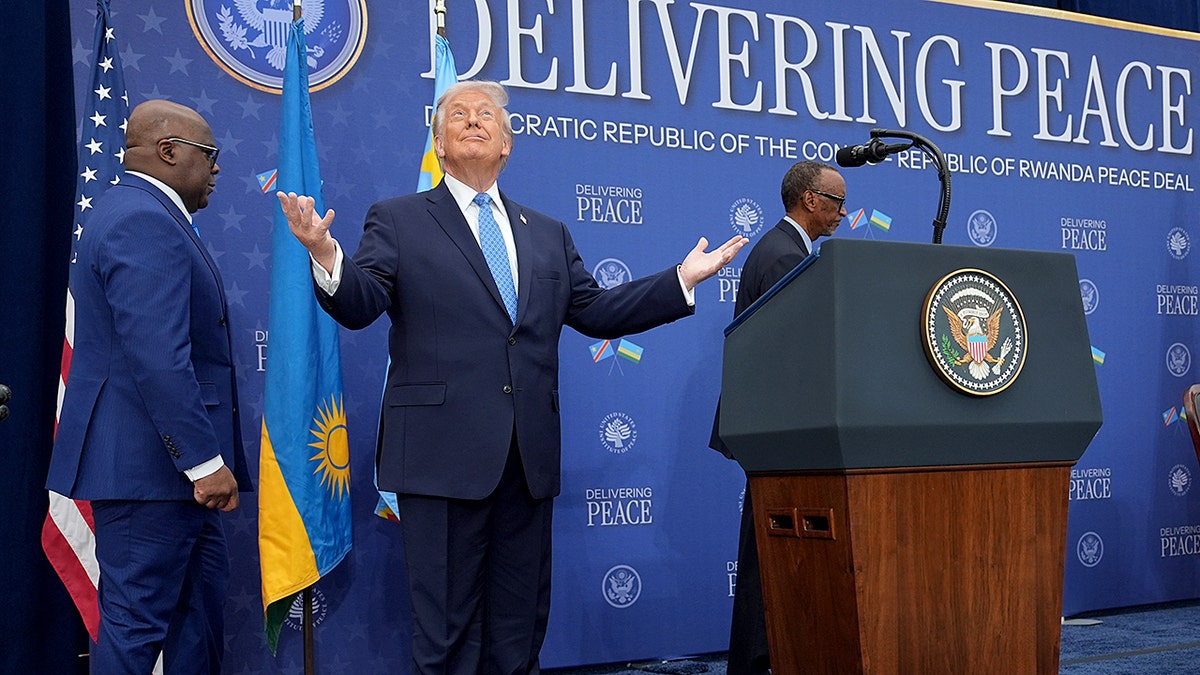
President Donald Trump arrives for a signing ceremony with Rwanda’s President Paul Kagame and Democratic Republic of Congo President Felix-Antoine Tshisekedi at the Donald J. Trump Institute of Peace, Thursday, Dec. 4, 2025, in Washington. (AP Photo/Evan Vucci)
In her U.N. remarks, she cited the Rubaya mining area, which is under M23 control and supplies a significant share of global tantalum demand. She said U.N. experts estimated that at least 1,400 tons of coltan were smuggled into Rwanda during the first year after the mines were seized, generating approximately $800,000 per month for the armed group.
The Treasury department imposed additional sanctions on June 25 against a network it accused of working with M23 to smuggle minerals from eastern Congo into Rwanda, saying the action was intended to support the Washington peace framework and improve transparency in regional mineral supply chains.

- Admin
- Heroes, zeros from sloppy Yankees Game 2 loss to Rays: Brooklyn’s Richie Palacios opened it up for Tampa Bay October 6, 2026
- Yankees Collapse to Rays Defensively Down 2-0 in ALDS | Recap & Reactions October 6, 2026
- Raider Nation bashes Taylor Swifts look by trolling Travis Kelce October 6, 2026
- Mamdani charges ahead with another careless promise: Unfunded NYC 2-K October 6, 2026
- Jim Bakker, Television Preacher Felled by Sex and Financial Scandals, Dies at 86 October 6, 2026