An Israeli paraglider tries to save migrating swifts that nest in the Western Wall
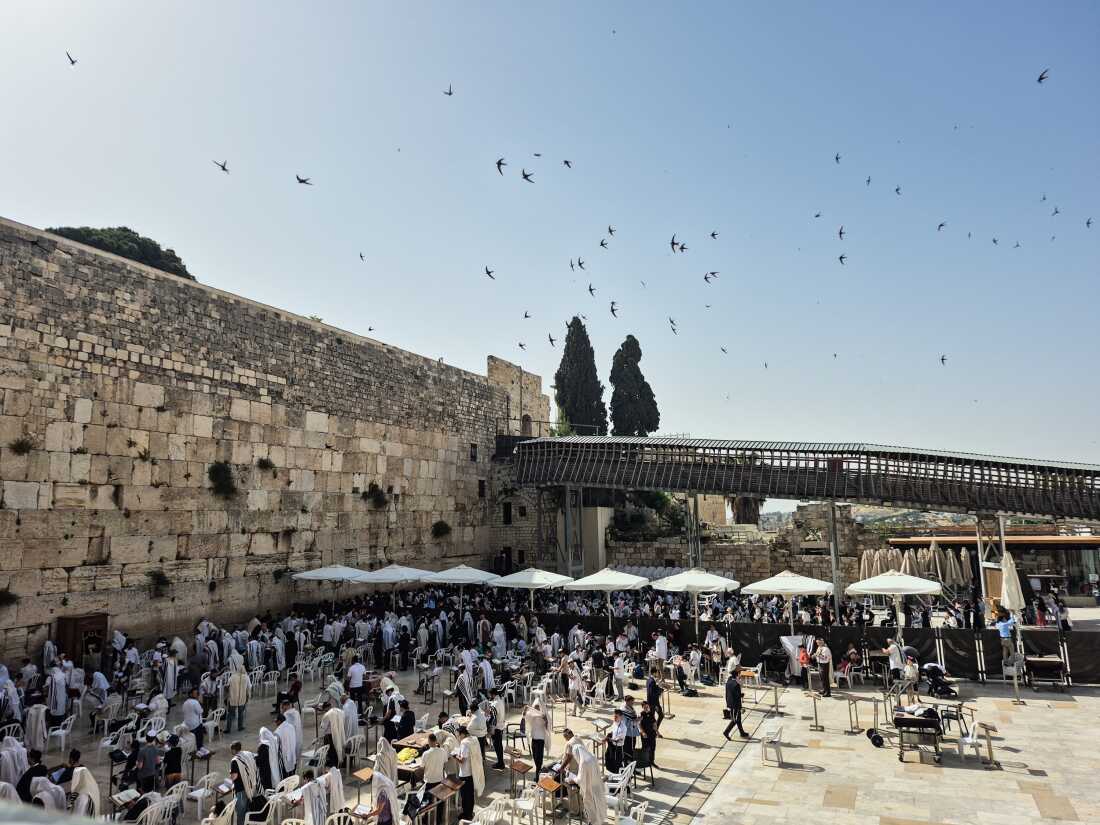
Swifts have been nesting in the Western Wall for centuries. Experts count at least 88 nests in the nooks and crannies of this holy site. The birds swoop and dive above the worshipers, catching insects to feed their young or encouraging their nestlings to take flight.
Ruth Sherlock/NPR
hide caption
toggle caption
Ruth Sherlock/NPR
JERUSALEM — Every spring at the Western Wall in Jerusalem, a rabbi presides over a ceremony to welcome the arrival of the common swift in its great migration about 2,800 miles from Africa. Between February and June, men’s and women’s prayers at the wall mix with the calls of the birds that swoop and dart above this ancient religious site.
These scythe-winged birds, researchers believe, have raised their young in the nooks and crannies of these stones since Herodian times, two millennia ago. Researchers have counted 88 nests in recent years. Modern translations of the Bible quote Jeremiah contrasting the regular visits of the swifts with the failure of many of the faithful to make the pilgrimage to Jerusalem: “Even the stork in the heavens knows her appointed times / And the turtledove, the swift, and the swallow / Observe the time of their coming / But My people do not know the judgment of the Lord.”
“The connection between birds and the Torah is very deep,” says Sarah Wurtzel, an Israeli resident born in New York, who has come with her family to pray at the wall. She says seeing the swifts here makes her feel closer to God. “Every moment he is allowing these creatures to stay in the air and live, how much more so is he hovering over us every moment? And it’s that protection that I feel when I see them and hear them.”
A symbol of peace
In the modern-day contested Jerusalem, swifts have been invoked by artists as a uniting symbol of peace. The birds, unconstrained by politics and religion, are a ubiquitous site in the Old City that hosts holy sites for the world’s three largest monotheistic religions. As well as the Western Wall, they have been known to nest at the Al-Aqsa Mosque, and Church of the Holy Sepulchre.

British artist Mark Coreth worked with Jewish, Christian and Muslim communities to craft a sculpture inspiring unity — his work, an olive tree with a canopy of swifts as leaves, is displayed in the courtyard of St. John Eye Hospital in Jerusalem’s Old City. He also fixed bronze sculptures of swifts to hospital walls in Gaza and the West Bank.
“Where the white dove failed to bring peace, we hope the swift will,” says Amnonn Hahn, the chair of the Friends of the Swifts Association in Israel, who says Coreth consulted him for the project.

Amnonn Hahn, the head of the Friends of the Swifts association in Israel, dedicates himself to working with the council in Tel Aviv and in other parts of Israel to create nesting sites for swifts.
Ruth Sherlock/NPR
hide caption
toggle caption
Ruth Sherlock/NPR
A population in collapse
The swifts that come to Israel for the spring nesting season follow a route from East Africa, through the Jordan Valley into Israel, a route rich in insect life.
Across their European range, swifts are in steep decline — in Britain, numbers have fallen by some 70% since the mid-1990s. Scientists attribute this to collapsing populations of the insects they feed on, more erratic weather linked to climate change and, crucially, the loss of suitable nesting sites. Hahn sees this decline in Israel too.

“Swifts adapted to live with humans, around window shutters and under roof tiles,” Hahn explains. Now modern building techniques — the glass facade skyscrapers and neat constructions in cities — leave “no space for swifts.”
Swifts foster nestlings that need help
The adult swifts are forced to nest in ever less adequate places, like small holes between broken bricks, Hahn says. Then, when the nestlings hatch, “within two or three weeks, there isn’t enough room for all of them, and at least one falls out.”
Hahn, 72, has seen this firsthand and now spends much of the nesting season rushing to sites where he’s been alerted to fallen nestlings to save them. By 2018, the situation was critical, with people bringing dozens of nestlings to the Israeli Wildlife Hospital. The hospital called Hahn, asking for help finding a solution for the birds that had fallen out of their nests.

Hahn began placing the rescued nestlings into the care of swifts raising their young in the more spacious boxes Hahn had set up around his home. The swifts readily fostered the fledglings. “To my amazement, they fed the newcomer before their own,” Hahn says. “The parents noticed the new one is hungrier than the others.”
A commitment to help swifts live
Hahn fell in love with swifts during a national paragliding championship in 1999 when he followed these birds to locate the thermal he needed for uplift. Maneuvering toward them, he was suddenly pulled up and flew with the swifts for about 25 minutes, up to over 6,500 feet.
“I was circling with them in the thermal. It was like magic,” he says.

In those moments, Hahn turned off his variometer, which beeps to signal the rate of ascent or descent, leaving him in a silent communion with the birds around him, shaped like arrows with a wingspan of some 16 inches. “You see the big eyes they have, and white throat, and the way they communicate and maneuver. If you fly with the sun at your back, you see them completely black,” he says. “And if you circle with them in the sun, they are golden. I was enchanted. And of course I won the competition.”
The experience changed Hahn. When he retired from his work importing motorcycles into Israel he dedicated himself to saving the swift. In 2005 his daughter’s school was renovated, and Hahn remembers hearing the distressed sounding calls of the swifts as they returned from Africa to find they had nowhere to nest. Hahn adapted the school building, sourcing ammunition boxes from the Israeli army and installing the nesting boxes he made from them into the school’s outer walls. “Eighteen I put around the school, and the rest around the houses, even in my house,” he says.

The distinctive screaming calls of the swifts mix with the songs and prayers of those who come to this Jewish site of worship.
Ruth Sherlock/NPR
hide caption
toggle caption
Ruth Sherlock/NPR
In his work with the Friends of the Swift Association, he’s gone on to work with city councils and schools across Israel, seeing nesting boxes installed in buildings across Israel. At a kindergarten in Tel Aviv he helped install 222 nesting and installed cameras in some of the nests.
A life on the wing
On a warm May evening at the kindergarten at sunset, the swifts flew at top speed around and around the rooftop play area — small black arrows against a golden sky. Researchers call this behavior a “screaming party” for the loud high-pitched calls they make when together like this. They do this for many reasons but on this evening, Hahn says, they were likely showing the nestlings their skills, trying to convince them to leave their nests. “They like showing off,” Hahn jokes.
Once the fledglings take flight they may not land again for the first two or three years. They eat and sleep and even wash themselves on the wing — slowing their flight to catch water droplets of rainstorms. They mate in the sky and even make their nests from delicate wisps of material — other birds’ feathers, straw caught by the wind — that float in the air.
They mate for life, but Hahn says, they migrate separately — traveling thousands of miles possibly to different African countries and only reuniting at their nesting grounds. If they both survive the journey, the couple will meet year after year, at the same nesting site. They land only to raise their young.
The Iranian missile strikes on Tel Aviv during the war with Israel sent many nesting pairs fleeing from the kindergarten site, Hahn says. But more than 30 pairs remain. From the kindergarten roof, Hahn looks out over the neighborhood of Tel Aviv he is in. “All these places around here are going to be demolished and these skyscrapers will be built, and there will be no more room for the swifts to nest in,” he says.
The nesting boxes Hahn helped install mean that when the swifts return from Africa, they will still have spaces in which to raise their future generations.

- Admin
- Bari Weiss’ fate up in the air as Paramount prepares to close Warner Bros merger: sources October 3, 2026
- This Yankees season has redefined a core narrative thanks to a transformation in real time October 3, 2026
- Extreme Heat in Los Angeles Area Expected to Last at Least a Week October 3, 2026
- With Tony Romo out at CBS, Troy Aikman and Greg Olsen suddenly become logical replacements October 3, 2026
- Damning 700-page Palisades, Eaton fire report exposes staggering delay in warning residents as homes burned October 3, 2026