U.S. signs nuclear deal with Saudi Arabia. And, Nolan Wells' independent autopsy results
Good morning. You’re reading the Up First newsletter. Subscribe here to get it delivered to your inbox, and listen to the Up First podcast for all the news you need to start your day.
Today’s top stories
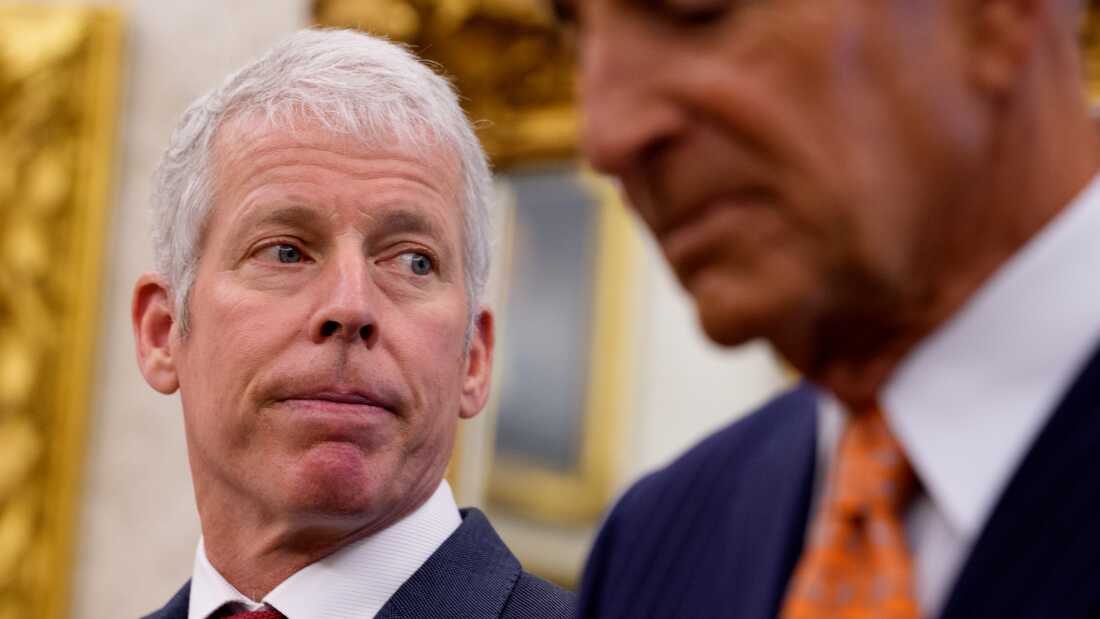
The Trump administration has signed a nuclear cooperation agreement with Saudi Arabia that would allow American companies to operate commercial nuclear power plants in the country. American companies will have priority access to supply nuclear reactors and fuel to the Saudi nuclear energy program, according to an administration memo about the agreement seen by NPR. Saudi Arabia cannot reprocess American nuclear material for weapons per the agreement. But the memo lacks the “gold standard” provisions that would prevent the country from using American-built plants to enrich uranium or other nuclear fuel supplied by other countries. The country is also not required to adopt terms that would lead to greater oversight from the International Atomic Energy Agency.
Energy Secretary Chris Wright at an Oval Office meeting earlier this month.
Andrew Harnik/Getty Images
hide caption
toggle caption
Andrew Harnik/Getty Images
- 🎧 NPR’s Emily Feng tells Up First that the announcement sent shockwaves through the Middle East because Saudi Arabia has sought nuclear cooperation with the U.S. for more than a decade. Concerns over the country’s human rights abuses and potential ambitions for nuclear weapons previously stalled this collaboration. The agreement strengthens ties between the U.S. and Saudi Arabia at a time when Gulf states have faced heavy repercussions for aligning with the U.S. during the war in Iran. Israeli former defense and foreign minister Avigdor Lieberman has criticized this agreement, saying it could lead to a nuclear arms race in the region. Feng says Israel is widely believed to have nuclear weapons, but has never confirmed it. She adds that the agreement also raises worries in Israel about a growing rift with the U.S.
House Republicans passed several significant pieces of legislation yesterday ahead of a more than month-long recess. Lawmakers approved $1.1 trillion for the National Defense Authorization Act (NDAA), with six Democrats joining Republicans in supporting the effort. Republicans also separately advanced a $95 billion budget blueprint that would set them up for a reconciliation bill. The framework allocates more than $70 billion for the war in Iran, $12 billion for farmers and funds to implement the SAVE America Act, President Trump’s election overhaul bill. The House also advanced a bill that could ban lawmakers from acquiring new individual stocks while in office, and voted to extend government funding past the midterms to Dec. 4. These bills are now headed to the Senate, which will be in session for one more week.
- 🎧 In order for the bill to pass in the Senate, it will l need to be rewritten to secure the 60 votes, which means getting Democratic support, NPR’s Eric McDaniel says. Democrats oppose the $1.1 trillion Pentagon budget. For the government funding extension bill, they want concessions on Trump’s immigration enforcement. Senate Leader John Thune is considering a backup plan for government funding if he cannot reach a deal with Senate Democrats to keep the government open past the midterm elections, McDaniel says.
Starting today, the Food and Drug Administration is holding a two-day meeting to decide whether compounding pharmacies should be allowed to produce popular injectable peptides. The panel will evaluate seven compounds, including the highly sought-after TB-500, BPC-157 and MOTs-C. These compounds have not undergone large-scale trials to assess safety and effectiveness, which the FDA requires for drug approval. Despite limited data, many in the wellness industry tout peptides for claims related to recovery, muscle growth, fat loss and more. Despite limited data, some major direct-to-consumer telehealth companies, med spas and high-end longevity medical practices market peptides for their potential to assist with recovery, muscle growth, fat loss and more. Others argue that the current Biden-era restrictions are pushing consumers toward unregulated overseas suppliers, increasing safety risks.
An independent autopsy of 18-year-old Nolan Wells failed to reveal a clear cause of death, prominent civil rights attorney Benjamin Crump announced yesterday. “These findings are inconclusive … pending further investigation,” Crump said during a press conference. He added that the body wasn’t in a suitable condition for a complete forensic examination. Wells was found dead two days after the Fourth of July on an island off the Mississippi coast after attending a party with friends. The press conference aimed to urge law enforcement to accelerate their efforts, as the public’s concerns linger about the possibility of foul play and the role of race in Wells’ death.
Deep dive

International students studying in the U.S. will soon encounter new challenges with visa restrictions. The Department of Homeland Security is implementing strict time limits on student visas and limiting how international students transfer schools or change their study plans. Here’s what is behind the changes and the concerns they provoke:
- ➡️ The administration is eliminating what’s known as “duration of status.” Secretary of Homeland Security Markwayne Mullin said the change would strengthen national security and reduce the number of “forever students” who intentionally take a long time to complete their degrees.
- ➡️ Clear numbers on students who intentionally enroll to stay in the country are unclear. The DHS reports “Suspected In-Country Overstay” data, and in 2024, the rate was 2.45% for the more than 1.4 million student visa holders.
- ➡️ The rules cut the post-graduation grace period for recent graduates to find work and update their visas to stay in the U.S. from 60 days to 30 days.
- ➡️ Critics say the new restrictions on switching programs and changing majors undermine one of U.S. higher education’s main attractions: the ability for students to discover new interests and add double majors or minors.
Picture show

In Harrisburg, Pennsylvania, a large community of Nepali-speaking Bhutanese refugees has turned soccer into a sense of belonging. Their love for the sport stretches back to refugee camps in Nepal, where soccer first served as a vital lifeline to help families process trauma and displacement. These days, the soccer fields feel like a safe space as the community faces an unprecedented wave of deportations under the Trump administration. Through tournaments and local youth programs, elders pass the game down to keep their shared history alive across generations. Take a look at how soccer is uniting these community members.
3 things to know before you go

University of Cambridge professor Elizabeth Murchison and Peter Emerson of the Vermont Fish & Wildlife Department scoop up catfish for testing in Newport, VT. Emerson was one of the researchers to publish a new paper in the journal Nature describing the first known transmissible cancer in fish.
Joshua Brown/University of Vermont
hide caption
toggle caption
Joshua Brown/University of Vermont
- Researchers have discovered a transmissible skin cancer spreading through catfish in a Vermont lake. They believe these fish could offer insights into how tumors spread in humans.
- In this week’s installment of Far-Flung Postcards, NPR’s Ruth Sherlock sends greetings from Jerusalem, where scythe-winged birds have made nests in the cracks of the Western Wall and other sacred sites.
- Irondale, Alabama’s Mayor James D. Stewart sparked a major backlash after he announced that the town’s “I Love Irondale Day” festival would be renamed “AI Love Irondale Day.” He has since assured the public that the festival is not about AI and would return to its original name.
This newsletter was edited by Suzanne Nuyen.

- Admin
- UFC 332 predictions: Full card picks, best bets for Salt Lake City October 3, 2026
- Star snaps of the week: Christina Aguilera, Cardi B, Dakota Johnson, Anne Hathaway, Olandria Carthen and more October 3, 2026
- Virginia Tech's controversial missed field goal sparks fiery debate as different angles tell a different story October 3, 2026
- Now that her love story is complete, are we over Taylor Swift? October 3, 2026
- Everything You Need to Know About Godzilla, Ghidorah, and Their New Movie ‘Godzilla Minus Zero’ October 3, 2026