They call it 'a dream fulfilled' — new homes designed for (and by) slum residents
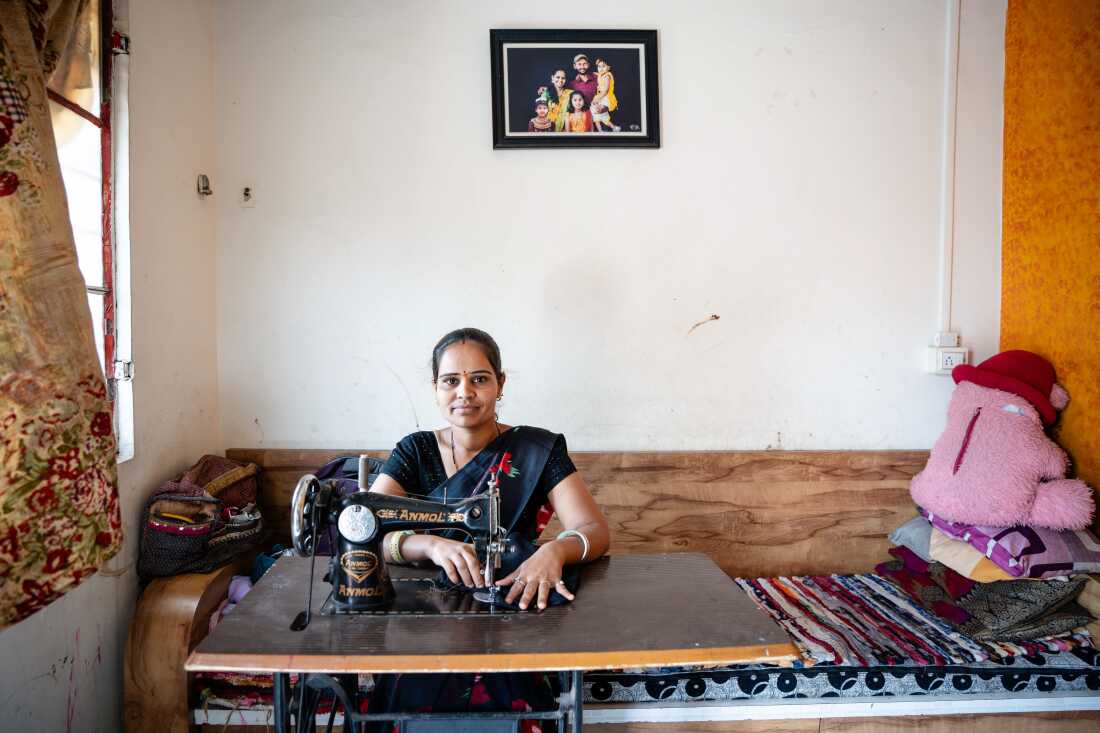
Pooja Gawali and her family left the tin shack in which they’d live and moved into a new apartment building. She helped design their unit, which, she says, gives her much needed privacy and the space to take on a hobby. Her sewing machine occupies pride of place in her living room. The construction project has won an award for its innovative spirit.
Viraj Nayar for NPR
hide caption
toggle caption
Viraj Nayar for NPR
Pooja Gawali used to live in a one-room home with no indoor plumbing. The walls were tin sheets. The roof leaked when it rained. The 32-year-old shared the cramped space with her husband, her in-laws and her husband’s two brothers.
She never knew what it meant to truly relax, she says. The lack of privacy in her home meant that she always had to always be on alert — conscious of how she sat or behaved.
That’s not uncommon in Sanjaynagar, a crowded slum in the western Indian state of Maharashtra where she lives. On mud lanes slick with goat droppings, homes press against each other. Around 900 people are squeezed into 206 metal shacks.
Today, things are very different for Gawali. In 2022, she moved into an apartment on the second floor of a newly constructed three-story building with 33 units that houses not just her own family but 30 other families from her slum neighborhood. One brother-in-law lives in the apartment below hers; the other in one above. When their home was being built, the family had a request — they wanted their apartments to be connected through an inner flight of stairs. They got that wish –- and more.
“I relish the privacy I have now,” she says. “It’s a joy to be able to live freely. We’re still a tight-knit family, but life is so much easier when everyone has their own space.”
Residents have named the three-story building Swapnapurti — Marathi for “a dream fulfilled.” It’s easy to see why. Each unit has its own living room, a single bedroom, a kitchen, bathroom with running water and balcony. Green plants and benches line the central courtyard. Bamboo screens along the walls provide natural shade and ventilation.

Children relax outside the newly constructed apartment building.
Viraj Nayar for NPR
hide caption
toggle caption
Viraj Nayar for NPR
And it’s noticeably cooler. The architects used building materials like bricks made of crushed sand and ash residue that have been found to be effective insulators, deflecting heat.
A revolutionary design initiative called the Sanjaynagar Redevelopment Project is transforming the slum where Gawali lived in stages. It’s a partnership between the local government, charitable donors, nonprofits and family members. Each participating family pays 10% of the costs of construction — roughly $1,000 for a 300-square-foot apartment —which they fund by taking out low-interest housing loans provided by the social lending platform Rang De. Rang De offers peer-to-peer lending, a financial method that connects individual borrowers directly with individual lenders, bypassing traditional banks. The federal government’s low-cost housing scheme, called the PMAY, contributes $2,500 and philanthropic donors such as the U.S.-based Currystone Foundation contributed the rest.
Even in these early stages, the project is generating praise, winning the Silver at this year’s World Habitat Awards for innovative and sustainable housing projects.
Francesca Lionetti, an expert on housing rights at UN-Habitat, which co-runs the awards, says: “The fact it is community-led means there is a lot of attention on communal areas and social services. It’s showing a path for other communities in India and in other parts of the world.”
Sandhya Janardhan, an architect with the Community Design Agency, the nonprofit that helped redesign the houses, says the project focuses on the design details alongside the deep bonds the community shares.

Sandhya Janardhan, an architect at Community Design Agency, has been instrumental in this project. Here, she is photographed in a balvadi in the heart of the slum — one of seven community recreational centers set up by the state government. It’s a place for children to gather after school, for play and for creating art.
Viraj Nayar for NPR
hide caption
toggle caption
Viraj Nayar for NPR
“All the apartments are built around a central courtyard,” says Janardhan. “This is a shared space for children to play, with benches where residents can sit and rest, and where community events can be held. The apartments are flanked by wide corridors that bring light and fresh air into the building.”
A sanctuary in the slums
No one was certain this project would succeed. That’s because the organizers had to persuade families to leave the only homes they knew and move into temporary accommodations based on a promise that they would one day return to something better. Their wait spanned three years while their old houses were torn down and rebuilt.
That leap of faith was possible largely because of Snehalaya, a local nonprofit. Snehalaya had been working in the community for years before redevelopment began. Since 2004, the group has run a learning center for children, raised awareness about drug and alcohol abuse and brought doctors and mobile clinics into this neighborhood with very few basic services.

A bird’s eye view of the Sanjaynagar slum in the city of Ahmednagar. The terrace of the new apartment building is visible. Roughly 900 people live in 206 metal shacks or dwelling units.
Viraj Nayar for NPR
hide caption
toggle caption
Viraj Nayar for NPR
Over time, this sustained presence built deep trust with residents. When redevelopment was proposed, Snehalaya became an important voice, helping families understand the plans, express concerns and prepare for temporary relocation.
Hanif Shaik, a director of education projects at Snehalaya, says the idea began on a motorbike ride through the community in 2016. He wanted to show Janardhan, the architect, around a balvadi in the heart of the slum. It’s one of seven community recreational centers set up by the state government and run by Snehalaya — a place for children to gather after school to play and to create art.
“Slums are easy ground for the spread of addiction, violence and child labor,” says Shaik. “We noted that a lot of these troubles came from the living conditions — dark, dingy homes and no personal space.” It was easy for arguments to break out in these tight spaces; the threat of violence was always imminent. A balvadi provided a safe space but was not really a solution.
Shaik and Janardhan had an inspiration — if they could work together to redesign the slum, it could do a world of good.
They solicited donors. They got the consent of residents. And in 2017, the real work began. “We submitted a proposal [to the local government] to redevelop the slum in the city of Ahmednagar together,” Janardhan says.
A gazillion meetings
The local government provided land, temporary water supply, electricity and sanitation for makeshift camps.
“We gave the residents materials [like corrugated tin sheets, metal scraps and plaster] to create new shacks while their homes were being rebuilt,” says Janardhan.
Snehalaya reached out to a younger generation of slum residents to explain the nitty-gritty details to the others and to help with paperwork. “They played a vital role,” says Shaik.

Anjali Naydu (right) sits with her mother outside her home in the Sanjaynagar slums. Her family is waiting for construction to begin on a new apartment building in which they’ll live. As a community representative, Naydu had meeting after meeting with the members of the community to get them to support the redesign project.
Viraj Nayar for NPR
hide caption
toggle caption
Viraj Nayar for NPR
Anjali Naydu, who’s 30, is one such representative. She’s been working with Snehalaya for the last 6 years. Her family, including her parents and five aunts, will soon begin the process of moving out. The single room home where she grew up in the middle of the slum is small, but cheery — one exterior wall is painted bright pink. Potted plants line a shelf above the entrance. Sometimes, her mother and father move their bed outdoors so they can have more room.
“At first, it was hard,” she says of the relocation process. “We had to have meeting after meeting. When we first started work, many people just couldn’t believe that someone would go to all this trouble to make their homes and their lives better.”
Trained as a bedside nurse, Suryavanshi, 26, who is on a break from work to raise her child, serves as a community representative for the project as well.

Pooja Suryavanshi and her child, Rudransh, outside their home in Sanjaynagar.
Viraj Nayar for NPR
hide caption
toggle caption
Viraj Nayar for NPR
“People have lived here for years, so of course, even if our homes aren’t perfect, there’s an emotional attachment,” she says. “But they’re also happy to move into proper homes. We told them: you have choices. You can choose your building, decide where exactly you want to live within it and even choose your neighbors and be involved in designing your home.”
For many residents living in cramped rooms with adult sons, daughters-in-law and grandchildren, the prospect of additional privacy was attractive. “For example, if there are parents and three grown sons in one slum home, each son can get a separate unit without paying extra costs,” says Naydu. “Slowly, people began to believe in the project. Many volunteered to give it a try.”
After several meetings, a slum committee and eight housing cooperative societies [a collective body of residents who will own, manage, and govern the new housing] were instituted to ensure that the interests of different groups were represented across the project.
“We often forget that slums possess high levels of social capital,” says Janardhan. “These are networks built over the years on trust and solidarity.” For instance, neighbors rely on each other for mutual support during tough times or for childcare. Many NGOs offer free services, like breast cancer checkups, dental checkups, medical outreach for the community.
“Most low-income re-housing programs [in India] displace residents completely from where they’ve lived, moving them to an entirely new location, and they stand to lose all of that. We didn’t want that to happen,” she says.
A “dream fulfilled”
Savitha Yadava is a 42-year-old widow. After her husband passed away several years ago, she could no longer even afford to live in the Sanjaynagar slum. She moved back to her native village with her three children — a son and two daughters. To provide for them, she worked long hours as a farmer.

Savitha Yadava and her daughter, Poonam, 19, pose in their living room of their new apartment. There’s a small shrine in one corner. Decorating her home has become a passion, she says.
Viraj Nayar for NPR
hide caption
toggle caption
Viraj Nayar for NPR
When the redevelopment project began her in-laws urged her to come back. They said their two sons were eligible for two housing units and though Yadava had lost her husband, they wanted her to bring the kids back to Sanjaynagar and move into the new unit with them..
The decision to return changed their lives, she says. With better lighting, and a home that did not fill up with mud and water during every monsoon, her children began to perform well in school. Her son, who lives with them, had access to better paying job opportunities in the city. Yadava takes pride in decorating her home. “I really enjoy it,” she says. From her son’s income, she’s changed the flooring from cement to gleaming white tiles, added plenty of new wardrobes, a television and a small altar in the corner of the living room. Her college-going daughter Sonali, who is good at art, painted murals on the walls.
As residents have watched the first few families move into the newly designed homes –- and seen how their lives have changed as a result –- interest in the project has grown.
The government could cause some delays. With an ongoing overhaul of housing laws, legal and policy changes are expected. As a result, philanthropic support will likely be paused till the new policy takes effect.
But the project is going to move forward –- and will be “be more cost-effective and self-reliant, ” says Janardhan. For many families still waiting to move in, this has sparked hope. Pooja Suryavanshi’s toddler son is playing with his kittens on the chipped cement floor of their kitchen. “I dream of the day he will grow up in a home with sturdy walls that keep out the wind and rain, and with the possibility of a more secure future,” she says.
Kamala Thiagarajan is a freelance journalist based in Madurai, Southern India. She reports on global health, science and development and has been published in The New York Times, The British Medical Journal, the BBC, The Guardian and other outlets. You can find her on X @kamal_t

- Admin
- Mike Tyson said he gave Trump a letter from Sean ‘Diddy’ Combs: ‘I did what he told me to do’ October 9, 2026
- Luka Dončić says he 'definitely' regrets playing through hamstring injury that ended his season October 9, 2026
- Federal grand jury hears evidence in probe of former Trump aide Cassidy Hutchinson's Jan. 6 testimony: source October 9, 2026
- Commanders reveal Jayden Daniels’ status ahead of Week 5 matchup with Giants October 9, 2026
- 2 foreign nationals breach UK base housing key US, NATO intel hub amid $556M expansion October 9, 2026