Federal funds can't be used to give test strips to drug users, raising overdose fears
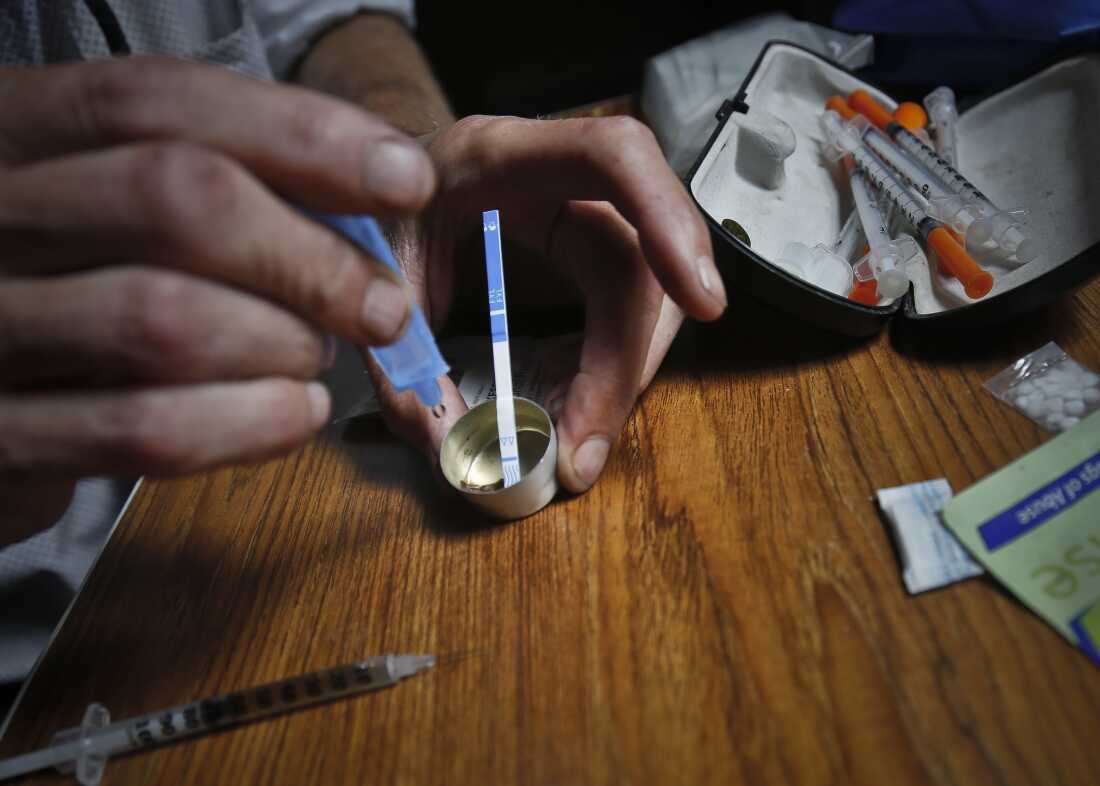
A drug user uses a test strip on Aug. 22, 2018, in New York, to see if fentanyl has been added to heroin, which could increase the risk of overdose.
Bebeto Matthews/AP Photo
hide caption
toggle caption
Bebeto Matthews/AP Photo
Last year, Baltimore had three mass overdose incidents in the span of three months in its Penn North neighborhood.
In one incident, more than two dozen people were hospitalized after many were found unresponsive, lying in the streets or on sidewalks. No one died, but some came close.
Follow-up testing found that the street drugs contained high levels of N-methylclonazepam, a benzodiazepine that operates similarly to Xanax or Valium.
Like opioids, benzodiazepines suppress breathing. When they’re combined, the risk of overdose goes up. And benzodiazepines don’t respond to opioid overdose reversal drugs.
Afterward, the Baltimore Harm Reduction Coalition created test strips specifically for benzodiazepines. The group distributed them — along with test strips that identify other harmful adulterants, such as fentanyl, xylazine, and medetomidine — at clinics and neighborhood events.
The strips, available at no cost, can also be found in bars and spread out on street corners. People testing drugs mix a small amount with water and then dip a test strip into the liquid. The strip will change color if it identifies an adulterant.
“Nobody really knows what they’re getting whenever they’re getting stuff off of the street,” said Candy Kerr, a spokesperson for the coalition. “Having the test strips available for the general public gives them the option to move slower if they’re going to use whatever they’re going to use.”
But a new federal policy could make it harder for organizations such as Kerr’s to give out the test strips, and they’re worried that overdoses could increase.
In late April, the Substance Abuse and Mental Health Services Administration banned the use of federal grants for distributing strips to the public and for some other harm reduction practices that have been credited with saving lives. Test strips have been used for nearly 10 years to identify adulterants.

A box with free test strips for different types of adulterants sits outside the Chesapeake Detention Center in Baltimore. Many health advocacy groups try to give the strips to people when they are released from jail or prison, to avoid overdoses.
Scott Muacione
/WYPR
hide caption
toggle caption
Scott Muacione
/WYPR
A letter sent to local health departments and nonprofits that provide addiction services explained that the Trump administration believes those harm reduction practices “facilitate illicit drug use and are incompatible with Federal laws.”
According to the letter, grants from the Department of Health and Human Services also cannot be used for programs that support the use of clean needles or drug paraphernalia such as pipes, or to fund a type of specialized hotline that people can call while taking drugs, so someone is aware and can call for help if they overdose.
The Trump administration wants to focus more on other techniques, such as giving out naloxone, an overdose reversal drug available as a nasal spray, according to Emily Hilliard, an HHS spokesperson.
“It is critical that federal funding provided by the American taxpayer goes to effective, common-sense solutions that have been proven to save lives and keep people out of an endless cycle of addiction and moves them into a life of recovery,” she said.

Baltimore Mayor Brandon Scott at a press conference after a mass overdose incident in Baltimore’s Penn North neighborhood in 2025.
Scott Maucione/WYPR
hide caption
toggle caption
Scott Maucione/WYPR
The new policy does not prohibit federal funds from being used to purchase test strips for use by law enforcement officers, public health officials, EMTs, or other medical professionals.
That creates an important exception for government agencies that test drugs and send out regular reports on what adulterants are saturating the drug supply in certain locations.
Still, Yngvild Olsen, who oversaw SAMHSA’s Center for Substance Abuse Treatment in the Biden and Trump administrations, says there is a substantial body of evidence that shows giving test strips to people who use drugs can change behavior.
“There’s some people deciding not to use the substances, some people deciding to reduce, to use less, or take other types of precautions, including naloxone, and making sure that there are people around that can actually then help in the case of an overdose,” Olsen said.

Naloxone, a nasal spray that can help reverse an opioid overdose, is spread out on a sidewalk for people to take, after a mass overdose incident in Baltimore’s Penn North neighborhood in 2025.
Scott Maucione/
WYPR
hide caption
toggle caption
Scott Maucione/
WYPR
Kerr said the best approach would be to continue to promote the use of test strips while also continuing to give out lifesaving medications like naloxone. She believes that working on all fronts has helped lead to Baltimore’s decline in overdose deaths, which havedropped more than 40% since 2023.
Under the new policy, nonprofits will still be able to hand out test strips, but they will have to find other funding for that work, which Kerr finds worrisome.
“We’ve been making these strides forward because we’ve had these things, because we’ve been funded,” she said. “We’re going to have to pull money from other places.”
To pay for the test strips, Kerr said, the Baltimore Harm Reduction Coalition will have to cut back on services such as giving out hygiene and wound care kits. But she said that option is better than risking another mass overdose in Baltimore — or allowing even just one preventable fatality.
This story comes from NPR’s health reporting partnership with WYPR and KFF Health News.

- Admin
- Disturbing video shows moment Houthi terrorists bombed Saudi Arabia’s Riyadh airport, killing 13 people October 12, 2026
- Trump's backyard is quietly transforming into 'Silicon Valley South' as wealthy Americans flock in October 12, 2026
- The Iran war didn't make your heating bill this high. Blue-state energy policy did October 12, 2026
- Sarah Ferguson rejects tell-all speculation as expert says discretion is ‘only hope’ for future with family October 12, 2026
- 'Helicopter brain' could be making you feel sick: How to spot it and what to do October 12, 2026