Whatever happened to the U.S. famine alert system that Trump shut down, then reopened
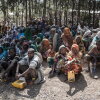
A child is screened for malnutrition at a health clinic in Baidoa, Somalia, where drought and other conditions have sparked concerns about famine.
Sally Hayden/SOPA Images/LightRocket/via Getty Images
hide caption
toggle caption
Sally Hayden/SOPA Images/LightRocket/via Getty Images
In February 2025, we reported that “A respected U.S. famine warning system is ‘currently unavailable.’ ” That system is known as FEWS NET and ran a database that could pinpoint areas where the risk of famine is high, enabling aid groups to prepare for relief. As NPR noted: “The website that once served up detailed, color-coded maps of hunger hot spots around the world now bears a stark message: The site and its data are “currently unavailable.”
About This Series
Over the next week, we’ll be looking back at some of our past global health and development stories to see “whatever happened to …”
FEWS NET did eventually come back online. But now there have been some new developments. This is the first story in our annual series of follow-ups.
Jeremy Konyndyk was on a flight to Somalia in early August, when he checked a U.S. database routinely used by aid workers to predict and respond to hunger crises across the globe: The Famine Early Warning System (FEWS NET).
To his surprise, a map of East Africa on the website’s landing page showed a gray outline where Somalia’s color-coded famine report should be.
“I was reading this stuff on the flight over, and I thought oh that’s weird – why isn’t there anything since June?” Konyndyk says.
Despite Somalia’s worsening food crisis affecting an estimated 6.5 million people, the country’s profile did not show any updates after July. Additionally, Somalia as well as Afghanistan and Yemen were eliminated from a regular “Peak Food Assistance Needs Outlook Brief,” published on August 14, 2026.
The Trump administration previously slashed aid funding to all three countries; despite all three experiencing widespread food insecurity.
“Somalia is probably the country that FEWS NET has historically reported on more than any other,” says Konyndyk, president of Refugees International and a former top official at USAID, the U.S. foreign agency that is now shuttered. “The conditions are extremely dangerous, extremely precarious, and now is the moment where you really need that sort of reporting.”
In a statement to NPR on Monday, the State Department said that FEWS NET’s reporting for specific countries has historically “increased or decreased based on shifts in need, policy priorities, access, cost-efficiency, and other factors.”
The pause in reporting led several organizations, including the Rockefeller Foundation, as well as former USAID employees to speak out against it.
“If they allow FEWS Net to continue reporting, they’re basically documenting the damage of their own decisions,” Konyndyk said. “I think they don’t want the world to see, they don’t want their own systems to tell them the damage of what they’re doing.”
A reversal
However, the State Department told NPR on Monday afternoon that FEWS NET will resume reporting on those three countries in September.
Their statement noted: “The Department will continue to evaluate that all programming appropriately uses limited resources to address foreign policy priorities.”
This is not the first time that FEWS NET has faced the chopping block. Before the Trump administration, the service was run by a private contractor and funded by USAID. It was suspended for six months in early 2025, as part of Trump’s unilateral freeze on foreign assistance.
Piecemeal stoppages of reporting on specific areas are not new, either: FEWS NET has not reported on the hunger crisis in Gaza, since the fall of last year.
The role of FEWS NET
Developed 40 years ago to help USAID respond to crises, FEWS NET is widely used by international aid groups to strategically preposition donations and time their responses. Its analysts pull in crop reports, market data and satellite images to create hyperlocalized information, often predicting major crises up to nine months in advance. That window allows governments and aid groups to ship supplies, arrange transportation and prevent famines.
Five million Yemenis — nearly half of the country’s population — are facing acute food insecurity, according to the U.N. In Afghanistan, the U.N. estimates that 14 million people are facing acute hunger.
This summer’s pause in data reporting for Somalia came at a particularly precarious time.
Approximately a third of Somalis — 6.5 million people — are facing acute food insecurity, according to the U.N. A survey by Doctors Without Borders found that half of children under age 5 in camps near the city of Baidoa were malnourished.
“When we went there, we were seeing that a lot of children even over the age of five had distended stomachs and discolored hair, indicative of malnutrition,” saysid Chenoa Sankar, an epidemiologist for Doctors Without Borders.
A third of nearly 900 families who were interviewed said they were surviving on just one meal a day. In just two months this summer, Doctors Without Borders treated 2,600 pregnant and breastfeeding women for malnutrition.
“Because of the extended drought and the multiple missed rainy seasons, there’s this huge influx of people coming in,” Sankar says. “When you sit down with people, the main complaint is there is simply no food.”
Mukhtar Sirat Mahdi, an aid worker coordinating treatment centers for malnourished children, recalls the face of a starving 11-month old baby.
In June, the child arrived with her family in a camp for internally displaced refugees after being forced off their farm by Somalia’s multi-year drought.
“The child was very weak,” Mahdi says. “Between death and life.”
After six weeks of treatment, the baby recovered. But close calls like this, Mahdi says, are happening more often.
Efforts to prevent famine have been hampered by the January decision of the United States, once Somalia’s largest donor, to freeze nearly all of the country’s humanitarian aid. Assistance had reached $770 million during the Biden administration. But in early January, the Trump administration accused Somali officials of seizing food aid and destroying a U.S.-funded warehouse used by the World Food Program. Other Western countries have also cut assistance, leaving a patchwork of aid programs to fill the gap.
Previously U.S. funding helped the World Food Program feed about 2 million Somalis every month. That’s now down to 350,000, and those families are only receiving half rations, said Konyndyk from Refugees International. Additionally, 205 clinics used to feed malnourished kids have closed due to a lack of funding, according to UNICEF.
“When you close facilities you create longer journeys for mums and their babies — which means later treatment, and later means a greater risk of preventable death,” UNICEF spokesman James Elder tells NPR.
Data that makes a difference
Whether or not Somalia reaches the international threshold for famine depends largely on outcomes of the next growing season and the success of food aid programs. Now, aid workers say, is when FEWS NET data is most critical.
“If you can’t get to the place, you can’t deliver the food,” says Colin Thomas-Jensen of the Aurora Humanitarian Initiative. “This is effectively a global public good. This is a publicly available data set that is rigorous, that has historically predicted pockets of extreme food insecurity.”
Thomas-Jensen was a national security adviser to USAID in 2024, when FEWS NET reports played a critical role to help USAID organize airdrops of food aid into Sudan’s Nuba Mountains. Because the system’s forecasts can anticipate crises six to nine months out, humanitarian workers were able to coordinate with foreign governments and target the highest-risk communities.
“The FEWS NET data allowed us to target specific towns and counties [where] we could drop the food to reach the most acutely affected populations,” Thomas-Jensen says.
Top quality
The U.N. also maintains data on food insecurity, known as the Integrated Food Security Phase Classification (IPC). The World Food Program also publishes its own data, which it calls HungerMap.
However, aid workers and experts who use FEWS NET say it stands out as the highest-quality indicator available for their work. Governments are often reluctant to label a food crisis in their country as a famine; fearing losses to investment and other economic implications.
“If governments are allowed to put their thumb on the scale of these systems, including where data is allowed to be collected, the system itself loses its credibility,” says Michelle Jurkovich, an expert on food aid policy at the University of Massachusetts Boston.
For stories about life in our changing world, subscribe to NPR’s Global Health newsletter.

- Admin
- For an Experiment in Political Affirmative Action, Look to Taiwan October 22, 2026
- Delhi’s Winter Season of Polluted Air Begins October 22, 2026
- Student Protests Mushroom Across Europe, Exposing Bleak Views of the Future October 22, 2026
- Colorado State assistant sleeping at team facility — and hasn’t been home for two weeks October 22, 2026
- Looted Goods From French Stores Appear on Resale Sites After Riots October 22, 2026