10 years after taking a knee, Colin Kaepernick is still waging a 'Perilous Fight'
Colin Kaepernick kneels for the National Anthem before the San Francisco 49ers game against the Tampa Bay Buccaneers on Oct. 23, 2016.
Ezra Shaw/Getty Images
hide caption
toggle caption
Ezra Shaw/Getty Images
Former NFL quarterback Colin Kaepernick was adopted as a baby into a white family, in a town that was almost entirely white. He was 8 when a group of older boys called him the n-word and tried to tie him to a tree — an incident he never mentioned to his parents.
“Instinctively, as a Black boy, I didn’t think they would believe me,” Kaepernick says. “I went [home] and got cleaned up, came downstairs, and went about the day like nothing had happened. But it was a moment that also shaped and defined me.”
For Kaepernick, football became a space for him to understand his Blackness. He found support in his fellow teammates and their mothers, who shared their own experiences with racism and advised him on how to navigate situations involving the police. He went on to play college football for the University of Nevada, Reno.
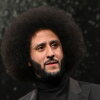
“One of the things that I always appreciated about sports is it became much more difficult for people to approach things from a subjective lens. Sports is very — you won or you lost, you did your job or you didn’t, you scored a touchdown or you did it, you completed the pass or you didn’t,” he says.
The San Francisco 49ers drafted Kaepernick as quarterback in 2011. He played in the NFC championship games in 2013 and 2014 and in the 2013 Super Bowl. But he also became increasingly concerned by incidents of police violence against Black people, including the fatal shootings of Mario Woods in San Francisco, Alton Sterling in Baton Rouge and Philando Castile in a suburb of Saint Paul, Minn. At the beginning of the 2016 season, he took a knee during the national anthem in protest.

“The treatment of Black people and the systems that have been built to continue to oppress Black people and people of color more broadly — that’s not something I was OK with,” he says. “And I wasn’t gonna show pride in those systems that are continuing to kill us, continuing to target us and hold us back and discriminate against us.”
Kaepernick’s protest sparked a firestorm of criticism and commentary. After the 2016 season, he never played another NFL game. Kaepernick would go on to file a grievance accusing NFL owners of colluding to keep him out of the league; they reached a settlement in 2019. In his new memoir, The Perilous Fight, retraces his journey to joining the NFL — and explains why he’s still hoping to make it back to the league.
“The NFL tried to send a very clear message that if you protest police killing Black folks, if you fight for a better society and better community, we’re going to try to take your career from you,” he says. “I … don’t accept that that is going to be the end outcome of this, and will do everything I can to make sure that I change that narrative.”
Interview highlights
On one player saying: “I want to protest, but I need to ask my owner.”
It was mind-blowing candidly. I did not think in my lifetime I would hear a Black man say, “I need to ask my owner for permission.” I think it speaks to the mentality that the NFL tries to breed though, which is be obedient and we’ll give you opportunity. Do as we say and you’ll be rewarded for it. If not, we’ll try to take away what you have built your lifetime towards earning. And again, I understand players trying to navigate this and say, “I’m supportive of it in theory, but in practice, I’m afraid to lose what I have.” And I think the dynamic of players being afraid to lose what they have, that is an environment that the NFL has created.
On the media coverage of his protest
The coverage overall, I think, was used to detract from the actual issue of addressing police killing Black people. … We are talking about police brutality. We’re talking about the issues directly in our community, and a lot of the narrative is, “Well, are you disrespecting the flag? Are you disrespecting the military? Is this the right form of protest? Should you be doing it a different way? Should there be a different approach?”
Oftentimes, a missing piece of this was actually the intention behind the protest and the thing that we had repeated over and over again as to why we were protesting. I think that was a part that was frustrating to have to navigate. I will say there were some phenomenal journalists and phenomenal people within the media that were steadfast in covering this true to form in relation to our goals and objectives, and also calling out some of the broader manipulation within the media.
On the NFL’s response to his protest

The response from the NFL and the positioning of a lot of the conversation is also a little bit mind blowing to me. Just looking at it from a fundamental level of, “Hey, we want to stop police killing Black people.” And the NFL had an issue with that being said. I want people to just pause and take a moment and think about that. Why would that be an issue for anybody to say we want police to stop killing Black people? … The NFL revealed who they were and their intentions and also where they sit politically in that moment.
On that false narrative, following the 2016 season, that he didn’t want to play football
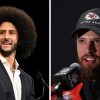
Really what that became is a way to try to manipulate people to say, “Oh, you shouldn’t care about this because he doesn’t care about it.” And that’s just demonstrably false. I love playing football. I am passionate about it. I was actively seeking and pursuing my career, but I also didn’t see the need to sit down in an interview and explain that I wanted to play football when I had been saying it and showing it in all of the other ways.
On whether or not he’d let his kid play football

We would avoid our kids playing football at at all costs. … If we had a son that was adamant on playing, I don’t think we would let him play contact football until he was much older … not until high school. … The studies that exist today show significant impact on their brain, in particular because their brain is still developing.
Anna Bauman and Susan Nyakundi produced and edited this interview for broadcast. Bridget Bentz, Molly Seavy-Nesper and Beth Novey adapted it for the web.

- Admin
- 35 most splurge-worthy women’s luxury gift ideas to spoil her in 2026 September 15, 2026
- WWE championship chaos could bring everything fans have waited for September 15, 2026
- Yankees vs. Twins prediction: MLB odds, picks, best bet Monday September 15, 2026
- Macklemore: Ed Sheeran and I had ‘painful disagreement’ over ‘Free Palestine’ speech backlash before tour firing September 15, 2026
- Rams share Nate Landman injury update before ‘MNF’ vs. Giants September 15, 2026