Swiss glaciers suffer another year of record ice loss
A Swiss glacier shows the effects of years of ice loss, with exposed rock replacing ice that once covered the landscape.
Swiss Academy of Natural Sciences
hide caption
toggle caption
Swiss Academy of Natural Sciences
BERN, Switzerland — Switzerland’s glaciers lost more than 5% of their ice in 2026, marking another year of rapid decline. The loss reflects a wider global trend: Glaciers around the world have been shrinking at increasingly rapid rates, a phenomenon scientists link directly to global warming.
Matthias Huss leads Switzerland’s glacier monitoring network, known as GLAMOS. Each summer, he heads high into the mountains to measure the country’s ice fields. For years, his research has documented rapid ice loss, with the decline peaking in 2022, when Switzerland recorded a record 6% loss in a single year.
At the end of this year’s long, hot summer, Huss returned to some of the glaciers to find much of the ice gone.

Melting ice exposes bare rock on a Swiss glacier, as rising temperatures accelerate the loss of ice across the Alps.
Swiss Academy of Natural Sciences
hide caption
toggle caption
Swiss Academy of Natural Sciences
“They are completely devoid of ice,” he said. “It’s a moon landscape that is dry and dead. There are some little remnants, some ice blocks still lying around and melting there on the hot rocks.”
In other places, alpine plants are now seeding themselves in areas once covered by glaciers that were meters thick. This year’s glacier monitoring report shows the ice loss in 2026 is 5.5%, and the only reason it is slightly lower than 2022’s record is because there was slightly more winter snow covering the ice.
Ominously, though, Huss’ research shows that individual glaciers, among them Switzerland’s biggest, like the mighty Rhône and Aletsch, have suffered record ice loss this year.
Why is this important? Because these huge ice fields are often called Europe’s water towers. They store winter snow and release it gently as it melts over the spring and summer. That snowmelt fills Europe’s key waterways, like the Rhine and the Danube. The water is key to Europe’s food supply, and much more.
“It’s the food supply, it’s the transportation chains,” says Huss. This summer, as river levels sank, freight transport in the Rhine and Danube came to a standstill, and nuclear power stations, cooled by river water, had to be temporarily shut down.
This situation can only get worse if the melt continues. Although Europe’s rivers did have some water this summer, it came not from seasonal snowmelt, but from the glaciers themselves melting. Once they are gone — and 1,200 smaller glaciers have disappeared in the last 50 years — drought could pose an existential threat to Europe’s farmers.
There are other threats too. Glaciers and alpine permafrost are key to stability; they are a kind of glue that holds the mountains together. Without that glue, the risk of landslides and even flooding increases. Last year, the Swiss village of Blatten was wiped out when a fragile glacier crashed down, bringing the side of the mountain with it and destroying 300 homes.
Fortunately, the instability was being monitored, and Blatten’s population was evacuated before the landslide. But one year later, they are still living in temporary accommodation, with no idea if they will ever be able to return to homes now buried under an estimated 9 million cubic meters of ice, rock and mud.
This summer, on Nepal’s border with Tibet, the collapse of a glacier triggered devastating floods that killed at least 1,400 people.
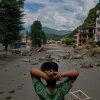
Matthias Huss is cautious about making a direct link between climate change and such disasters. Mountain environments, he points out, have always been risky. “It’s a bit more complicated than just saying it’s warm and the glaciers are disappearing, so the mountains are falling apart and causing disasters like this,” he explains.
But, he adds, climate change can be the catalyst for such natural disasters. “Combined with this heat, with the disappearance of the ice, with the warming of permafrost, climate change can be a triggering factor. That can just be the last bit that is missing to trigger such events.”
And after years of monitoring the glaciers, Huss has little patience with those who still claim climate change does not exist. What is happening to the glaciers should be a warning sign, he argues. “Look at them, it’s not a hoax. The evidence is clear, and it’s been clear for decades. And I think many people have understood that it’s time to act now.”
Without action, Europe’s beloved alpine landscape could, quite soon, look very different. If the planet keeps warming at its current rate, the glacier monitoring unit predicts, all the glaciers will be gone by the end of this century.

- Admin
- DoorDash reveals launch timeframe for delivery drones in Northern California October 1, 2026
- What New York’s Rape Laws Mean for the Cornell Case October 1, 2026
- Fetal tissue supplier billed $765 procurement fee per organ, warn paperwork could imply illegal sales: records October 1, 2026
- Pennsylvania records fifth measles death as country sees worst outbreak in 35 years October 1, 2026
- California superintendent candidate calls out teachers union, says she's a 'real threat' to 'socialist agenda' October 1, 2026