One way to protect coral reefs? Bring back seabirds
At Palmyra Atoll in the remote Pacific Ocean, wildlife refuge manager Paige Mino observes red-footed boobies. Scientists have found a surprising link between the seabirds and the health of the surrounding ocean.
Claire Harbage/NPR
hide caption
Claire Harbage/NPR
The remote Pacific Ocean has some of the most pristine coral reefs in the world. The corals themselves are bigger than cars, their delicate arms creating a dense underwater maze. Above them, the skies are filled with seabirds like red-footed boobies and white terns, searching for fish.
These species, separated by land and sea, are far more intertwined than once thought. Their relationship is the backbone of an entire ecosystem — a hidden connection that’s changing the way scientists think about conservation.
That connection: bird poop. Coral reefs near seabird colonies are generally healthier, thanks to the nutrients that birds deposit in their guano. It’s one reason tropical islands and atolls are biodiversity hot spots in the vast Pacific Ocean.

Joe Pollock of The Nature Conservancy photographs the reefs of Palmyra Atoll, known for being some of the most pristine coral reefs in the world.
Claire Harbage/NPR
hide caption
Claire Harbage/NPR
On some islands, this close-knit partnership has broken down. Seabird colonies have declined because of habitat loss and invasive species like rats. With fewer birds, fewer nutrients reach the ocean ecosystem.
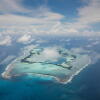
Now, as coral restoration projects work to bring back reefs, they’re also focusing on bringing back seabird colonies, reestablishing a connection that helps both species. Coral reefs are increasingly vulnerable to rising ocean temperatures, and biologists say they need every advantage in a hotter world.
“If we can figure out ways to just stop the local threats to ecosystems, they will, in a lot of cases, find ways to repair themselves,” says Alex Wegmann, lead scientist for The Nature Conservancy’s island resilience strategy. “They can reestablish their natural functions that will then allow them to adapt to the climate impacts that are coming.”

A white tern takes flight among native trees on Palmyra Atoll.
Claire Harbage/NPR
hide caption
Claire Harbage/NPR
Forest of birds
More than a thousand miles south of Hawaii, there’s a tiny group of islands known as Palmyra Atoll. In the rainforest there, a tiny chick the size of a fuzzy, white golf ball perches on a tree limb. The parents hover nearby, chattering rhythmically.
“That’s a white tern chick, and a young one at that,” Paige Mino, manager of the Palmyra Atoll National Wildlife Refuge with the U.S. Fish and Wildlife Service, says as she looks up at the birds. “I think that their call sounds like an electric rubber band snapping,” she adds with a smile.
The forest echoes with the calls of seabirds, like red-footed boobies, large birds with bright blue beaks and signature red feet. Almost all of the birds on Palmyra Atoll rely on the ocean, flying out to sea daily to feed on fish or squid, bringing some back for their young.

White tern chicks (left) and red-footed boobies (right) depend on the ocean for food. Tens of thousands of birds nest on Palmyra Atoll.
Claire Harbage/NPR
hide caption
Claire Harbage/NPR
The abundance is thanks in large part to Palmyra Atoll’s remote location. While it was likely visited by Polynesians who crossed the Pacific on seafaring voyages, the atoll wasn’t permanently inhabited. In the 1800s, coconut plantations were developed. The U.S. military turned the atoll into a logistical station during World War II, building bunkers and roads.
In 2000, The Nature Conservancy bought Palmyra Atoll from private owners and transferred the majority of it to the federal government. The U.S. Fish and Wildlife Service manages it as a national wildlife refuge.
“There’s no human impact of pollution or overcapacity, so I think it really gives the wildlife and vegetation the space to thrive,” Mino says. “It gives the wildlife a chance to do what they naturally do.”

During World War II, the U.S. military built bunkers, supply buildings and a runway on Palmyra Atoll, the remnants of which are still visible today.
Claire Harbage/NPR
hide caption
Claire Harbage/NPR
An ocean mystery
Palmyra Atoll’s thriving ecosystem has given scientists a window into the hidden processes that make it work, including some mysteries.
More than a decade ago, a team of scientists noticed something at Palmyra Atoll: Manta rays were more commonly seen in waters near seabird colonies. The massive mantas, some with a 9-foot wingspan, slowly glide through the water as they feed on tiny plankton.
That led them to uncover an efficient system of nutrient recycling that starts with the birds.

Roughly 100,000 sooty terns nest on Palmyra Atoll. The birds spend years at sea before returning to land to breed.
Claire Harbage/NPR
hide caption
Claire Harbage/NPR
When seabirds return to land after eating fish at sea, they roost in the trees. There, they deposit a lot of nutrients in their guano. One study of almost 200 atolls estimated that seabirds brought more than 100,000 pounds of nitrogen back to land. That acts as a fertilizer, nourishing the trees and plants.
Those nutrients spread with Palmyra Atoll’s frequent, heavy rains. They get washed into the ocean, where they help the entire marine food web. Tiny, microscopic plankton grow, feeding larger plankton that are eaten by many species, including fish and manta rays. Though it’s not their primary food source, even corals eat plankton.

Reef manta rays (left) are known to feed in waters near seabird colonies, where there’s more abundant food, thanks to nutrients from birds. Coconut crabs (right) are scavengers that break down organic matter in Palmyra’s forests, helping support the nutrient cycle.
Claire Harbage/NPR
hide caption
Claire Harbage/NPR
“Studies show that those marine nutrients from seabird guano are really valuable and important for the whole reef ecosystem,” says Katie Franklin, who works on Palmyra Atoll conservation strategy for The Nature Conservancy. “Guano will help nourish the ecosystem from the rainforest to the reef, so we really just want to bring on more guano.”

The Nature Conservancy’s Alexandra Corti searches the forest with binoculars. At most, only a few dozen people stay on Palmyra Atoll at a time, living temporarily at the small research station.
Claire Harbage/NPR
hide caption
Claire Harbage/NPR
The quiet of coconut palm forests
Scientists figured out the seabirds’ role because there are places on Palmyra Atoll where birds are hard to find. Some forests are eerily quiet.
“We’re standing in a dense monoculture of coconut palms,” Franklin says, pushing past large palm fronds. “It is literally just coconut palms growing. There are way fewer birds in this type of forest.”

A juvenile red-footed booby sits on a nest. Palmyra Atoll has one of the largest red-footed booby populations in the world.
Claire Harbage/NPR
hide caption
Claire Harbage/NPR
The palm trunks are densely packed together, letting in very little sunlight. The trees are the legacy of coconut plantations established more than a century ago.
“None of these attempts at farming coconut palms ended up being very successful or profitable and were all abandoned,” Franklin says. “But the impact that these coconut palm plantations made has lasted.”
In 2000, almost half of Palmyra Atoll was covered in coconut palms, where few seabirds nest. It’s why the U.S. Fish and Wildlife Service and The Nature Conservancy have started a decade-long project to bring the native forest back.

Katie Baur, a conservation science volunteer on Palmyra Atoll, saws down invasive coconut palms. More than a million palm trees and sprouts have been removed from the atoll.
Claire Harbage/NPR
hide caption
Claire Harbage/NPR
Hacking palm trees
In blazing midday tropical heat, Katie Baur saws the trunk of a young coconut palm. The beach is covered in coconuts, all sprouting young trees. She’s a conservation science volunteer with The Nature Conservancy who lives on the atoll for six months.
“It’s hard — it’s definitely not glamorous,” she says with a laugh.
Since the project started in 2019, more than a million coconut palm trees and sprouts have been removed. Baur says once the palms are gone, the native forest returns rapidly.
“I get to go around the atoll and see places where new native flora is starting to reestablish,” Baur says. “So it’s exciting for me because I know that the work I’m doing now, in six months, in a year, is going to look like those places.”

Katie Franklin of The Nature Conservancy says Palmyra Atoll’s thriving ecosystem makes it a “natural laboratory, where we can really understand how an ecosystem like this works and what can we take away from Palmyra that can be useful for islands elsewhere.”
Claire Harbage/NPR
hide caption
Claire Harbage/NPR
Eradicating a furry invader
Even as native forest has returned to Palmyra Atoll, the ecosystem’s recovery has also depended on tackling another tricky invader: rats.

Rats were likely brought to Palmyra during World War II accidentally, but they quickly made themselves at home.
“They probably thought they had gone to heaven,” says Wegmann of The Nature Conservancy’s island resilience strategy. “Palmyra is so productive as an ecosystem. There are invertebrates everywhere, land crabs, insects, cockroaches, lots of yummy things for them to eat, and there are no predators.”
With unlimited food and warm weather year-round, rat populations boomed, topping an estimated 30,000 rats. As a result, seabird populations declined, particularly birds that build their nests on the ground. It’s a pattern that’s been seen on hundreds of other islands. One study found that 41% of highly threatened mammals, birds, reptiles and amphibians are found on islands, where invasive species have been a major driver of extinctions.

Ground-nesting birds, like the sooty tern, are highly vulnerable to invasive rat populations.
Claire Harbage/NPR
hide caption
Claire Harbage/NPR
In 2011, the U.S. Fish and Wildlife Service, along with nonprofit partners, led a campaign to eradicate rats from Palmyra Atoll. Wegmann says when the rats were successfully removed, the ecosystem rebounded quickly.
“Land crab populations exploded and the forest exploded,” Wegmann says. “We saw new crab species emerge. We saw more and more seabirds nesting in trees throughout the entire atoll. And we started to see the native forest trees that had not been reproducing with rats here start to reproduce.”
Researchers are now hoping to see the return of other seabirds that seem to have disappeared from Palmyra Atoll. Eight species are thought to have once nested there, but are no longer found. One, the gray-backed tern, recently reappeared and has nested on the atoll for four consecutive years.

Fake decoy birds on Palmyra Atoll are used to attract seabirds that were once thought to nest there but are no longer found. The hope is to reestablish the populations. One species, the gray-backed tern, recently reappeared and has nested there for four years in a row.
Claire Harbage/NPR
hide caption
Claire Harbage/NPR
Resilience for the changes ahead
Even with its remote Pacific location, Palmyra Atoll is still threatened by global changes. In 2013, a marine heat wave elevated ocean temperatures for months, causing the corals to bleach and turn white. Many of the atoll’s reefs have since recovered, but some didn’t bounce back as readily.
As the climate gets hotter, the future for coral reefs globally is dire. Studies show that if humans continue burning fossil fuels, the planet will heat up more than 1.5 degrees Celsius (2.7 degrees Fahrenheit), compared to preindustrial temperatures. At that level, between 70%-90% of coral reefs worldwide won’t survive, according to a report by the Intergovernmental Panel on Climate Change.

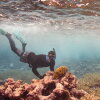
Even in remote places like Palmyra Atoll, coral reefs are threatened by rising ocean temperatures from climate change.
Claire Harbage/NPR
hide caption
Claire Harbage/NPR
With marine heat waves getting more frequent and intense, research shows it’s vital that reefs recover as quickly as possible between bleaching events.
“We want to give them the best chance possible to do that,” Wegmann says. “And we believe that by creating the habitat for the seabirds and maximizing that seabird nutrient benefit, we will give the reef its best chance of enduring whatever climate future comes.”
Wegmann says the conservation lessons learned at Palmyra are being applied at other islands and atolls, like the Chagos Archipelago in the Indian Ocean.

Coconut palms have taken over half of the forested land at more than 200 atolls around the Pacific. Roughly a quarter of all tropical seabirds in the world also rely on atolls for nesting. While atolls seem small, the linkages between land and sea mean they play an outsized role in global biodiversity.
“They create this halo of influence on the ocean around them,” Wegmann says. “If you add up all of the area of ocean for all the atolls just in the Pacific, it’s about the same size as South America. So, protecting atolls is important for the individual atoll, but also for a huge amount of ocean surrounding it.”

Alex Wegmann, Dana Sabine and Katie Franklin of The Nature Conservancy head to a seabird colony.
Claire Harbage/NPR
hide caption
Claire Harbage/NPR

- Admin
- Hillary Clinton Steps to the Podcast Mic as Midterms Approach October 13, 2026
- Want to dodge the flu this year? Eat these secret-weapon immunity-boosting foods October 13, 2026
- Musk Pours $276 Million Into the Midterms, and Federal Agents Raid Home of Rep. Ilhan Omar October 13, 2026
- Trump's new press secretary faces first major test as White House briefing room enters new era October 13, 2026
- Trump’s right to push a Ukraine-Russia energy cease-fire — but it must be real October 13, 2026