New restrictions at Texas Tech are changing what professors can teach
Paul Ingram, an associate professor of psychology at Texas Tech University, holds a sign expressing concern about the effect of new university policies on faculty during a campus protest in February 2026.
Michelle Waida/KTTZ
hide caption
Michelle Waida/KTTZ
LUBBOCK, Texas — Outside the library at Texas Tech University on a recent Wednesday morning, a small group gathered behind a folding table in a spot known to students as the “free speech area.”
Spread across the table flyers referenced names of familiar works.
Homer’s The Odyssey. William Shakespeare’s Romeo and Juliet. Herman Melville’s Moby-Dick.
Students streamed past on their way to and from class. Most kept walking. Every so often, someone lingered long enough to ask what the list was about.
The people behind the table were Texas Tech professors. And the works printed on those flyers were examples of texts that professors say could run afoul of new rules governing what they can teach.
Texas Tech is among the state’s 45 public universities navigating a wave of higher education policy changes. That shift began with Senate Bill 17, the 2023 law banning diversity, equity and inclusion offices and programs at public universities, while explicitly exempting classroom instruction and academic research. More changes followed in 2025, including new state oversight of university curriculum.
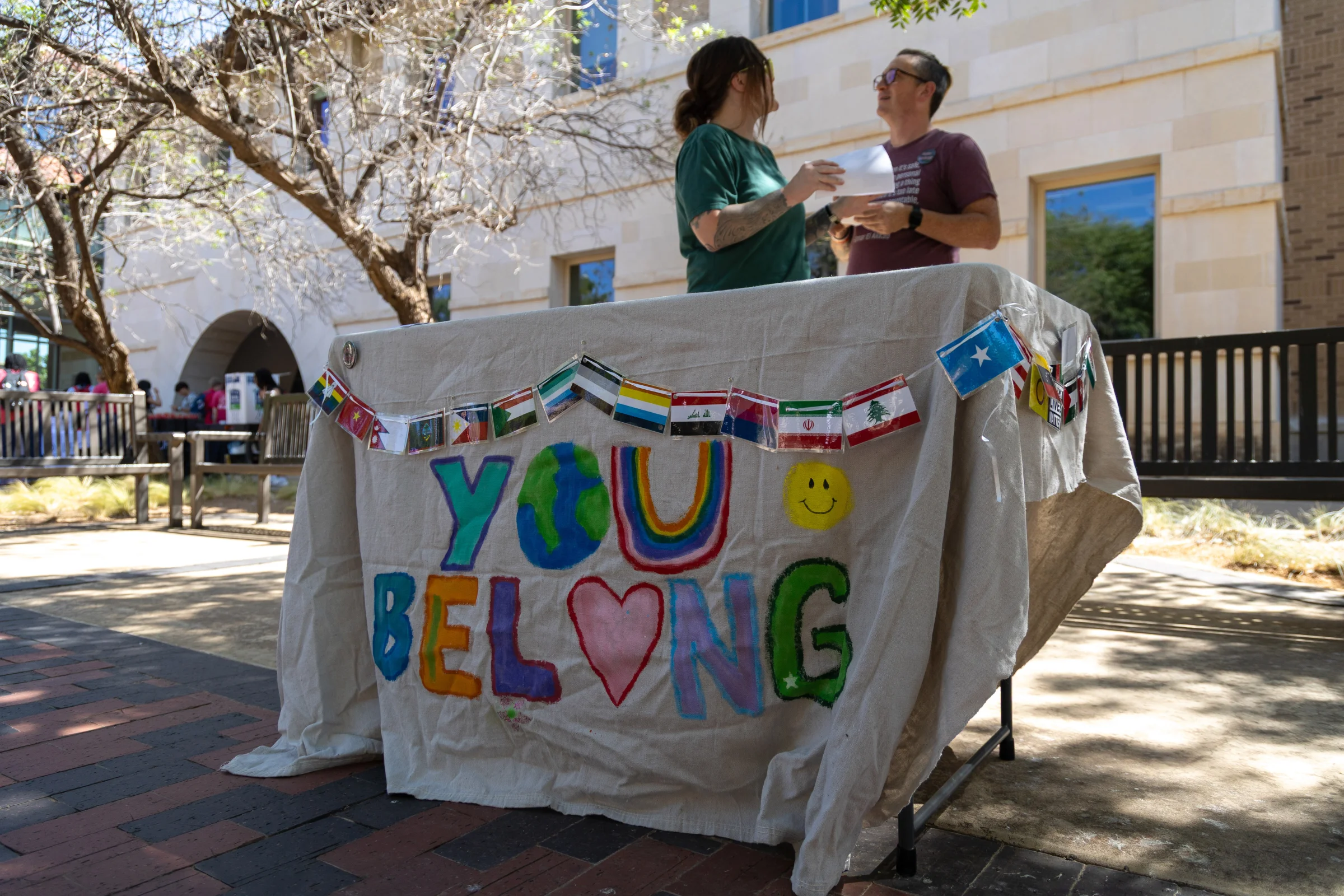
Texas Tech University professors Deena Varner, left, and Paul Ingram speak behind a table decorated with a “You Belong” banner in September 2026 in Lubbock, Texas. The professors have been talking with students about new university restrictions on classroom instruction.
Lucio Vasquez/The Texas Newsroom
hide caption
Lucio Vasquez/The Texas Newsroom
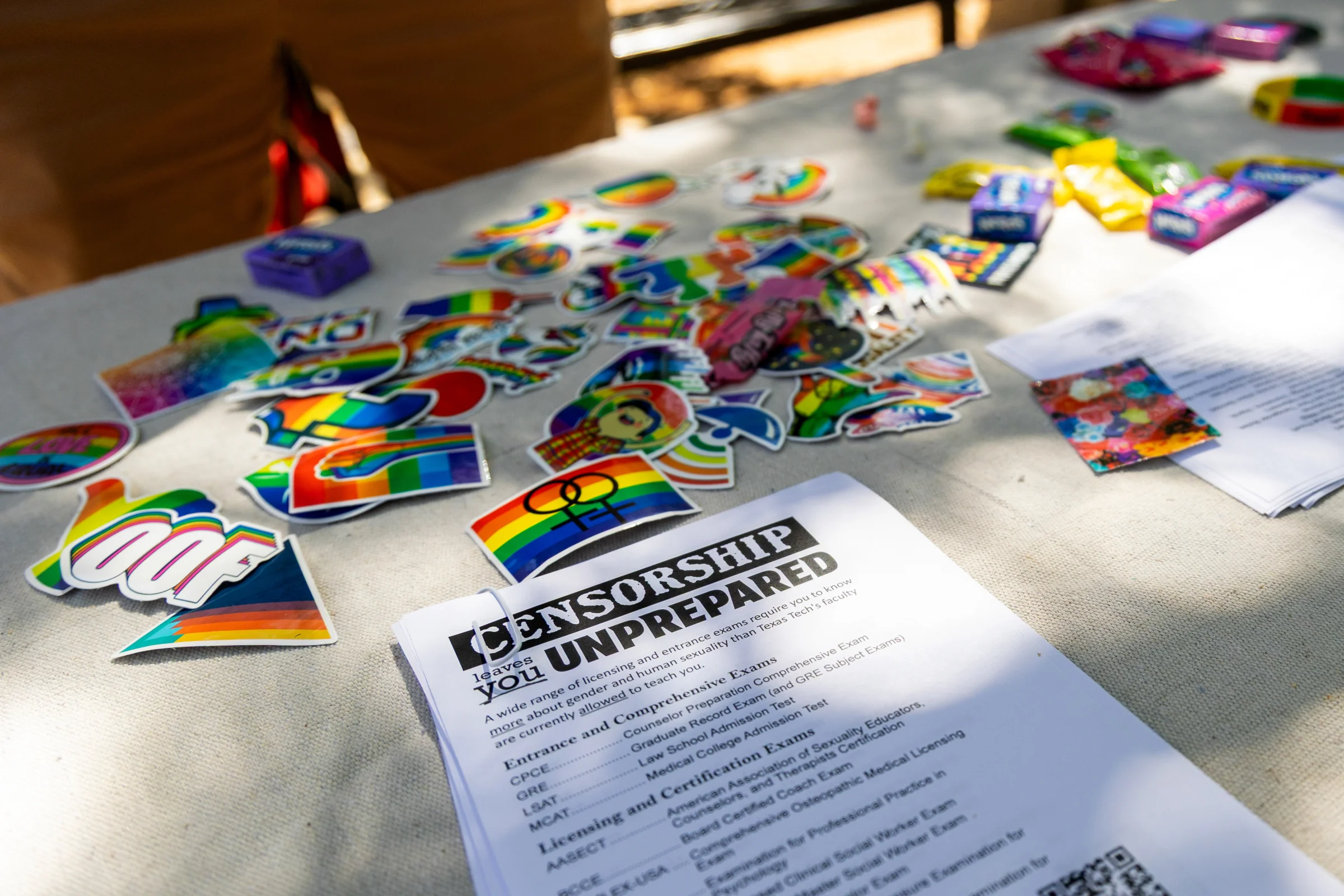
Flyers and stickers sit on a table where Texas Tech University professors spoke with students about new restrictions on classroom instruction in September 2026 in Lubbock, Texas. Faculty members say the policies have created uncertainty about how they can teach topics including race, sex, gender identity and sexual orientation.
Lucio Vasquez/The Texas Newsroom
hide caption
Lucio Vasquez/The Texas Newsroom
Texas Tech has since adopted some of the state’s most sweeping restrictions on how professors can teach about race, sex, gender identity and sexual orientation. The rules have led to changes in course materials, prompted accusations of censorship and fueled pushback from faculty and students.
Deena Varner, an assistant professor of practice in English who’s taught at Texas Tech for five years, was among the professors who stood in the Texas heat talking with students about how the new rules could affect the courses they take.
Varner said she and her colleagues have spoken with hundreds of students since they began tabling nine months ago, continuing even after university administrators instructed faculty not to discuss the new policies with students.
Inside the classroom, professors face the uncertainty of what’s allowed to be taught.
“Everyone is walking around really afraid of doing the wrong thing, saying the wrong thing, teaching the wrong thing,” Varner said. “Because everyone has a gender identity and everyone has sexual orientation, what it means to not be able to talk about those things is really unclear.”
And the consequences for getting it wrong can be significant. Texas Tech administrators have warned that faculty who don’t comply with the new policies could face disciplinary action.
“It’s a scary time,” Varner said. “One of the things that I try to tell myself every morning is that I have rights and it’s my civic duty to exercise my rights, and that’s one of the things that kind of keeps me going.”

Deena Varner, an assistant professor of practice in English at Texas Tech University, poses for a portrait in September 2026 in Lubbock, Texas. Varner says new university policies restricting how professors can teach about race, sex, gender identity and sexual orientation have affected what she can bring into the classroom.
Lucio Vasquez/The Texas Newsroom
hide caption
Lucio Vasquez/The Texas Newsroom
How the restrictions took shape
The restrictions began taking shape shortly after Brandon Creighton became chancellor of the Texas Tech University System in November 2025.
During his first five months on the job, Creighton issued two directives — one in December 2025 and another in April 2026 — outlining what could be taught across the system.
Together, the policies restrict how professors can teach about race, sex, sexual orientation and gender identity. They also call for phasing out academic programs centered on those topics.
Before becoming chancellor, Creighton spent more than a decade in the Texas Senate where he chaired the higher education committee. He authored SB 17 in 2023, and two years later, he spearheaded Senate Bill 37, which gave university governing boards greater authority over curriculum and required regular reviews of core courses.
An earlier version would have barred core courses from teaching “identity politics” or theories that systemic racism, sexism, oppression or privilege are inherent in U.S. institutions. Lawmakers removed that language before the bill passed.
The final law, instead, prohibits core courses from requiring students to adopt beliefs that one race, sex, ethnicity, or social, political or religious belief is inherently superior to another.
After becoming chancellor, however, Creighton imposed restrictions at Texas Tech on some of the same subjects lawmakers had removed from his bill.
Creighton’s office and the Texas Tech University System Board of Regents did not respond to multiple requests for comment on this story.

Sen. Brandon Creighton during the Senate K-16 Education Committee meeting on Thursday, May 15, 2025. The Senate discusses HB 2 at the Texas Capitol.
Patricia Lim/KUT News
hide caption
Patricia Lim/KUT News
Creighton has described the law as a “floor” for what Texas Tech can do, signaling that the system’s policies could go further than what the Legislature required. He has also pushed back on some groups of professors and students describing the restrictions as censorship.
“I think that it’s easy to throw those types of terms around, but at the end of the day, we have to make decisions, and decisions that are centered around what is best for our students and the future workforce that we see on the horizon,” Creighton said in an April interview with Everything Lubbock. “I think that it’s appropriate.”
Creighton has found support among some conservative students. In August, Preston Parsons, president of Texas Tech’s Turning Point USA chapter, described the policies as a return to “biblical truth.” Parsons declined an NPR request for an interview.
How the policies are affecting classrooms
Across Texas Tech, professors say the restrictions are changing what they can bring into the classroom, from the books they assign to the subjects they discuss and even material drawn from their own research.
Varner said she was pressured to remove course material involving The Silence of the Lambs because its villain, Buffalo Bill, could be interpreted as transgender.
“I tend to teach about structures of power, and that often includes relationships related to gender, sexuality, race, class, ethnicity, so it impacts me directly quite a bit,” Varner said.
Paul Ingram, an associate professor of psychology at Texas Tech, said the restrictions have affected how he teaches about suicide, including discussion of differences in suicide risk among men and women. He said the policies have created a conflict between following university rules and giving students the level of training he believes the science demands.
“I think that hurts Texas Tech. I think it hurts my career. I think it hurts my students. I think it hurts education,” Ingram said. “It hurts the mission of this university.”

Paul Ingram, an associate professor of psychology at Texas Tech University, poses for a portrait in September 2026 in Lubbock, Texas. Ingram says new classroom restrictions have affected how he teaches about suicide, including differences in suicide risk among men and women.
Lucio Vasquez/The Texas Newsroom
hide caption
Lucio Vasquez/The Texas Newsroom
The effects aren’t always as visible as a book or lesson being explicitly removed. Faculty members say uncertainty over where the university draws the line has led some professors to avoid certain subjects altogether — resulting in what they describe as self-censorship.
“So many faculty in English and other departments, reasonably fearful of disciplinary action, have simply preemptively censored their own texts instead of teaching the texts that are the most important in their field,” said Sara Spurgeon, another professor of English at Texas Tech.
That kind of uncertainty can itself broaden the reach of such policies, said Amy Reid, director of PEN America’s Freedom to Learn program.
“When prohibitions come down from above that are not clear, but are vague and broadly construed, it increases their impact,” Reid said. “It’s a design principle, not a design flaw.”
Spurgeon, two years from retirement after more than two decades at Tech, said she’s also been pressured to pull back from teaching subjects she has spent years researching, including gender, race and sexuality in literature of the American West. She’s continued teaching them.
“Despite multiple emails making clear to them that I’m teaching this anyway. I mean, maybe this interview will be the nail in my coffin. It is possible,” Spurgeon said. “If they’re gonna fire me for doing my job to the best of my ability, then go ahead.”

Sara Spurgeon, a professor of English at Texas Tech University, works at her computer in September 2026 in Lubbock, Texas. Spurgeon says she has been pressured to pull back from teaching subjects she has long researched, including gender, race and sexuality in literature of the American West.
Lucio Vasquez/The Texas Newsroom
hide caption
Lucio Vasquez/The Texas Newsroom
Pushback on campus and beyond
Chancellor Creighton’s policies have drawn organized opposition from students and faculty.
In July, faculty groups challenged them in federal court, arguing Creighton effectively revived restrictions that lawmakers declined to include in the final version of the state law. The lawsuit alleges the policies violate professors’ constitutional rights and are so vague that faculty cannot reliably determine what they’re allowed to teach.
And students have organized too.
Aaron Texidor, a 19-year-old finance major, helped found Raiders Against Censorship earlier this year with Maddox Guillen, 19, and James Snoddy, 20. The group has organized against the restrictions and worked to inform students about Creighton’s directives.
“It’s very demoralizing,” Texidor said. “I think the point of college is to challenge your perspectives, broaden your perspectives and make you think critically, and I don’t believe that Brandon Creighton believes that us as students have the ability to understand nuance and to understand different perspectives and to grow and be better people because of it.”
Snoddy sees the restrictions as part of a broader political effort to shape what students learn and, ultimately, how they see the world.
“I think this will be the first step for the federal administration to look at how they can change universities, because if you can change the past, you control the present,” Snoddy said. “If you focus on what students are learning in classes, you can change their perspective so they can vote for you in the future. This is all political.”

The Texas, U.S. and Texas Tech University flags fly over the university’s campus in Lubbock, Texas.
Bishop Van Buren/KTTZ
hide caption
Bishop Van Buren/KTTZ
For some faculty, the restrictions have also factored into a deeply personal decision: whether to stay at Texas Tech. Lisa Limeri ultimately walked away from a life she built over five years as a biology professor at the university. She said she was happy.
“I loved my life there,” Limeri said. “I had the most wonderful colleagues in that department, the most wonderful students.”
Limeri earned tenure at Tech this spring but left shortly afterward for a position in Rhode Island, a decision she said was driven entirely by the university’s restrictions. She believed the policies would prevent her from teaching biology accurately and would constrain her research.
“I would rather be untenured with academic freedom than tenured at Texas Tech University,” Limeri said. “The censorship is so severe and so damaging and so unacceptable that I uprooted my very happy life and moved across the country.”
History professor Jacob Bell described a similarly difficult decision. He taught history at Texas Tech for three years before leaving earlier this year for a job in New York, saying the restrictions would interfere with his ability to teach works like The Odyssey, where the Greek goddess Athena takes both male and female forms.
Texas Tech isn’t alone.
Several Texas university systems have gone beyond the requirements of SB 37, adopting their own restrictions on classroom instruction. Texas A&M has limited teaching about race, gender and sexuality, policies that are now being challenged in federal court. Other universities have also reviewed courses, removed materials or adopted new restrictions on classroom instruction.
For Varner, the last nine months have left her uncertain about her own future at Texas Tech. Every professor interviewed for this story said they expect more faculty to leave over the next year.
But for now, outside the university library, Varner and her colleagues are still trying to make sure students know what’s happening inside their classrooms.
“There’s always a possibility that I’ll be disciplined. There’s a possibility that I will be terminated,” Varner said. “I’m willing to take the risk.”

- Admin
- North Korea launches missiles toward the sea as Pyongyang protests against US claims on Binance hack November 4, 2026
- Dem wins Trump-targeted Texas district in rebuke of Republican redistricting shakeup November 4, 2026
- Pete Ricketts wins Nebraska Senate race, making Dan Osborn two-time loser November 4, 2026
- Speaker Mike Johnson projected to cruise to re-election for fifth House term November 4, 2026
- Dems flips yet another Senate seat in Trump country amid sweeping GOP upsets November 4, 2026