Herbert Blomstedt, conductor of great orchestras for seven decades, dies at 99
Herbert Blomstedt conducts the Gewandhaus Orchestra of Leipzig in April 2026, at the age of 98.
Jan Woitas/picture alliance/Getty Images
hide caption
Jan Woitas/picture alliance/Getty Images
Herbert Blomstedt, an American-born, Swedish conductor whose remarkably long career saw him leading many of the world’s major orchestras, including the San Francisco Symphony for 10 years, died on Wednesday at his home in Gothenburg, Sweden. He was 99.
His death was announced in a statement released by his management company, KünstlerSekretariat am Gasteig.
In a profession routinely flush with elderly practitioners, Blomstedt, year after year, retained his title as the world’s oldest active conductor. He worked into his late 90s, conducting concerts this year, at the age of 98, with the Detroit Symphony and the Gewandhaus Orchestra of Leipzig, Germany.
“Retirement is not a question of age,” Blomstedt told the Australian Broadcasting Corporation. “It should be flexible. I just love the music so much that I just can’t give up.” And he didn’t.
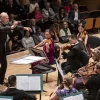

Blomstedt suffered falls in 2022 and 2023, and an ear infection in 2025, forcing him to cancel performances in Europe and the U.S., but he was undaunted. He resumed adding dates to his schedule, leading the world’s top orchestras. In recent years, he conducted while seated at a piano bench. He had plans to conduct a series of concerts with the San Francisco Symphony in May of this year and again in January 2027, both of which were canceled when health concerns got in the way.
“The music-making of elderly conductors can sometimes be either lofty or slow, sometimes both,” Martin Kettle wrote in The Guardian in 2022. “Neither quality applies to Blomstedt … his conducting in old age radiates both flow and glow. Blomstedt does not force or underline the music, he releases it. But the attentiveness to pulse, phrasing and dynamics are unflagging.”
Blomstedt brought clear-eyed structural integrity and a strict devotion to the composer’s score to wide swaths of orchestral music — and eras — from J.S. Bach to Elliott Carter. But late in his career, he distilled his repertoire down to a few favorite Scandinavian composers and a handful of Germanic staples by Bruckner, Brahms, Schubert, Haydn, Mahler and his beloved Beethoven.
He recorded all nine Beethoven symphonies twice, once with the Staatskapelle Dresden, which he led from 1975 to 1985, and later with the Gewandhaus Orchestra of Leipzig, where he was chief conductor from 1998 to 2005.
“Both cycles remain beacons of good taste, with a distinctive spiritual power shining through,” David Allen wrote in The New York Times in 2022. “That’s particularly true of the Fifth [symphony], which may be less brutally violent than under other conductors but has a merciful empathy to its relative restraint.” Asked by Allen why Beethoven remains such an obsession, Blomstedt pointed to the humanity in the composer’s music.
“It can represent the suffering of everyone,” Blomstedt answered. “Not only his, but mine. The suffering of today in Ukraine, for instance. That helps it outlive the personal situation of the composer, or the personal situation of the interpreter. It’s something that we go through, as humans.”
YouTube
Herbert Thorson Blomstedt was born on July 11, 1927, in Springfield, Mass. to Swedish parents, both Seventh-day Adventist missionaries who returned home when Blomstedt was two, settling in Gothenburg.
In his youth, Blomstedt learned piano, violin and organ, then fell in love with symphonic music. He memorized the names of orchestra players and when the revered German conductor Wilhelm Furtwängler performed in Gothenburg, the shy young Blomstedt asked the maestro for an autograph.
In 1945, Blomstedt entered the Swedish Royal College of Music where he began to study conducting. His education continued with a broad range of influential figures, including stints with John Cage at Darmstadt, Igor Markevitch in Salzburg, Jean Morel at Juilliard and Leonard Bernstein at Tanglewood in 1953, the year in which Blomstedt won the Koussevitzky conducting prize. His formal conducting debut came in 1954 with the Stockholm Philharmonic, moving directly to his first professional post with the Swedish Norrköping Symphony Orchestra.
Blomstedt had close relationships with dozens of orchestras around the world, including the San Francisco Symphony, of which he was music director from 1985 to 1995.
“Blomstedt inherited an orchestra that was skilled and committed but lacking in discipline,” says Joshua Kosman, former classical music critic for the San Francisco Chronicle. “Under his guidance, everything became sharper, cleaner, more crisply focused. It was also during his time as music director that the San Francisco Symphony began to tour internationally and record. These two developments were related. Blomstedt made the Symphony, as it were, ready for prime time.”
In 2003, Blomstedt returned to lead the Symphony. Kosman said in a review at the time that it only took a few measures of music to realize how much the former music director was missed, especially in a performance of Schumann’s Fourth Symphony.
“Looking spry and attentive, Blomstedt led a wonderfully vital performance,” he wrote. “And the orchestra — clearly delighted to see its former music director — responded with some of its finest, most spirited playing.”
While Blomstedt could elicit ecstatic performances from his orchestras, his own demeanor on the podium was calm and economical with no hint of spotlight-craving showmanship. At times, perhaps too much control led to the occasional indifferent performance. Another return visit to the Symphony in 2013 left Kosman cold. “The program began with the Prelude and “Liebestod” from Wagner’s Tristan und Isolde, done with plenty of orchestral richness –- the strings sounded especially robust –- but not much fervor or freedom,” he wrote. “Blomstedt is too rational and cautious an interpreter, I think, to make much of this music’s luxuriant eroticism.”
Blomstedt believed that music could be what he called “an enormous ethical force in society.” Speaking with broadcaster Bruce Duffie in 1988, the conductor tried to explain its power. “I’m not so naïve that I think everybody who leaves the concert hall after a Bruckner symphony is saying, ‘I won’t do so many bad things tomorrow,’ but something in that direction,” he said. “To experience the order and beauty of great music brings the listener in contact with something greater than himself, something that is meant to be perfect and positive, and this is one of the greatest blessings of great music.”
What Blomstedt sensed as something greater than himself was spiritual. A devout Seventh-day Adventist who eschewed alcohol, coffee, tobacco and meat, Blomstedt, early on, refused to rehearse on Saturdays, when he observed the sabbath. It cost him some jobs, he admitted. And yet he conducted concerts on those days, rationalizing that all the real work had been done in rehearsal and performing great music was a spiritual communication to the glory of God.
“I’m a seeker,” Blomstedt told journalist Paul Bodine in 2004. “I find God in many places, in nature and scores, in people. I think the ultimate aim of every artist is not to project himself, but there is something in the music that he thinks is important, and when understood by listeners will bring them close to an answer to these eternal questions: Where we come from, why we are here, and where we are going?”
Blomstedt was married to Waltraud Blomstedt, also a Seventh-day Adventist, who held a degree in musicology. She died in 2003 at age 74 in Lucerne, Switzerland, where the couple had lived for years. Blomstedt moved back to Sweden, near Örebro, where three of his four daughters reside.
Earlier this year, the Danish Radio Symphony Orchestra announced plans for Blomstedt to conduct concerts during the three months leading up to his 100th birthday next July.
Always thinking about music and looking ahead, Blomstedt mused, in an interview with Die Welt in the fall of 2025, when he was 98, on what he might conduct for his centennial concerts. Mendelssohn, perhaps, he said. That same year, he told CBS News Sunday Morning, “Without work, I don’t live. If I just twiddle my thumbs, that is not living.” He said he wanted to be remembered as modest, but truthful and genuine.
“I’m not tired,” he said firmly. “Because every time I stand in front of the orchestra, it’s like a flame starts to sparkle again. The moment I hear the sound of the orchestra it transforms me.”

- Admin
- Matt Wright’s ‘devastated’ loved ones urge Ellen DeGeneres to ‘do more’ after $5K donation November 5, 2026
- Former NFL QB Duck Hodges says marrying country star gave friends 'false hope' about landing Ella Langley date November 5, 2026
- Chilling Philly protest on Nazi terror demands Jewish-owned shops leave the city November 5, 2026
- Progressives fume at Hakeem Jeffries for saying Democrats won't 'get even' with Trump November 5, 2026
- Joe Gorga talks jump-starting his Botox journey in his 50s: ‘I’m a fan’ November 5, 2026