Democrats won big. Can they lower your grocery bill?
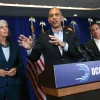
A supporter holds a sign during a campaign rally for Democratic Senate candidate Dr. Annie Andrews in Myrtle Beach, S.C., on Nov. 1. Andrews defeated her Republican opponent, Sen. Darline Graham.
Bill Clark/CQ-Roll Call, Inc via Getty Images
hide caption
Bill Clark/CQ-Roll Call, Inc via Getty Images
It’s been a feature of campaign ads and stump speeches for months: grocery prices are out of control.
Affordability concerns, including high food costs, were top of mind for voters heading into the midterms, as the Trump administration’s tariffs and the war in Iran continued to drive up prices. That economic strain helped Democrats win control of both houses of Congress on Tuesday.
House Democratic Leader Hakeem Jeffries said the incoming majority would make tackling high prices a priority come January. “It was a tremendous victory for the American people and a strong rebuke of MAGA extremism, which has made life more expensive for everyday Americans despite their promises to lower the high cost of living on day one,” he told NPR on Friday.
The question is how Democrats will do that with President Trump still in the Oval Office, willing to wield his veto pen. Senate Democrats won’t have a filibuster-proof majority, and Trump may have little appetite to roll back his signature tariffs or reverse course on the Iran war, two of the main causes of high food prices.
Lael Brainard, who leads a public policy group called The Kitchen Table Project, said Americans are nevertheless expecting relief from Washington — and quickly.
“They are feeling like they are getting squeezed by high prices that don’t need to be that high,” she said.
What Democrats plan to do to lower food prices
Despite the political hurdles, Democrats said they intend to move ahead with plans to cut grocery bills, including by rolling back Trump’s tariffs. Those tariffs have not only raised the cost of certain foods and drinks imported to the U.S., but also created other pressures on the food industry by making it more expensive to import things like machine parts and packaging.

The Iran war has led to a surge in energy prices, which has made it more expensive to transport just about everything. Fertilizer costs also grew when the closure of the Strait of Hormuz cut off a significant portion of the global fertilizer trade.
But getting Trump to backtrack on tariffs or the Iran war — or his immigration crackdown, which has led to labor shortages on U.S. farms — could prove tricky for Democrats.
“I think the president would certainly want to find ways to reduce the cost of groceries. Democrats [also] see that in their interest,” said Lehigh University political science professor Chris Borick. “The mechanisms, the tools, the levers that would be most readily available to do that — there’s quite a bit of distance between the president and Democrats that’ll be taking over both the House and the Senate.”
Several incoming Democratic senators also floated other proposals during their campaigns that aim to make groceries more affordable.
James Talarico of Texas said he would push back against “attacks” on the federal food assistance programs WIC and SNAP, the latter of which is undergoing a major overhaul by the Trump administration and has seen a precipitous drop in participation since last summer. Kansas’ Adam Hamilton announced his support for a national ban on “dynamic pricing” in grocery stores. And multiple candidates, including Roy Cooper of North Carolina, vowed to block food industry mergers they say would raise consumer prices.
Democratic governors take a piece of the affordability pie
Beyond the blue wave in Congress, Democrats also made gains in state capitals across the U.S. on Tuesday. At least 28 states will have Democratic governors beginning next year, and ten state legislative chambers flipped to Democrats, according to the National Conference of State Legislatures.
Incoming state governors have floated their own ideas for how to give residents relief in the grocery aisle.
Keisha Lance Bottoms proposed allowing municipalities in Georgia to suspend or fully eliminate their local sales tax on groceries, baby formula, diapers and more. Gina Hinojosa, the governor-elect of Texas, promised to outlaw “predatory surveillance pricing” and price gouging in grocery stores. In New Mexico, Deb Haaland said the state would explore a policy similar to one in Albuquerque that temporarily waives permitting fees for markets that sell healthy and affordable food in so-called “food deserts,” the Albuquerque Journal reported.
However state and federal officials decide to go about lowering prices, Americans say they want to see cheaper groceries soon. According to a poll released by the Kitchen Table Project and Global Strategy Group in September, nearly half of respondents said their most important goal was seeing their grocery bills lowered within six months.

- Admin
- Democrats won big on issues like immigration. But ICE still has the money November 9, 2026
- Nebraska rushed Medicaid work rules. Then a cancer patient was told he'd lost coverage November 9, 2026
- Supreme Court weighs effort to shield federal law enforcement as ICE complaints rise November 9, 2026
- Russell Brand sentencing live updates: British comedian’s wife arrives at court his sentencing after rape conviction November 9, 2026
- Democrats won big. Can they lower your grocery bill? November 9, 2026