Shedeur Sanders has become the Angel Reese of the NFL, thanks to his insufferable supporters
From Skip Bayless accusing NFL teams of racism after the 2025 NFL Draft to ESPN personalities invoking Colin Kaepernick, the Shedeur Sanders discourse looks awfully familiar to anyone who has followed Angel Reese’s career in the WNBA. Criticism, of any sort, is seen as a microaggression.
The Shedeur Sanders experiment and discourse has become toxic. Legitimate football criticism is apparently a microaggression, NFL general managers are supposedly conspiring against a young quarterback, and anyone who questions the former Colorado star’s abilities as a quarterback in the NFL risks being branded more than a hater. They’re labeled discriminatory.
If Sanders does not get the recognition, playing time or praise fans believe he deserves, those fans scream racism.
A screen shows Colorado quarterback Shedeur Sanders after being chosen by the Cleveland Browns with the 144th overall pick during the third day of the NFL football draft, Saturday, April 26, 2025, in Green Bay, Wis. (AP Photo/Jeff Roberson)
That should sound very familiar to the way fans and WNBA media have treated the Angel Reese discourse.
In my opinion, Sanders has become the Angel Reese of the NFL, not necessarily because of anything the athletes themselves have done on the court or field, or in the media, but because of the exhausting victimhood narratives pushed by some of their most devoted supporters.
The similarities are uncanny.
Criticize Sanders’ decision-making, pocket presence, pre-draft interviews or news conferences? You’re racist.
Question Reese’s offensive efficiency, shot selection or how she compares to Caitlin Clark? Prepare for accusations of racial bias.
And heaven forbid you suggest another quarterback deserves an opportunity over Sanders or that Clark is simply a better, more exciting basketball player.
For certain corners of sports social media, everything must be viewed through a racial lens. Black versus white. Oppressor versus oppressed. Victim versus villain. They’re obsessed with race.
It’s exhausting, and some prominent sports media personalities have helped pour gasoline on the fire.
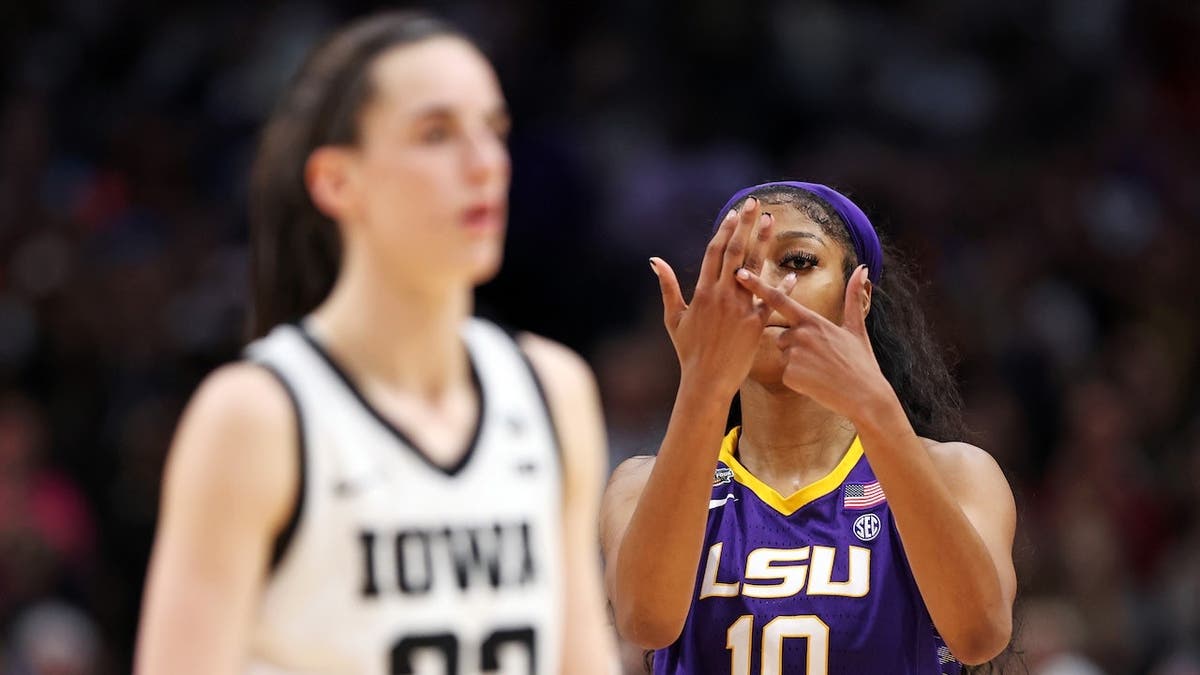
Angel Reese of LSU reacts toward Caitlin Clark of Iowa during the fourth quarter of the 2023 NCAA Women’s Basketball Tournament championship game at American Airlines Center in Dallas, Texas, on April 2, 2023. (Getty Images)
COLIN KAEPERNICK SAYS NFL IS ‘ACTIVELY BLACKBALLING ME’ 10 YEARS AFTER KNEELING PROTEST BEGAN
Skip Bayless, Stephen A. Smith, & Ryan Clark Turn Sanders’ Draft Slide Into a Racial Controversy
Remember when Sanders inexplicably fell to the fifth round of the 2025 NFL Draft?
The Cleveland Browns eventually selected him with the 144th overall pick, despite considerable pre-draft hype that once placed him in the conversation as a first-round election.
Rather than consider that NFL franchises might have legitimate concerns about Sanders’ talent, personality, football IQ, work ethic, maturity, or overall fit, some of the biggest names in sports media immediately began suggesting something more sinister.
ESPN’s Stephen A. Smith was among the loudest.
KAEPERNICK TELLS ‘THE VIEW’ THAT NFL OWNERS KEPT HIM OUT OVER POLITICS AND POWER, CLAIMS THEY DONATE TO TRUMP
As Sanders continued falling down draft boards, Smith suggested the situation resembled the NFL’s controversial treatment of former San Francisco 49ers quarterback Colin Kaepernick.
Smith declared, “This feels like (Colin) Kaepernick-level collusion.”
He also accused NFL owners of appearing to collude against Sanders and suggested teams were motivated by their dislike of his father, Deion Sanders.
Think about that.
Thirty-two NFL franchises making their own personnel decisions somehow became evidence of a coordinated effort to keep Sanders down, in part because of his race, allegedly.
And Smith wasn’t alone.
Skip Bayless initially described Sanders’ draft slide as the most disgusting development in NFL Draft history. Then, following Sanders’ impressive preseason debut against the Carolina Panthers in August 2025, Bayless took things considerably further.
“Tonight, Shedeur Sanders made the entire National Football League look like a whole bunch of petty fools and, in some cases, racist fools.”
Bayless also accused teams of being motivated by their dislike of Deion Sanders, arguing that Shedeur had embarrassed the organizations that passed on him.
There was just one glaring problem: Bayless didn’t provide evidence establishing that any NFL team passed on Sanders because of his race.
Apparently, one strong preseason performance was enough to expose an alleged league-wide racial conspiracy.
Former ESPN analyst Ryan Clark also brought race into the conversation before the draft, suggesting that Sanders faced additional scrutiny because he was a confident Black quarterback, something many Sanders fans have echoed online throughout the last two seasons.
Clark argued that Sanders’ appearance, bravado, and skin color contributed to the criticism surrounding him.
They willfully chose to ignore the legitimate football-related explanations for his slide and pushed the black victim narrative.
CBS Sports NFL insider Jonathan Jones reported concerns about how Sanders handled the pre-draft process, while other reporting highlighted questions surrounding his interviews, preparation, and ability to transition to the professional game.
Former NFL quarterback Boomer Esiason even reported that some teams had removed Sanders from their draft boards entirely.
Could NFL teams have misjudged Sanders? Sure.
Could they have overreacted to his personality or the attention surrounding his famous father? Plausible.
But being evaluated incorrectly isn’t automatically discrimination. Sometimes teams simply don’t believe a player is worth the investment, especially in the early rounds.
That’s how the NFL Draft works.

Quarterbacks Shedeur Sanders (12) and Deshaun Watson (4) of the Cleveland Browns watch from the sidelines during a game against the Cincinnati Bengals at Huntington Bank Field on Sept. 07, 2025 in Cleveland, Ohio. (Jason Miller/Getty Images)
The Angel Reese Playbook: When Basketball Criticism Becomes a Racial Controversy
If you’ve followed the WNBA since Caitlin Clark and Angel Reese entered the league, you’ve already watched a similar spectacle unfold.
Clark and Reese have been linked since their memorable college basketball battles, but some supporters have transformed their rivalry into something far more divisive than basketball.
For certain Reese defenders, criticism of her offensive game, including mentioning her uncanny ability to rebound her own misses, humorously trademarking “MeBounds,” is treated not merely as an opinion about basketball skill, but as a potential indictment of the critic’s racial attitudes.
Meanwhile, praise for Clark can become entangled in arguments about racial privilege and the treatment of Black women in professional sports.
ESPN’s Monica McNutt helped illustrate just how quickly the conversation can shift.
Following Clark’s flagrant foul against Reese in May 2025, McNutt discussed allegations of racist fan behavior and questioned how differently the incident would have been received had Reese committed the foul.
McNutt argued that the two athletes were being placed into opposing roles, with one portrayed as a victim and the other as someone needing protection.
Her comments were part of a broader discussion about racial double standards, but they also demonstrated how quickly a basketball play can become a referendum on race.
The race card is pulled in almost every controversial play and action Reese has been involved in.
The controversy became even more revealing when the WNBA investigated allegations of hateful fan comments and “monkey noises” directed toward Reese during that same Fever vs Sky game.
The league ultimately announced that its investigation could not substantiate the specific allegations.
Even WNBA commissioner Cathy Engelbert found herself under fire in September 2024 when she discussed the commercial appeal of the Clark-Reese rivalry without initially delivering the condemnation of racist fan behavior that several players and the players’ union wanted.
The backlash was substantial, with prominent players including DiJonai Carrington criticizing her response. Engelbert subsequently clarified that racism and hatred had no place in the league.
More often than not, situations involving Angel Reese have become a racial grievance. It’s nauseating.
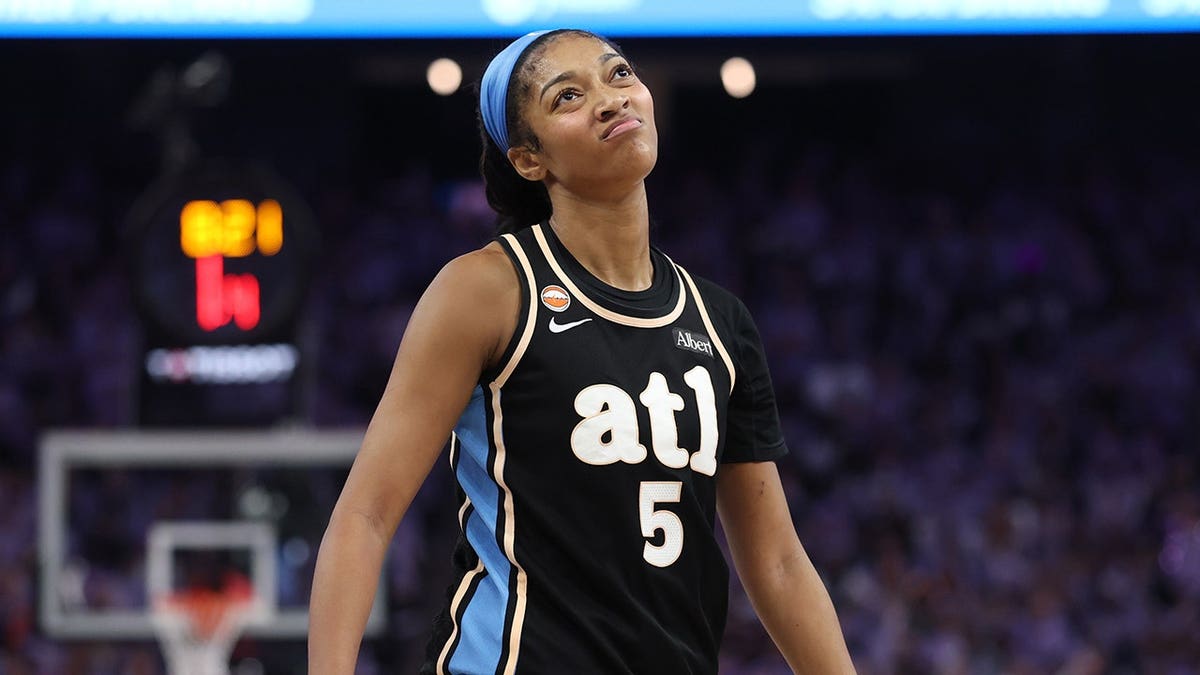
Angel Reese #5 of the Atlanta Dream reacts during the fourth quarter in Game 7 of the 2026 WNBA Finals against the Golden State Valkyries at Chase Center on Oct. 31, 2026, in San Francisco, Calif. (Getty Images)
Dillon Gabriel Versus Shedeur Sanders: Another Manufactured Racial Controversy
And now we have the Dillon Gabriel vs Shedeur Sanders situation.
Sanders and Gabriel entered the Cleveland Browns’ quarterback room under dramatically different circumstances. Gabriel was selected in the third round of the 2025 NFL Draft, while Sanders had to wait until the fifth.
For some Sanders supporters, that draft order itself became another reason to question whether the NFL was treating their favorite quarterback fairly based on race.
The rivalry has also provided endless ammunition for social media arguments about which quarterback deserves opportunities and whether Cleveland has handled Sanders appropriately.
Instead of allowing Gabriel and Sanders to compete as quarterbacks based on meritocracy, some fans seemed determined to make their competition about something bigger.
Every compliment directed toward Gabriel becomes a potential slight against Sanders. Every criticism of Sanders becomes an opportunity to question the motivations of coaches, executives, or media members.
It’s the same exhausting dynamic surrounding Clark and Reese.
Rather than simply acknowledging that two athletes have different strengths, weaknesses, and accomplishments, some supporters insist on turning the conversation into a moral crusade.

Cleveland Browns quarterback Dillon Gabriel (5) passes as quarterback Shedeur Sanders (12) looks on during rookie minicamp at CrossCountry Mortgage Campus. (Ken Blaze-Imagn Images)
Athletes Don’t Need to Be Victims to Be Worth Supporting
Here’s what makes this entire controversy so ridiculous: Shedeur Sanders and Angel Reese don’t need these narratives to justify their places in professional sports.
Sanders was a productive college quarterback who earned an opportunity in the NFL. Reese became a national champion at LSU and established herself as a formidable rebounder, and many times this season, an effective scorer in the WNBA.
Their accomplishments are legitimate, but so are criticisms of their games.
Sanders can be a talented quarterback who still has weaknesses that NFL coaches and GMs must evaluate. Reese can be an outstanding rebounder whose offensive efficiency deserves scrutiny. Neither observation is inherently racist. Neither athlete needs supporters inventing ulterior motives every time someone offers an unfavorable assessment.
The irony is that the constant racial framing can ultimately undermine the very athletes their fans claim to defend.
Instead of discussing Sanders’ development as a quarterback, we’re debating whether NFL executives are racists. Instead of discussing Reese’s rebounding, scoring, or defensive impact, we’re debating whether someone praising Clark is participating in racial favoritism. It’s a disservice to both athletes.
And when media personalities with enormous platforms amplify accusations without presenting sufficient evidence, they make the discourse even worse. Sports fans should be able to criticize players without being subjected to a trial over their character. They should be able to support Gabriel, or in this season’s case, Deshaun Watson, without hating Sanders, or celebrate Clark without harboring animosity toward Reese.
Actual racism deserves condemnation. Actual discrimination deserves investigation. But disagreement is not discrimination, criticism is not persecution, and losing a competition is not proof of a conspiracy.
Unfortunately, that’s a message some of the loudest Sanders and Reese supporters desperately need to hear.
Because the more they insist that every setback is evidence of racial injustice, the more they turn two accomplished athletes into perpetual victims in a culture war neither needs to win.

Shedeur Sanders finished 19-of-31 for 297 yards, two touchdowns and no interceptions in Cleveland’s 23-22 overtime loss to the New Orleans Saints. (Getty Images)
CLICK HERE TO DOWNLOAD THE FOX NEWS APP
A Response to Sanders Supporters
When I see Sanders fans in my replies say things like, “ANY black athlete that has confidence and swagger makes white nationalist males uncomfortable I’m starting to see,” I immediately roll my eyes. These fans can’t understand that Shedeur may come across to many people as immature, self-absorbed at times, and lacking self-awareness when he seemingly disrespects the Saints defense when he’s about to make his first start of the season.
Disagree all you want, but his actions, including his arrogance he’s displayed at times, along with his play are why so many teams passed on him in the NFL Draft.
Let this sink in. Out of 42 eligible quarterback last season, Shedeur Sanders ranked 41st in Passer Rating. He threw more interceptions than touchdowns. He had the fifth-worst QBR since QBR became a stat in 2006, making it the worst for any Browns QB with at least six starts in the history of the franchise.
My criticism is not racism. I could lay out why I believe Watson is the best option as starter for the Cleveland Browns, but we’ll save that for another article. All in all, my thoughts are based on what I see on the field and my opinion of what I hear from him off of it, which seems to be echoed by NFL front office and some media members.
The stats don’t lie. You supporter do.

- Admin
- Inside Russell Brand’s grim new prison life: Just one hour outside his cell and no conjugal visits November 10, 2026
- Nick Sirianni denies flipping off Eagles fans in viral video after seventh straight loss November 10, 2026
- Jaguars are all in on winning the Super Bowl after completing three trades in one day to make a title push November 10, 2026
- Nvidia’s Jensen Huang called to Congress by GOP — chip sale cutoff could be at stake over Chinese ‘spy’ honeypot November 10, 2026
- Shedeur Sanders has become the Angel Reese of the NFL, thanks to his insufferable supporters November 10, 2026