U.S. officials look to Europe to learn how to make prison better
A group of Americans, whose work intersects with the criminal justice system in New York City, tour the Moabit pretrial detention facility in Berlin, Germany. The nonprofit Vera Institute of Justice invites officials to tour prisons in Germany to see how they design their system for rehabilitation.
Lena Mucha
hide caption
Lena Mucha
More than a dozen New Yorkers crowded into an empty prison cell in Berlin, Germany, this October. Inside, they found many contrasts to U.S. prisons: For one, prisoners held at this German facility, Tegel Prison, have keys to their own cells.
The reason, prison director Martin Riemer told the group, is so the men held here can lock their own door when they go to work or school, just like someone might at home. The guards still have keys, but Riemer said this gesture offers a semblance of privacy.
Riemer also noted that every prison cell in Germany must have natural light and ventilation. In the cell the tour group inspected, the large window still had bars on it, but it opened. A breeze was blowing in.
The purpose of this trip was to inspire key players in the criminal justice system — a judge, a prosecutor, a prison official, among others — to see new ways of improving New York City’s troubled jail system, which officials are in the process of reimagining.
The trip, organized by the Vera Institute of Justice, a criminal justice reform nonprofit, is part of a larger trend: U.S. officials are increasingly looking abroad for how to design a better prison or jail system. In fact, at least 10 U.S. states now model some of their prison units or practices after prison systems in Western Europe and Scandinavia.
“It’s what happens when they get there that makes a world of difference, really seeing it with their own eyes,” says Nancy La Vigne, dean of the Rutgers School of Criminal Justice. “Touring the facilities, talking to the officers, talking to the incarcerated population, witnessing rehabilitation in real time is very inspiring.”

Aisha Elliott (in red jacket) and Tina Luongo, both seated, listen during a tour of a suicide prevention room at the Moabit pretrial detention facility in Berlin.
Lena Mucha
hide caption
Lena Mucha
On the tour of Tegel Prison, the group from New York kept finding tangible differences. Jails and prisons in the U.S. often have a distinct smell — the result of many bodies held in a poorly ventilated space. This German prison did not. Jails and prisons in the U.S. are often noisy. This prison was quiet.
Aisha Elliott, a tour member who spent more than 20 years incarcerated in New York state prisons, noticed the furniture.
“There’s a lot of wood and movable objects, which I think makes it more bearable. Everything in New York is steel, metal, thin and painful,” said Elliott, chief program officer at the Women’s Prison Association, an advocacy group.
Tina Luongo kept peeking at the cell toilets. In American jails, she says the toilets remind her of a metal dog bowl. In Berlin, most were porcelain, like in a home.
“It’s speaking to me because it’s the smallest thing,” said Luongo, who leads the Legal Aid Society’s criminal defense practice, the largest public defense provider in the U.S. “I have to believe that makes a difference in how you show up in those places.”
The German prison system
European prisons aren’t perfect. In countries like Norway and Denmark, prisons still experience overcrowding, understaffing and lockdowns. Officials at several German prisons were quick to tell the New York group that correctional officers often still have to deal with things like violence between prisoners and issues with drug overdoses.
German prisoners say that what they are experiencing is still prison: They long for more human touch, for instance, and better food.
But the country is often regarded as an international model. After the Holocaust, Germany adopted a new constitution that centers on protecting human dignity, including in its prisons. In Germany, the loss of freedom is seen as the punishment, not the conditions inside.
In contrast, prison conditions in the U.S. are often plagued with inhumane conditions and violence. The Department of Justice has dozens of open investigations into jails and prisons across the country for constitutional violations.
By law, life inside a German prison has to resemble life outside prison as much as possible, a concept known as normalization.

Cells inside German prisons, like this one in the Moabit pretrial detention facility, often feature wooden furniture that can move. Elliott, the women’s prison advocate, says prisons in the U.S. often have metal furniture bolted to the walls.
Lena Mucha
hide caption
Lena Mucha
Lauren-Brooke Eisen, senior director of the Justice Program at the Brennan Center for Justice, says normalization might look like allowing prisoners to cook their own food, or wear street clothes instead of a uniform. It could also be that a toilet inside a cell has a door or curtain on it for privacy.
German prison staff also go through years of training, and many have backgrounds in social work or law. In the U.S., correctional officers often only train for a few weeks or months. All of this, Eisen says, creates a culture of rehabilitation in German prisons.
“In many other countries, when you are incarcerated, you don’t lose your humanity the same way that you do necessarily in the United States,” Eisen says.
European models in the U.S.
Over the last decade, the Vera Institute’s own initiative, called Restoring Promise, has launched prison units modeled after Europe in six states: Connecticut, Massachusetts, South Carolina, North Dakota, Colorado and Idaho.
Its initiative focuses on 18- to 25-year-olds, a group that is more likely to make impulsive decisions, including resorting to violence to solve a conflict.
Ryan Shanahan, chief research officer at the Vera Institute, says prioritizing safety is necessary when any change happens inside a prison.
“But what does that mean? Traditionally in U.S. prisons, safety is keys, locks, cameras, barbed wire fences,” says Shanahan, who helped start Vera’s initiative.
But, Shanahan says, skills like asking questions, listening and relationship building can make an environment safer, too. The goal of the Vera Institute’s prison units is to build that culture. Older prisoners serving long sentences act as mentors for young people in the program. Staff members engage with families on the outside.

Director Martin Riemer of Berlin’s Tegel prison, shown here, says all prison cells in Germany must have access to natural light and ventilation.
Lena Mucha
hide caption
Lena Mucha
There are daily schedules that include discussion groups and activities aimed at “learning conflict resolution and being able to practice it, learning to care for each other and be vulnerable and practice that, so that you can care and be vulnerable when you go home,” Shanahan says.
That matters. Almost everyone who goes to prison in the U.S. is eventually released.
A cost-benefit analysis
But these types of programs are still in only a small percentage of U.S. prisons. One barrier to launching more of them is the sheer size of the U.S. prison system.
Around 2 million people are behind bars in the U.S. at any given moment, the most in the world. The German system is about 3% of that size. People in German prisons also generally serve sentences that are far shorter than those in the U.S.
Shanahan says for many U.S. prison leaders, the desire for change is there, but “there has to be a level of risk tolerance. There has to be a commitment to try to do something different.”
Other key barriers include cost and staffing, says La Vigne, the Rutgers professor. Many U.S. prisons are currently facing staffing shortages.
“Most of the programs that have been piloted have a pretty high ratio of correctional officers to incarcerated persons,” she says. “But investing those resources is probably cost beneficial because you’ll also be retaining your officers and your staff, because they’ll be more likely to feel like this is a place where I want to be.”
There is evidence to suggest that both staff and prisoners benefit from programs like the German model.
In a 2023 study of one of its units in South Carolina, Vera found prisoners there were far less likely to commit violence, and also less likely to end up in solitary confinement.
In Washington, a program modeled after Norwegian prisons in partnership with the University of California, San Francisco, also resulted in less violence among prisoners, and correctional staff began coming to work more consistently.
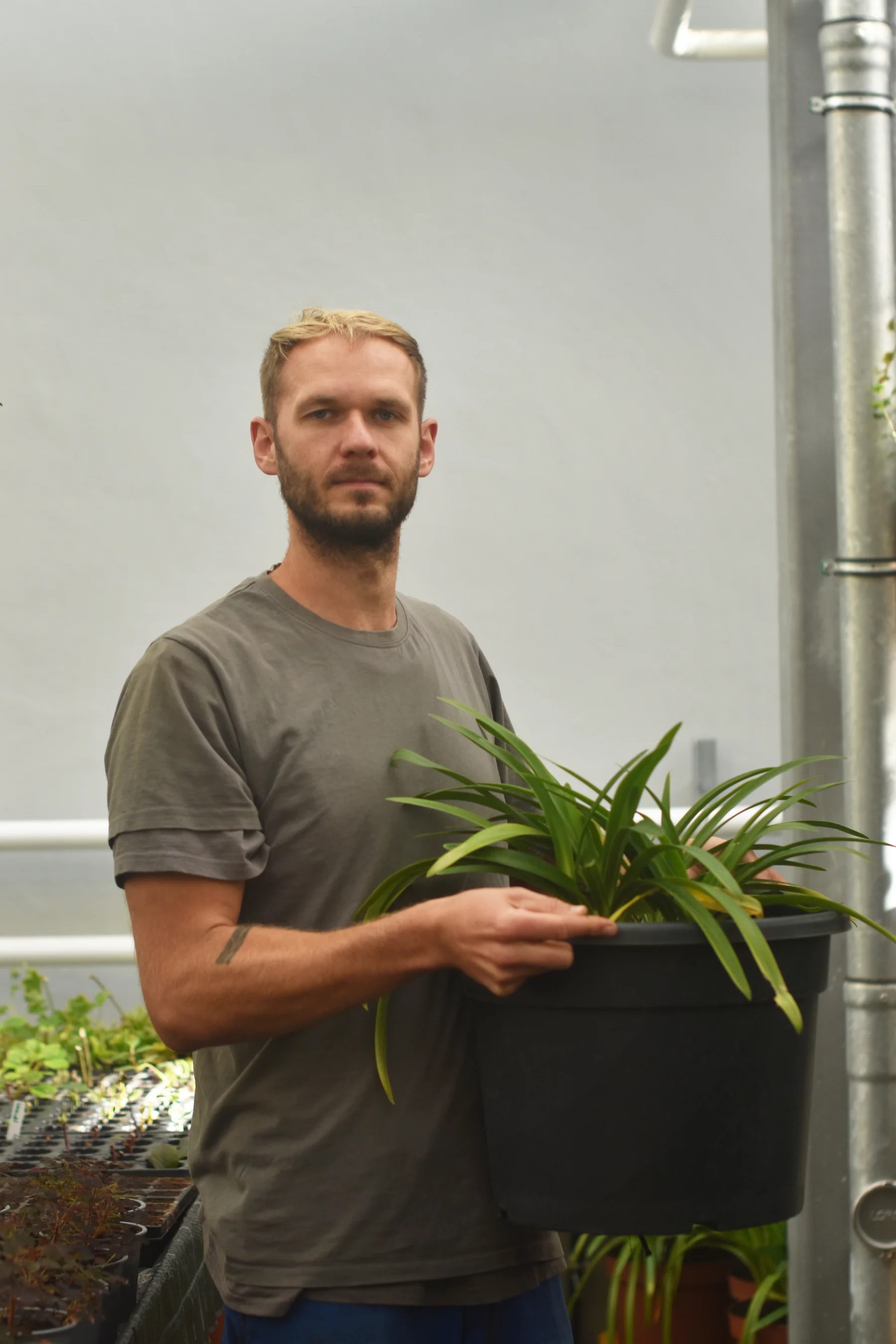
Lenny Albrecht, who has been incarcerated at Tegel for four years, says working in the prison’s greenhouse has helped him feel more calm and relaxed.
Meg Anderson/NPR
hide caption
Meg Anderson/NPR
When Maine remodeled its prisons around the concept of human dignity, it found prisoners were less likely to commit new crimes once they were released.
In Pennsylvania, a reform unit called Little Scandinavia saw almost no violent incidents in 2024, even as violence rose in other facilities, according to preliminary data cited in a Brennan Center report.
On its tour of Tegel Prison in Berlin, the New York group passed through a greenhouse that smelled like fresh dirt and lemon basil.
Inside, Lenny Albrecht, who has been incarcerated there for four years, was repotting plants. He said his job as a landscaper requires a lot of trust: He can use scissors and knives in his work, and he can walk the grounds without being supervised by an officer.
Mostly, though, he said he likes that the work makes him feel comfortable and relaxed.
“Before, I was very aggressive,” Albrecht said. “The work here makes you calm down and relax. And that’s a thing I never had before.”

Elliott, the women’s prison advocate, said the Tegel Prison greenhouse shows that officials there are “treating people like people” and supporting them toward their release.
Meg Anderson/NPR
hide caption
Meg Anderson/NPR
Nearby, Elliott, the women’s prison advocate, is taking in the freshness of the place. The yards in New York prisons, she said, are mostly concrete.
“This feels good because they’re treating people like people,” she said. “I feel like they are headed in the right direction, which is toward release, supporting people toward their release.”
She said a person in prison might not feel good about where they are, but the goal should be to make them feel good about who they are, or who they can become.

- Admin
- UK’s dire warning: Resist Islamist politics — or lose America’s freedom November 11, 2026
- Your guide to hosting a flavorful, cozy and stress-free Thanksgiving November 11, 2026
- U.S. officials look to Europe to learn how to make prison better November 11, 2026
- Volunteer musicians play songs for veterans who are hospitalized November 11, 2026
- AI hoaxes are deceiving 911 dispatchers, and they're only getting harder to detect November 11, 2026