Fox News Poll: Democratic enthusiasm shapes North Carolina Senate race
Midterm polls show razor-thin margins 100 days out
Fox News’ power rankings reveal tight races in both the Senate and House, with 100 days remaining until the midterm elections. Four Senate seats and 16 House seats are toss-ups, indicating a highly competitive midterm election landscape.
NEWYou can now listen to Fox News articles!
In North Carolina, more Democrats than Republicans say they are extremely interested in the midterm elections (51% vs. 42%), and more Democrats also say they are extremely motivated to vote (58% vs. 50%). This enthusiasm advantage creates an edge in the Senate matchup.
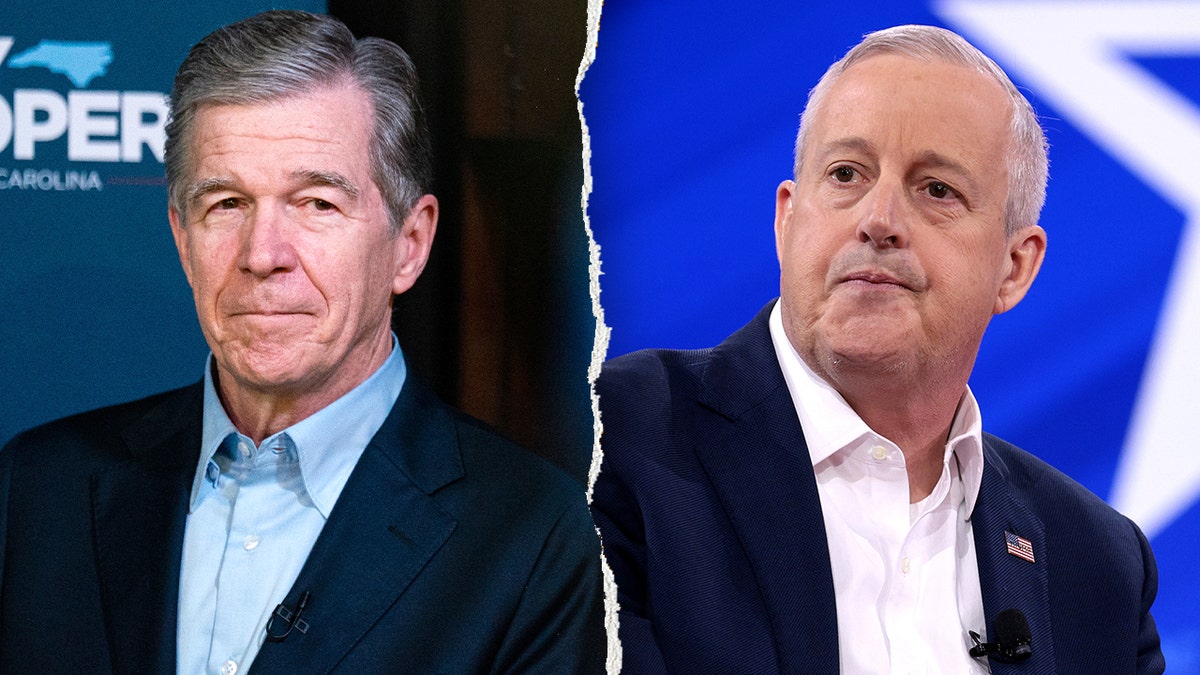
Democrat Roy Cooper leads Republican Michael Whatley by 53% to 44% in the race to fill the state’s open Senate seat, according to a Fox News poll of North Carolina voters.
Cooper’s gap widens to 15 points among those saying they’re extremely interested in the election (57% vs. 42%) and 13 points among those extremely motivated to vote (55% vs. 42%). The race is unchanged among those saying they’re “certain” to vote (53% to 44%).
FOX NEWS POLL: COOL YOUR SERVERS! VOTERS REJECT DATA CENTERS
Whatley is the former chair of the Republican National Committee, while Cooper served as North Carolina’s governor from 2017-2025. The candidates are vying to fill the seat held by retiring Republican Senator Thom Tillis.
Cooper receives high support from moderates, voters under age 30, independents, voters with a college degree, and women. He also captures support from about one in five non-MAGA Republicans and conservatives.
Whatley performs best among very conservative voters, White evangelical Christians, White voters without a college degree, and rural voters.
There’s also an enthusiasm gap when voters are asked why they back their candidate. Some 52% of Whatley’s supporters say they’re voting for him, while 46% say it’s mainly against Cooper. By contrast, 84% of Cooper supporters say they’re voting for him rather than against Whatley (13%).
FOX NEWS POLL: SIGNIFICANT SUPPORT FOR BOTH VOTER ID LAWS AND MAIL-IN BALLOTS
Most voters are committed to their choice: 81% of Cooper’s backers say they’re certain to vote for him and it’s 77% among Whatley supporters. Overall, one in five voters say they could switch their pick.
President Trump complicates the contest for Whatley. Forty percent of North Carolina voters view the president favorably and 58% unfavorable. That’s net negative by 18 points, while his ratings were underwater by just 6 points two years ago (47-53%).
And Whatley’s ties to Trump concern 48% of voters, with worry extending across the spectrum, including more than half of moderates, more than 4 in 10 independents, and about 3 in 10 non-MAGA Republicans. Meanwhile, concern about Cooper’s ties to the Democratic establishment is more partisan. Overall, 42% are concerned, including 7 in 10 Republicans, but just 3 in 10 independents and moderates.
“Recent data put the average Republican advantage in North Carolina statewide races at about 3 points,” says Republican pollster Daron Shaw, who conducts the survey with Democrat Chris Anderson. “Cooper’s edge rests on almost unanimous Democratic support and commanding numbers among independents. To win, Whatley must stop the bleeding with non-MAGA Republicans and improve his standing with disaffected, less partisan Carolinians.”
Personal popularity also sets the candidates apart. Cooper’s 54% favorable rating is significantly higher than Whatley’s at 40%. In addition, Cooper is more popular than the Democratic Party by a 12-point margin, while Whatley trails the GOP by 4.
Whatley is less well known overall, as 14% of voters say they’re unable to rate him or have never heard of him, including about 1 in 10 Republicans.
Tar Heel voters share equally negative views of the Republican Party (44% favorable vs. 54% unfavorable) and the Democratic Party (42% vs. 56%).
Negative partisanship is strong, as more Democrats view the GOP negatively (94%) than view their own party positively (83%). The reverse is also true: more Republicans (92%) hold an unfavorable opinion of the Democratic Party than view the GOP positively (85%).
Among the small subgroup viewing both parties negatively, Cooper draws twice as much support as Whatley (64% to 32%).
Inflation is the top issue for North Carolina voters, with 36% saying it will be most important to their vote for Senate. Next, it’s political divisions within the country at 14%, followed closely by healthcare and immigration at 13% each.
Half describe their financial situation as stable, 12% say they’re getting ahead, and 38% say they’re falling behind, which is 6 points lower than it was two years ago.
North Carolina’s recent voting history points in different directions. Cooper won reelection in 2020 by almost 5 percentage points. In fact, Democrats have won 8 of the state’s last 10 gubernatorial elections. The last Republican to win was Pat McCrory, by about 11 points in 2012.
At the same time, Republicans have won the state in 11 of the last 12 presidential elections. The last Democrat to carry the state was former President Obama, who won by 0.3% in 2008.
In the 2024 presidential election, Trump won North Carolina by 3 percentage points.
Conducted July 23-27, 2026, under the joint direction of Beacon Research (D) and Shaw & Company Research (R), this Fox News Poll includes interviews with a sample of 1,005 North Carolina registered voters randomly selected from a statewide voter file. Respondents spoke with live interviewers on landlines (115) and cellphones (654) or completed the survey online after receiving a text message (236). Results based on the full sample have a margin of sampling error of ± 3 percentage points. Sampling error for results among subgroups is higher. In addition to sampling error, question wording and order can influence results. Sources used to develop weight targets include the most recent American Community Survey, Fox News Voter Analysis, and voter file data. Weights are generally applied to age, race, education, and area variables to ensure the demographics of respondents are representative of the registered voter population. Results among subgroups are only shown when the sample size is at least N=100.
Fox News’ Victoria Balara contributed to this report.

- Admin
- One killed, 3 injured as reckless NYC Mercedes driver mows down pedestrians while trying to beat light: sources October 10, 2026
- Country singer Ella Langley cancels concert over 'serious security threat' to fans, crew October 10, 2026
- What To Make Of Knicks Pausing Extension Talks With Karl-Anthony Towns, Josh Hart | NY Got Game October 10, 2026
- Kalshi taps former FBI agent to fight against money laundering October 10, 2026
- Tyreek Hill changes divorce battery trial testimony, claiming he didn't push wife but was verbally abusive October 10, 2026