What really happened in Ceuta? Why we may never find out
A heavy police and army deployment prepare at the border between Morocco and Spain on August 15, 2026 in Fnideq (Castillejos), Morocco.
Adri Salido/Getty Images Europe
hide caption
toggle caption
Adri Salido/Getty Images Europe
SEVILLE, Spain — When Juanjo Coronado wrote back to NPR, two weeks after the July 30 mass border crossing in Ceuta, to send an update on how he and his daughter were doing, he sent just one line: “same, which means worse.”
Weeks after the mass crossing, in which more than 140 people died, Spain is trying to close the chapter. The government says that most of the over 70,000 migrants who crossed into Ceuta the week of July 27 are back in Morocco, and that they returned of their own accord.
The caveat is that “most” is not “all.”
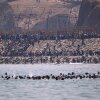
Thousands of migrants, many of them unattended minors, remain in Ceuta, while the local population adapts to their presence: from helping with food or shelter, to organizing neighborhood watch groups with aggressive tactics. Or in the case of Juanjo Coronado, simply not going outside.
The images of tens of thousands of migrants crossing into the small Spanish enclave came as a shock to Spanish leaders, who had been busy responding to some of the largest wildfires in Spain’s history. The event was also a shock, and a cause of division, in the European Union.
Many world leaders, such as President Donald Trump and Italian Prime Minister Georgia Meloni, quickly pointed at the event as the exemplification of the global anti-immigration movement’s worst nightmare.
But it was not a shock to Teresa Pardo and Juanjo Coronado, who have lived in Ceuta their entire lives, a territory of roughly 7 square miles, much of it surrounded by a fence.
And not just any fence. It’s a 5-mile long double fence, as tall as 30-feet, equipped with the latest technology designed to stop sudden crossing attempts by migrants from the other side of the border.
Pardo and Coronado have both seen enough throughout their lives in Ceuta to understand that events at the border always happen for a reason. But what happened on July 30 was not “normal,” both tell me. And they are living the consequences, Pardo says:
“We feel a sense of helplessness. There are shortages in the supermarkets, with limits on how many loaves of bread each person can buy. Even at 30 years old, I find myself having to call my parents to let them know I got home safely from work.” Both Pardo and Coronado say that they simply want Ceuta to go back to what it was three weeks ago.
And despite their desperation, past experience tells us that Ceuta can recover from these kinds of episodes.

Migrants receive food and aid from the NGO’s in El Trampolin Beach on August 14, 2026 in Ceuta, Spain.
Adri Salido/Getty Images Europe
hide caption
toggle caption
Adri Salido/Getty Images Europe
“What past experience shows us that there are always three steps involved,” says José Bautista, lead researcher at the non-profit organization porCausa, and investigative journalist.
Bautista adds: “First, Morocco creates a migration crisis in Ceuta, Melilla, or the Canary Islands. Second, Morocco negotiates with Spain to secure some form of concession. And third, Morocco creates a problem again — another migration crisis. But this time, instead of letting the crisis play out, Morocco presents itself as the solution.”
In this instance, the first step of this pattern that Bautista describes took place on July 30. The second step is often invisible, or rather, not officially communicated. The third step of the pattern could be witnessed on Saturday Aug. 15, when a rumored mass crossing in Ceuta was successfully suppressed by the same Moroccan law enforcement that apparently could not stop more than 70,000 people from entering Ceuta about two weeks before.
Before they point the finger at anyone in particular, Teresa Pardo and Juanjo Coronado use the exact same words to describe how they feel: “the people of Ceuta… we feel abandoned, exposed.”
Two exposed territories
Ceuta and Melilla have been Spanish territories for centuries, and they both precede the state of Morocco, which gained independence in 1956, having been a protectorate of France and Spain.
The two “autonomous cities,” as they are called in Spain, are a proud mix of four cultures: Christian, Muslim, Jewish and Hindu — and their population overwhelmingly supports being part of Spain, despite Morocco’s long-standing sovereignty claims over both territories.
But today, Ceuta and Melilla are two “de-facto islands,” says José Bautista. Decades ago the flow of people from Morocco to these two cities was constant. But in the 1990s the mostly free flow of people ended, as Spain started to build what today is a complicated border fence complex to separate the European territories from Africa.
Bautista believes Ceuta and Melilla are two laboratories for global migration control.
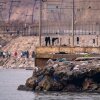
“The border fences in Ceuta and Melilla are big business for a very small group of companies,” Buatista says. “These companies not only profit from those two militarized border fences but also conduct technology trials and tests that they subsequently export to other countries,” he adds, citing his non-profit’s recent investigation on technology being used at Spanish borders.
But despite the technology, Ceuta and Melilla’s borders are nearly impossible to protect only from the Spanish side. There is only one solution to this problem. Bautista explains: “European governments are ceding their border sovereignty to third countries so that they can do the dirty work and crack down on migration flows.”
Morocco finds itself with the kind of leverage any country with imperial aspirations would dream of. And Morocco has been vocal about its territorial ambitions in Ceuta, Melilla, the Canary Islands, and the disputed former Spanish territory of Western Sahara.
That’s how we get to July 30, 2026, the day of the mass border crossing.

Relatives and friends wait by a fence topped with barbed-wire for the return of people who had previously crossed into Spain’s North African enclave of Ceuta, at Morocca’s Bab Sebta border crossing on the outskirts of Fnideq on August 2, 2026.
Abdel Majib Bziouat/AFP via Getty Images
hide caption
toggle caption
Abdel Majib Bziouat/AFP via Getty Images
Why July 30 was different
Soraya Aybar Laafou had been following the increase in social media activity in Morocco since late June. On Facebook, and Discord, many of the young Moroccans who had also been involved in a series of Gen Z protests in 2025 were talking about a mass border crossing brewing at the border with Ceuta. On Instagram, young people were sharing videos about how to swim into Ceuta.
Aybar, a political scientist and journalist based in Casablanca, decided to go find out what was happening. She left for Castillejo, a city on the other side of the border from Ceuta. But that’s when she noticed something strange — train tickets were selling out. It turned out, thousands of young people were traveling there too.
In the days leading up to July 30, border crossings started to increase. Local authorities in Ceuta were aware, and had notified the Spanish central government.
On the Moroccan side, law enforcement, vastly experienced in controlling migration flows towards the border, appeared to be missing this time.
That slow increase in border crossings became the event that Aybar thinks will mark a before and after in the history of Ceuta. For hours, thousands of people crossed from Morocco to Ceuta with no apparent obstacles or law enforcement restrictions. In fact, Aybar says she witnessed people flowing in until the next morning.
In the days after, the Spanish and Moroccan governments said they were acting in coordination towards the crisis, which was exemplified by their shared message about the culprits: the human trafficking networks, a recent Spanish Supreme Court ruling that said that migrants arriving in Ceuta by swimming could not be immediately deported back to Morocco, and social media.
But when Aybar talked to dozens of youths who crossed the border that day, none of them seemed to be aware of the Supreme Court ruling, or any human trafficking “mafias” involved. She observed something very different about this particular mass crossing.
“There are a number of factors driving many of the young people who attempted to cross — or who did cross — out of pure necessity,” she says. “Yet, there is also a segment of that group who will tell you themselves: they did it for the adventure, to understand the process, or simply to join in.” An adventure that proved to be a deadly one.
The uncomfortable aftermath
When we spoke with journalist Barbara Ayuso, on Monday, Aug. 10, she had just come back from Ceuta. She said that, despite the Spanish government claim that only a few thousand of the tens of thousands of migrants who crossed on July 30 had remained in Ceuta at that point, her reporting for the Spanish daily El País told a different story:
“There were 2,000 people on the Trampolín beach alone. To that figure, we must add the impromptu headcount conducted by local residents of minors, over 4,000. Then there are all the people hiding in the hills, and those who have taken refuge in the homes of Moroccan relatives in Ceuta. Based on this, we arrived at a rather revealing estimate: we are talking about a minimum of 8,000 people.”
Spanish authorities are just now beginning to report higher numbers of migrants in Ceuta, with nearly 6,000 having now received medical attention. Ayuso explained that the main issue is the lack of proper attention. Migrants on Trampolín beach are enduring high temperatures, with no protection from the sun, and no running water. And there is a particularly vulnerable group, dozens of Moroccan girls, wandering around on their own. Ayuso says the police was investigating seven reported cases of sexual abuse at the time of speaking with NPR.
In Ceuta, citizens are enraged. They have taken to the streets to protest what they say is a lack of appropriate response from the Spanish government. Resident Juanjo Coronado openly blames the Spanish prime minister and the interior minister: “I am singling out Pedro Sánchez or [Fernando] Grande-Marlaska for their inaction, or perhaps for overconfidence. It is clear that these two gentlemen have not risen to the occasion.”
The Spanish government, however, is caught between a rock and a hard place, as it tries to strike an impossible balance to make sure it doesn’t antagonize Morocco.

Migrants fill bottles with water on the beach next to the CETI (Centros de Estancia Temporal de Inmigrantes) on August 2, 2026 in Ceuta, Spain.
Adri Salido/Getty Images Europe
hide caption
toggle caption
Adri Salido/Getty Images Europe
One last word: Pegasus
Ignacio Cembrero has been publishing article after article since the July 30 crisis. He is a veteran journalist who specializes in geopolitics and the Maghreb region, which includes Morocco.
Cembrero is one of the hundreds of people whose phones were hacked some years ago, by a state actor using a hacking tool called Pegasus, which he argues played a role towards the border crossings on that day.
Pegasus, which is an advanced spyware developed by the Israeli cyber-arms company NSO Group, is officially sold exclusively to national governments, military, law enforcement, and intelligence agencies.
In mid-July 2026 Cembrero’s publication, El Confidencial, along with Le Monde, The Guardian and other international outlets, published an in depth investigation on the use of Pegasus by Moroccan intelligence services.
In 2021 – in the midst of a diplomatic crisis between Morocco and Spain – Moroccan authorities allegedly ordered the use of Pegasus to target the phones of the Spanish Ministers of Foreign Affairs, the Interior, and Defense. It also allegedly spied on Spanish Prime Minister Pedro Sánchez and even French President Emmanuel Macron.
Cembrero says the release of the investigation on the use of Pegasus by Moroccan intelligence services angered Morocco:
“Morocco is always careful about its image in the eyes of the West — Europe, the United States, and nowadays Israel, with whom it also maintains a privileged relationship. So, for a country that seeks to protect its reputation, the large-scale use of a spyware program like Pegasus over the years is, in my view, damaging to its image.
Cembrero argues the July 30 mass crossing was allowed by Morocco’s authorities as retribution for the publication of the investigation into its alleged use of Pegasus. But he also adds that things might have not have developed exactly as expected:
“I believe the King of Morocco was angered by the scale of the influx into Ceuta, which had far exceeded expectations. The situation was out of control, and the images circulating worldwide threatened to damage his image.”
Cembrero is a lone voice when it comes to making a direct connection between the alleged use of Pegasus by Moroccan intelligence agencies to spy on journalists and politicians in Spain, and the mass crossing of July 30 in Ceuta.
Riccardo Fabiani, Project Director for North Africa for the International Crisis Group, says the mass crossing seen in Ceuta on July 30 is by nature impossible to blame on a single actor or state. “You cannot confidently say there was involvement by a state, it’s plausible deniability.” Unless, Fabiani says, that actor is an enemy, which is not the case with Morocco, officially an ally of Spain.
And we may never find out what really happened in Ceuta that day, because those who could answer that question are likely only interested in one thing: turning the page.

- Admin
- Monster great white leaps out of ocean off scenic Monterey Bay beach October 20, 2026
- Angel Reese gives up mid-play on her Atlanta Dream teammates during historic WNBA Finals Game 2 performance October 20, 2026
- RJ Mitte’s fiancée’s move out of state contributed to strain before his death: report October 20, 2026
- Aaron Glenn’s failures in final two minutes could leave Jets vulnerable to Dolphins upset October 20, 2026
- Gruesome shark attack details emerge after failed migrant smuggling attempt in California Coast October 20, 2026